The Factory of the Future is Here
The landscape of modern manufacturing is undergoing a seismic shift. What was once the realm of science fiction—fully autonomous production lines, predictive maintenance powered by artificial intelligence, and globally connected supply chains operating in perfect sync—is rapidly becoming today's reality. To navigate this complex transformation, industry leaders and stakeholders rely on comprehensive analysis, such as the latest annual report on smart manufacturing from Rockwell Automation. This pivotal report for 2026 paints a clear picture of an industry at an inflection point, where the convergence of digital technology and physical machinery is unlocking unprecedented levels of efficiency, productivity, and innovation. The findings underscore a few critical themes: the maturation of AI and machine learning, the essential integration of Information Technology (IT) and Operational Technology (OT), the escalating cybersecurity risks, and the urgent need to prepare the human workforce for a new era of collaboration with intelligent systems.
AI and Machine Learning: From Pilot to Production Scale
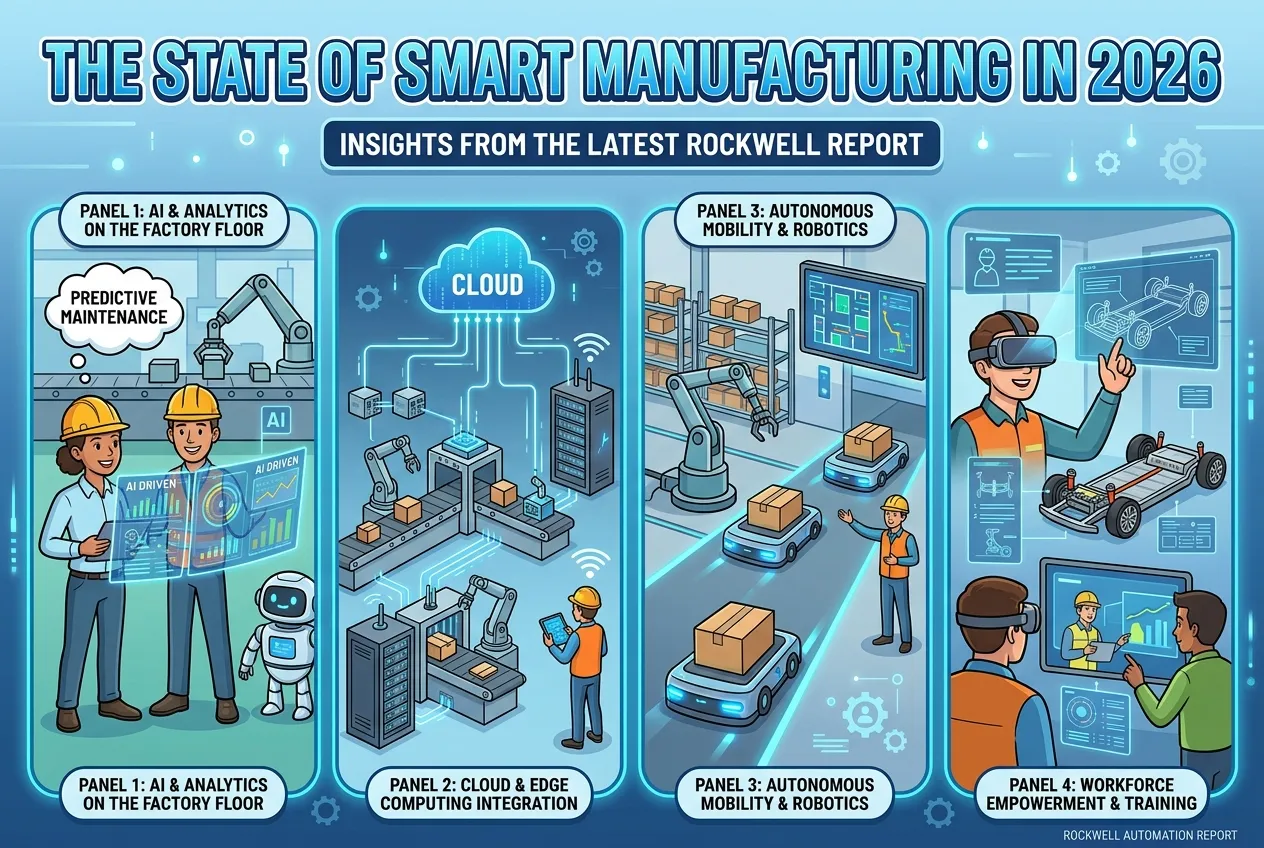
For years, artificial intelligence in manufacturing was confined to isolated pilot programs and proof-of-concept projects. The 2026 report indicates a significant trend toward scaled implementation. Companies are moving beyond experimentation and are now embedding AI and machine learning into core production processes. One of the most impactful applications remains predictive maintenance. By analyzing data from countless sensors on the factory floor, AI algorithms can now forecast equipment failures with remarkable accuracy, allowing teams to perform maintenance before a costly breakdown occurs, minimizing downtime and extending the life of critical assets.
Beyond maintenance, computer vision systems powered by AI are revolutionizing quality control. These systems can spot microscopic defects in products moving down an assembly line at high speeds, a task far beyond human capability. This not only ensures a higher quality final product but also reduces waste and rework. Furthermore, machine learning models are being deployed to optimize complex processes in real-time, adjusting variables like temperature, pressure, and flow rates to maximize yield and minimize energy consumption. This shift from reactive problem-solving to proactive, data-driven optimization is a hallmark of the modern smart factory.
The Convergence of IT and OT: A Unified Nervous System
Historically, the worlds of IT and OT have operated in separate silos. The IT department managed the enterprise systems—servers, networks, and business applications—while the OT team managed the industrial control systems on the factory floor. The latest industry analysis reveals that this separation is no longer sustainable. The integration of these two domains is now a foundational requirement for smart manufacturing.
This IT/OT convergence creates a seamless flow of data from the plant floor to the executive dashboard. When a sensor on a machine (OT) detects an anomaly, that information can be instantly communicated to the company's Enterprise Resource Planning (ERP) system (IT), which can then automatically adjust production schedules or raw material orders. This creates a holistic, real-time view of the entire operation, enabling more agile and informed decision-making. As noted in analyses by leading publications like Automation World, this integration is the digital backbone that supports nearly every other smart manufacturing initiative, from AI analytics to supply chain visibility.
Navigating the Top Cybersecurity Threats
The immense benefits of a connected industrial environment come with a significant challenge: an expanded and more vulnerable attack surface. As OT systems are connected to IT networks and the internet, they become susceptible to the same cyber threats that have plagued the corporate world for years, but with potentially more devastating physical consequences. The report highlights a growing concern around ransomware attacks that specifically target industrial control systems, capable of halting production entirely until a ransom is paid.
Other major threats include the theft of intellectual property, such as proprietary product designs or manufacturing processes, and the malicious manipulation of industrial controls to sabotage production or create unsafe conditions. To counter these risks, companies are adopting a “defense-in-depth” security posture. This involves not only firewalls and intrusion detection systems but also network segmentation to isolate critical control systems, strict access controls to limit who can interact with sensitive equipment, and continuous monitoring to detect and respond to threats in real time.
Upskilling the Workforce for an Automated Environment
Contrary to the common fear of robots replacing human workers, the prevailing trend is one of collaboration. Automation is handling the repetitive, physically demanding, and dangerous tasks, freeing up human workers to focus on more complex, value-added activities. However, this transition requires a profound shift in skills. The factory of 2026 needs fewer manual assemblers and more robot technicians, data scientists, and control system programmers.
Leading manufacturers are investing heavily in workforce development and upskilling programs. Augmented reality (AR) tools are being used to provide on-the-job training, overlaying digital instructions onto a worker's view of a complex piece of machinery. Digital twins—virtual replicas of physical systems—allow employees to train on complex procedures in a safe, simulated environment without risking damage to real equipment. The focus is on creating a culture of continuous learning, where employees are empowered to adapt and grow alongside the technology. The goal is not to replace humans, but to augment their capabilities, creating a hybrid workforce where human ingenuity and machine precision work in concert to drive the future of industry.

Comments
No comments yet — be the first to share your thoughts.
Join the discussion