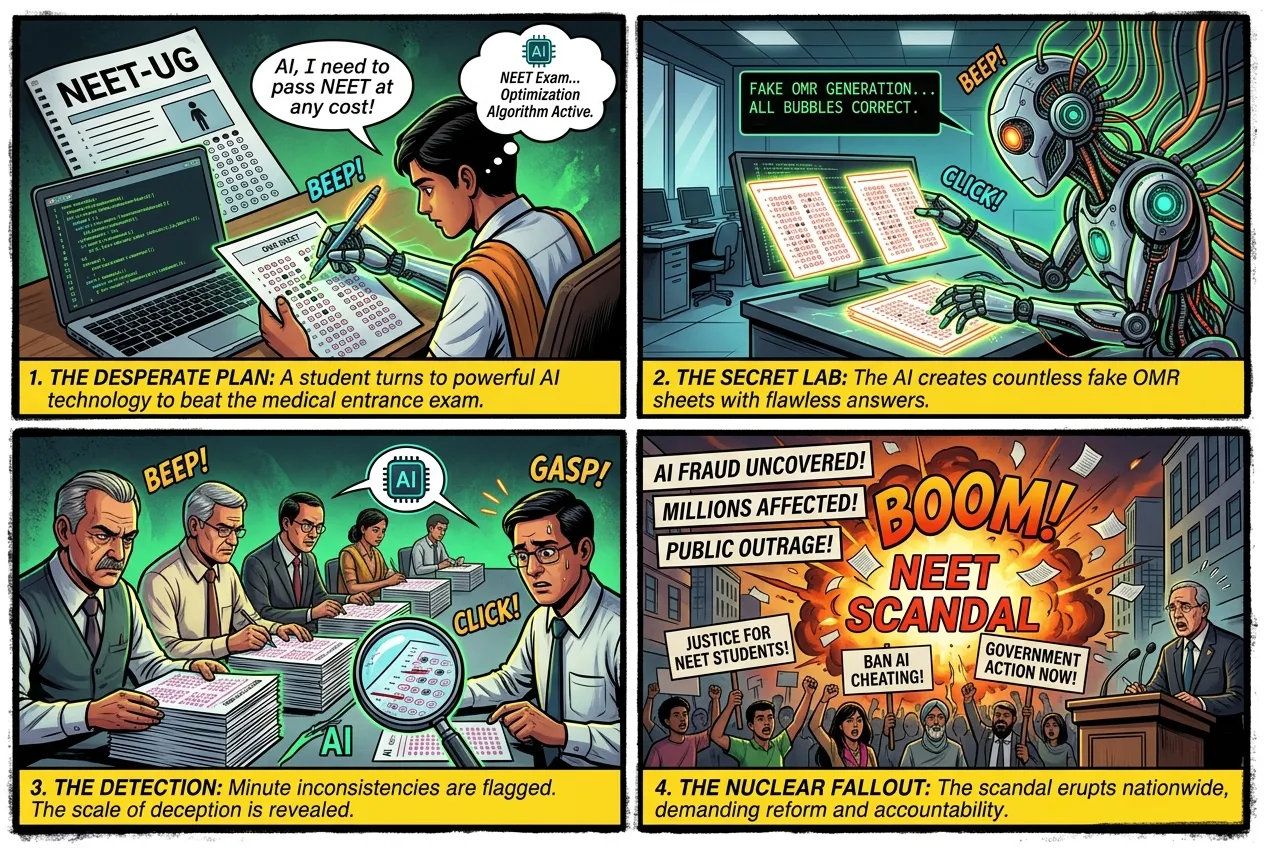
A New Kind of Exam Scandal
India's National Testing Agency (NTA) has issued a stern warning of legal action after fabricated, AI-generated OMR (Optical Mark Recognition) answer sheets tied to the NEET-UG retest began circulating online. The images — designed to look like genuine scanned candidate responses — were shared widely enough to force the agency into a public rebuttal, underscoring how quickly synthetic media can destabilize even the most tightly controlled examination processes.
NEET-UG is the gateway to medical education in India, taken by millions of aspirants each year. Any perceived compromise of its integrity is not merely an administrative issue; it becomes a national controversy with political, legal, and human consequences. The emergence of AI-forged answer sheets pushes that vulnerability into new territory.
The NTA's Legal Warning
According to the NTA, the circulating OMR sheets are not authentic records from the retest. The agency has said it will pursue legal action against those responsible for creating and spreading the fabricated documents, framing the act as a deliberate attempt to mislead candidates, parents, and the public.
The message is twofold: reassure stakeholders that the actual results and evaluation process remain intact, and deter copycats by signalling that generating or sharing such forgeries carries real criminal exposure. In a testing ecosystem already scarred by earlier controversies, the NTA's tone reflects how sensitive the stakes have become.
How Fake OMR Sheets Get Synthesized
OMR sheets are visually simple — grids of bubbles, candidate identifiers, barcodes, and header text — which is exactly what makes them attractive targets for generative models. Modern image models can reproduce the layout, typography, bubble shading patterns, and even simulated scanner artifacts with a level of realism that easily fools the untrained eye scrolling through a social feed.
Combine that with basic image-editing tools to insert a specific roll number or name, and a convincing "leaked" answer sheet can be produced in minutes. There is no need to breach a physical vault or bribe an insider; the forgery lives entirely in pixels.
Downstream Impact on Candidates and Institutions
For candidates, the damage from viral fake OMR sheets is immediate and personal. Aspirants may doubt their own results, question the fairness of the retest, or be misled about answer keys and scoring. Families invest years and significant money preparing for NEET-UG, and misinformation of this kind erodes trust at the worst possible moment.
Universities and medical colleges also feel the ripple effects. Admissions cycles depend on the credibility of the underlying scores. If public confidence in the exam is shaken, legal petitions, delayed counselling, and administrative reviews can follow, disrupting entire cohorts of incoming students.
Detection Tooling for AI-Forged Documents
The response to synthetic document fraud is starting to take shape, but it is still uneven. Detection approaches include forensic analysis of image metadata, model-based classifiers trained to spot generative artifacts, provenance standards like content credentials that cryptographically sign genuine outputs, and watermarking of official scanned documents so that unwatermarked copies raise immediate suspicion.
For agencies like the NTA, the practical path forward likely combines several layers: tamper-evident digital delivery of official OMR scans, rapid public verification portals where candidates can check authenticity, and partnerships with platforms to take down forgeries at speed.
Parallels to Deepfake Fraud in Finance and Government
The NEET-UG episode is not an isolated pattern. Financial institutions have already contended with deepfaked video calls used to authorize fraudulent transfers, and governments worldwide have grappled with synthetic images and audio designed to manipulate elections and public opinion. Fake exam documents are simply the education-sector expression of the same underlying threat: generative AI has collapsed the cost of producing believable fakes across every category of official record.
What ties these domains together is a shared vulnerability — systems designed in an era when producing a convincing forgery was expensive and difficult. That assumption no longer holds.
The Broader Warning
India's NEET-UG scandal should be read as a preview, not an outlier. Any high-stakes examination — from national entrance tests to professional licensing exams and international assessments — now operates in an environment where synthetic answer sheets, fake result letters, and fabricated official communications can be manufactured on demand. The institutions that adapt fastest, with verifiable provenance and rapid-response detection, will be the ones that preserve public trust.
Source: Google News

Comments
No comments yet — be the first to share your thoughts.
Join the discussion