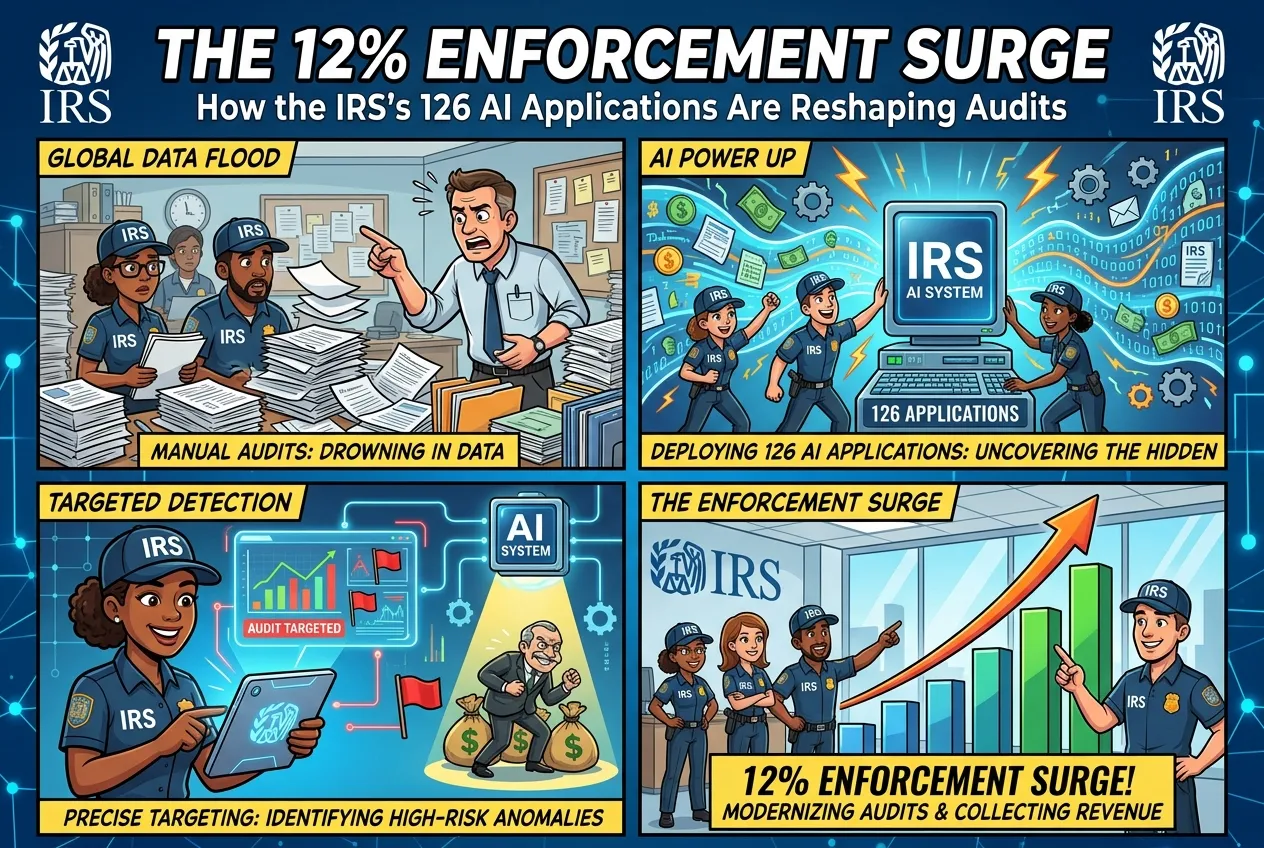
The Internal Revenue Service just did something that would have seemed impossible a decade ago: it collected significantly more enforcement revenue while shedding a quarter of its workforce. According to reporting from Greenback Tax Services, fiscal 2026 delivered a 12% jump in enforcement dollars against a 25% headcount reduction — a productivity story made possible by 126 AI applications now running in production across the agency.
That single ratio — more money, fewer people — is the clearest signal yet that tax enforcement in the United States is undergoing a structural shift. It is no longer primarily about revenue agents opening file folders. It is about pattern-matching models flagging returns, and humans validating what the software already believes.
What the Numbers Actually Say
A 12% enforcement lift on a 25% smaller staff implies a per-employee productivity gain of roughly 50%. That is not the sort of improvement you get from working harder or reorganizing teams. It is the kind of jump that only happens when routine cognitive work — comparing forms, spotting mismatches, prioritizing cases — gets handed off to machines.
With 126 AI applications reportedly in production, the IRS is no longer piloting the technology. It has industrialized it. Each application likely targets a narrow task: matching 1099s to reported income, identifying unusual deduction patterns, cross-referencing foreign account disclosures, screening cryptocurrency transactions against exchange data, or ranking returns by expected audit yield.
Who the Algorithms Are Watching
Automated audit selection does not treat all taxpayers equally. Models optimize for expected recovery, which means they concentrate attention where the potential dollars — and the historical noncompliance rates — are highest. Three groups stand out.
High earners. Complex returns with pass-through entities, capital gains, executive compensation, and charitable structures offer the biggest per-audit yield. AI is particularly good at spotting inconsistencies across the many schedules these filers submit.
Crypto holders. Exchanges now report to the IRS in structured formats, giving models clean data to compare against Form 8949 entries. Missing transactions, cost-basis mismatches, and unreported staking or DeFi income are exactly the kind of signals a classifier can catch at scale.
Expats and cross-border filers. As the Greenback analysis emphasizes, Americans abroad file some of the most complex returns in the system — FBAR, Form 8938, Form 5471, foreign tax credits, treaty positions. Each additional form is another opportunity for an algorithm to detect a discrepancy, whether or not one meaningfully exists.
Efficiency vs. Due Process
Faster enforcement is not automatically fairer enforcement. When a model flags a return, a taxpayer still has the right to respond, appeal, and be heard — but the practical burden shifts. The algorithm's suspicion becomes the starting point, and the taxpayer must produce documentation to unwind it.
That inversion raises real questions. How transparent are the models? Can a taxpayer see why they were selected? Are false-positive rates monitored for particular demographics or filing categories? Agencies rarely disclose the internals of their risk-scoring systems, and courts have historically given tax authorities wide latitude on selection methods. The 126-application footprint makes those governance questions more urgent, not less.
Practical Guidance for the AI-Audit Era
Taxpayers cannot opt out of algorithmic scrutiny, but they can make themselves harder targets — and easier to clear if flagged.
- Reconcile third-party data before you file. Pull your IRS wage and income transcript. If a 1099 or W-2 exists in the IRS system that is missing from your return, a model will find it.
- Document crypto meticulously. Keep exchange exports, wallet addresses, and cost-basis calculations. Reconstructing years later is painful and expensive.
- Keep contemporaneous records for foreign accounts. Year-end balances, currency conversion rates, and account ownership documentation should be saved as you go.
- Explain unusual items. A one-time large deduction or income event benefits from a short memo in your files describing the circumstances.
- Respond quickly to notices. Automated systems escalate on silence. A prompt, documented reply often closes a matter that inaction would inflame.
The Bigger Picture
The IRS's fiscal 2026 results are a preview of how every large regulator will eventually operate: fewer humans, more models, and enforcement decisions that start with a probability score. For taxpayers, the takeaway is not to panic — it is to file cleanly, document thoroughly, and assume that everything reportable to the IRS has already been reported.
Source: Greenback Tax Services — IRS AI Agents and Expat Tax Implications.










Comments
No comments yet — be the first to share your thoughts.
Join the discussion