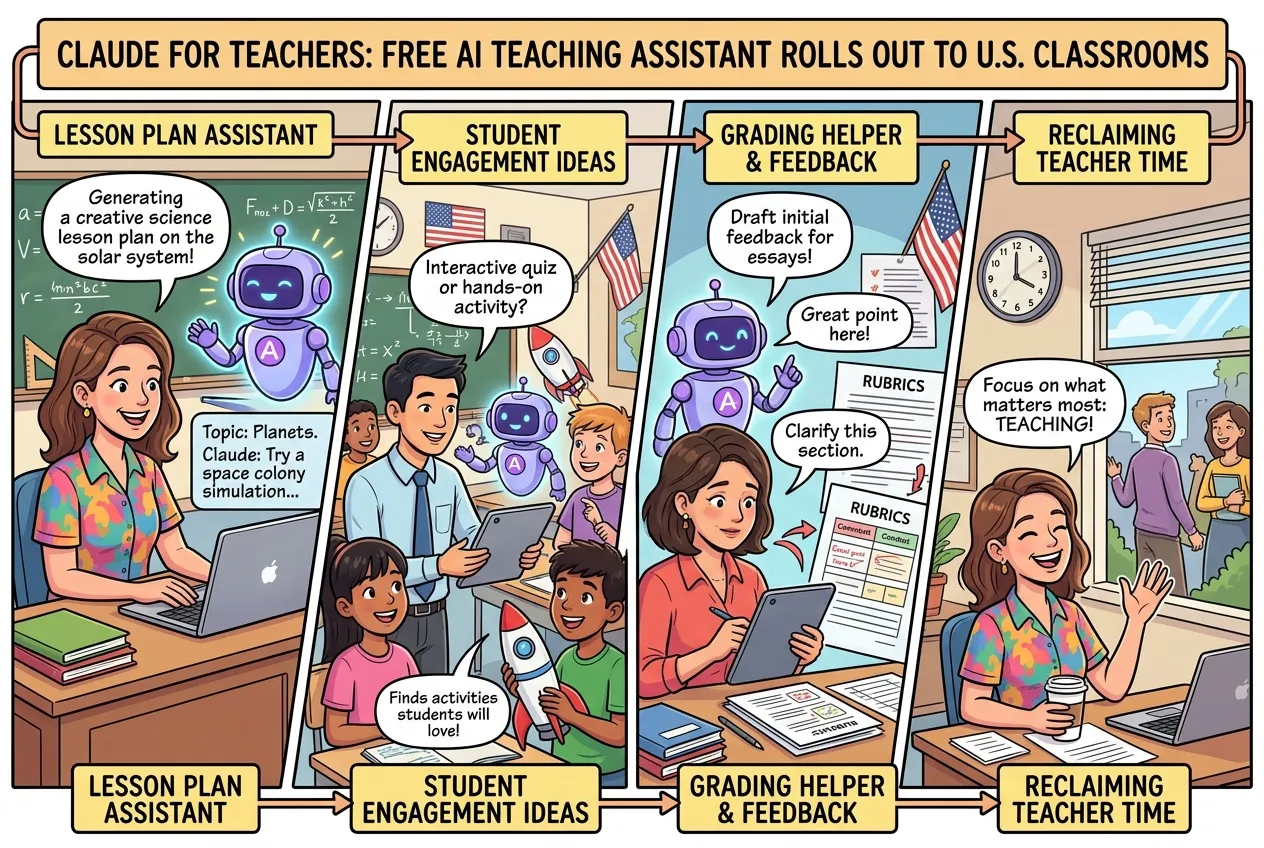
On July 14, 2026, Anthropic announced Claude for Teachers, a free tier of its AI assistant aimed squarely at U.S. K–12 educators. The rollout marks Anthropic's most direct push into the classroom to date, and it lands at a moment when teachers are being asked to do more with less time than ever.
The pitch is straightforward: give teachers a capable AI assistant at no cost, and let them decide where it fits in the messy reality of lesson planning, differentiation, parent communication, and the endless administrative tail that follows every school day.
What the free tier actually offers
Claude for Teachers provides U.S. educators with free access to Claude for professional use — the same underlying model families that power Anthropic's paid consumer and business plans, packaged specifically for classroom workflows. Teachers can use it to draft lesson plans, generate reading passages at different levels, build rubrics, translate parent letters, and rework materials for students with different needs.
Anthropic is also partnering with ASSISTments, the nonprofit math platform used in thousands of U.S. classrooms. ASSISTments is releasing a free Claude connector, with a premium tier planned for the fall. That connector is significant: it plugs Claude into a tool teachers already use for problem sets and student practice, rather than asking them to bolt a new app onto an already crowded stack.
Designed around the 49-hour week
The framing Anthropic leans on is time. U.S. teachers routinely log around 49-hour work weeks once grading, planning, and communication are added to instructional hours. Most of those extra hours are unpaid, and most of them are spent on tasks — writing feedback, adapting worksheets, drafting emails — that a competent AI assistant can meaningfully accelerate.
That's the wedge. Rather than positioning Claude as a tutor sitting between teacher and student, Anthropic is positioning it as an assistant sitting behind the teacher, absorbing the paperwork so more of the 49 hours can go back to actual teaching or, more importantly, to the teacher's own life outside school.
Why free matters here
Ed-tech has a long history of pilot programs that quietly convert to paid seats once teachers depend on them. A permanent free tier — assuming Anthropic keeps it permanent — changes the negotiation. Districts don't need to find budget, and individual teachers don't need to expense a subscription out of pocket to try it. That lowers the barrier enough that adoption is likely to be driven by teachers themselves rather than top-down district IT decisions.
It also puts pressure on competing AI vendors that have priced classroom tools per-seat or per-district. If the baseline for teacher-facing AI becomes "free and good," the market shifts.
The questions this rollout doesn't answer
The announcement is quieter on the parts of classroom AI that matter most to parents, principals, and privacy officers.
Student data. Claude for Teachers is aimed at educators, not students, which sidesteps some of the thorniest FERPA and COPPA questions. But teachers routinely paste student work into AI tools to get feedback drafts, and any real-world use will involve student writing, names, IEP details, or behavioral notes flowing through the model. How that data is stored, whether it can be used for training, and what districts need to configure to stay compliant are questions that will need clearer answers than a launch post can provide.
Grading. The most consequential — and most contested — use of AI in classrooms is grading and feedback on student work. Anthropic hasn't drawn a bright line on whether Claude for Teachers is intended to be used for summative grading, formative feedback only, or somewhere in between. Teachers will draw that line themselves, in practice, long before any official guidance catches up.
Equity across districts. A free national tier helps, but classroom AI still depends on device access, reliable internet, and administrative buy-in. Well-resourced districts will operationalize this faster than under-resourced ones, which is the same pattern every previous wave of ed-tech has followed.
What to watch this fall
Two things are worth tracking as the school year starts. First, the ASSISTments premium tier: how Anthropic and its nonprofit partner split free from paid features will preview the broader business model. Second, district-level policy. Whether large U.S. districts publish formal guidance on Claude for Teachers — approving it, restricting it, or defining acceptable uses — will shape adoption more than any single feature.
For now, the launch is exactly what it says on the tin: a free, capable AI assistant handed to American teachers, with the hardest questions politely deferred to whoever picks them up first.
Source: Anthropic — Claude for Teachers


Comments
No comments yet — be the first to share your thoughts.
Join the discussion