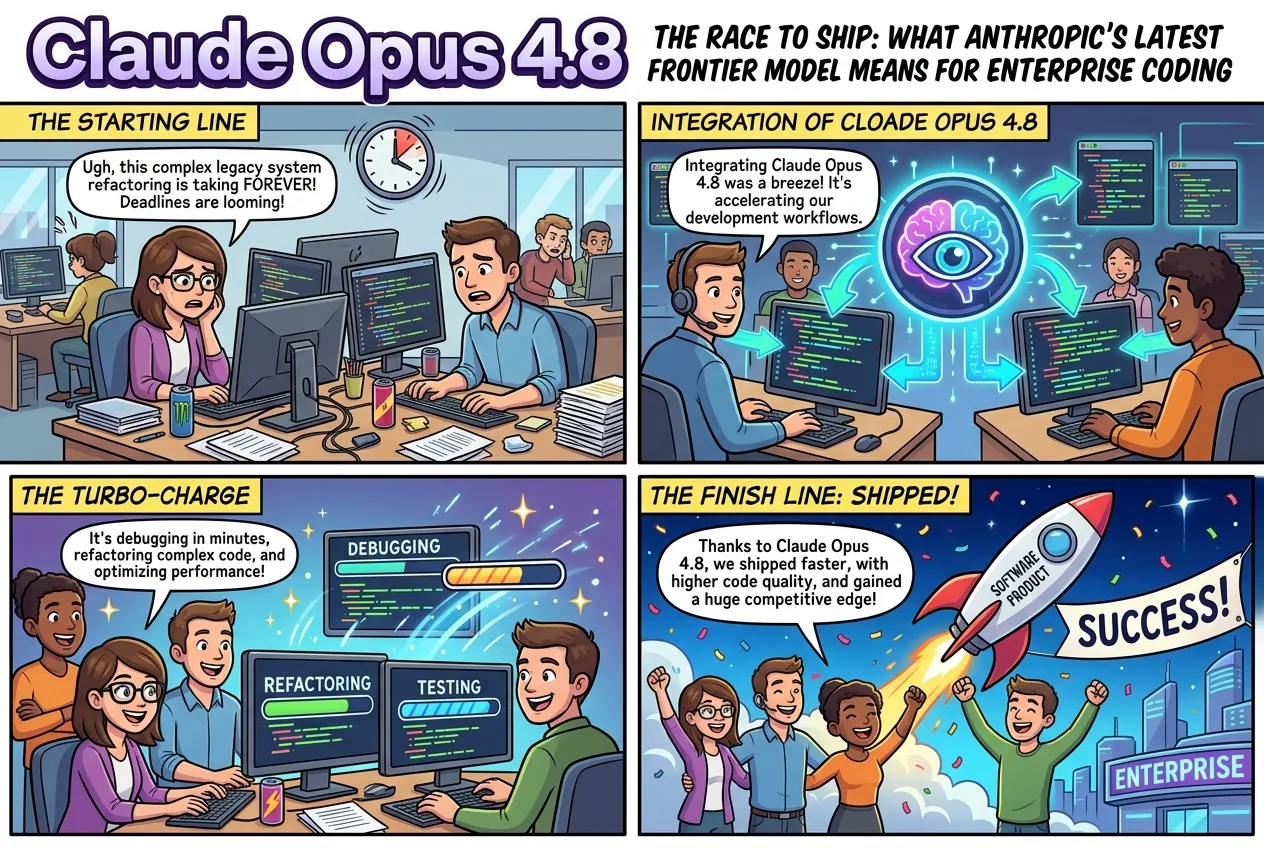
Anthropic has officially unveiled Claude Opus 4.8, the latest iteration of its flagship frontier model — and for anyone building serious software with LLMs, the update is arriving at exactly the right moment. The announcement, published on Anthropic's news page, positions Opus 4.8 as a focused upgrade on the three axes enterprise teams care about most: coding quality, agentic task execution, and consistency across long-running sessions.
It also lands in a very particular market context. Sonnet 5 has already been promoted to the default model across Pro, Team, and Enterprise tiers, adaptive thinking is now on by default, and prediction markets had been pricing in a roughly 91% chance of an imminent Opus release. In other words, the ecosystem was already leaning forward — Opus 4.8 is Anthropic catching the pass.
What's actually new in Opus 4.8
According to Anthropic's own framing, Opus 4.8 is not a from-scratch generational leap — it's a targeted step up on the same Opus 4 lineage. The headline improvements center on three areas:
- Coding. Better performance on real-world software engineering tasks, not just synthetic benchmarks.
- Agentic tasks. Stronger tool use, more reliable multi-step planning, and improved recovery from errors.
- Long-running consistency. Fewer of the drift, forgetfulness, and personality-shift failures that tend to plague hours-long agent runs.
That third point matters more than it sounds. For teams deploying Claude inside long-horizon agents — code review bots, autonomous refactoring pipelines, research assistants that grind through a codebase overnight — consistency is the difference between a demo and a production system.
Sonnet 5 as the new default
Alongside the Opus news, one of the most consequential shifts is that Sonnet 5 is now the default across Pro, Team, and Enterprise. Sonnet 5 brings a 1M-token context window into general availability for the majority of paying users, which reframes how developers should think about model selection.
Before, teams typically reached for Opus when they needed depth and Sonnet when they needed speed and price. Now, Sonnet 5 handles a huge share of "serious" work — long codebases, sprawling documents, extended conversations — while Opus 4.8 becomes the escalation path for the hardest problems. It's a cleaner mental model: Sonnet for breadth and throughput, Opus for the gnarly stuff.
Adaptive thinking, on by default
Anthropic has also made adaptive thinking the default behavior. Instead of forcing developers to choose between "fast" and "extended thinking" modes, the model itself decides how much to reason based on the difficulty of the prompt. Simple queries stay snappy; hard ones get more deliberation.
For enterprise developers, this reduces a class of prompt-engineering overhead that used to eat engineering time. You no longer need to manually route requests to different modes — the model does it. Combined with Opus 4.8's improved agentic reliability, this makes it more realistic to hand Claude an ambiguous, multi-step task and trust it to allocate effort intelligently.
Why prediction markets were 91% sure
The 91% market-implied odds of an imminent Opus release were not a coincidence. Anthropic has been visibly accelerating its release cadence, Sonnet 5's promotion to default hinted at a re-tiering of the lineup, and the competitive pressure on frontier coding models has never been higher. When the base tier levels up, the flagship almost has to follow — otherwise the value gap between Pro and Max collapses.
Prediction markets, in effect, were pricing in Anthropic's own product logic. The interesting signal isn't that traders got it right; it's that Anthropic's release strategy has become legible enough to forecast.
Implications for developers running long-horizon agents
If you're building agents that run for minutes or hours — autonomous coders, deep-research pipelines, customer-support workflows with tool use — Opus 4.8 is the most direct upgrade path. The gains in long-running consistency should translate into fewer mid-run collapses, less babysitting, and more sessions that actually finish the job they started.
Practically, that means teams can:
- Extend agent time horizons without proportional increases in failure rate.
- Simplify orchestration code that previously existed to catch model drift.
- Trust Opus for critical review steps while letting Sonnet 5 handle bulk work.
Pricing tiers: Pro vs Max
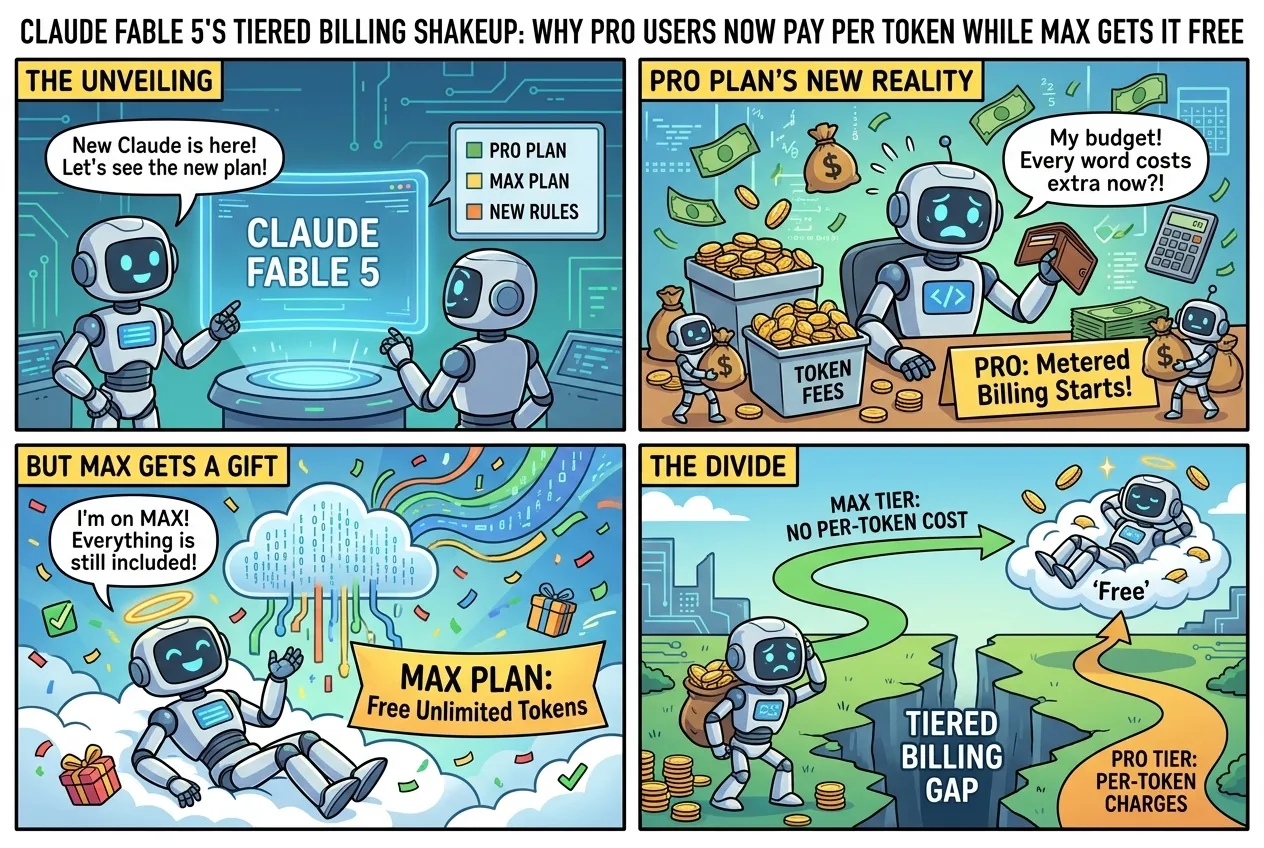
The Pro/Max split becomes more meaningful with this release. Pro users get Sonnet 5 as their high-quality default with the 1M-token context window, which for many developers is already more than enough. Max users get expanded access to Opus 4.8 for the harder, longer, more agentic workloads where the extra capability pays for itself.
For engineering leaders, the decision is now less about "do we need Opus?" and more about "which slice of our workload actually justifies Opus?" That's a healthier question — and a sign the lineup is maturing.
The bigger picture
Opus 4.8 isn't a marketing spectacle. It's a working model shipped into a market that expected it, optimized for the workloads enterprises are actually running, and positioned cleanly against a stronger Sonnet default. In an industry addicted to hype cycles, that quiet competence may be the most important signal of all.





Comments
No comments yet — be the first to share your thoughts.
Join the discussion