The Dawn of the Mega-Lease
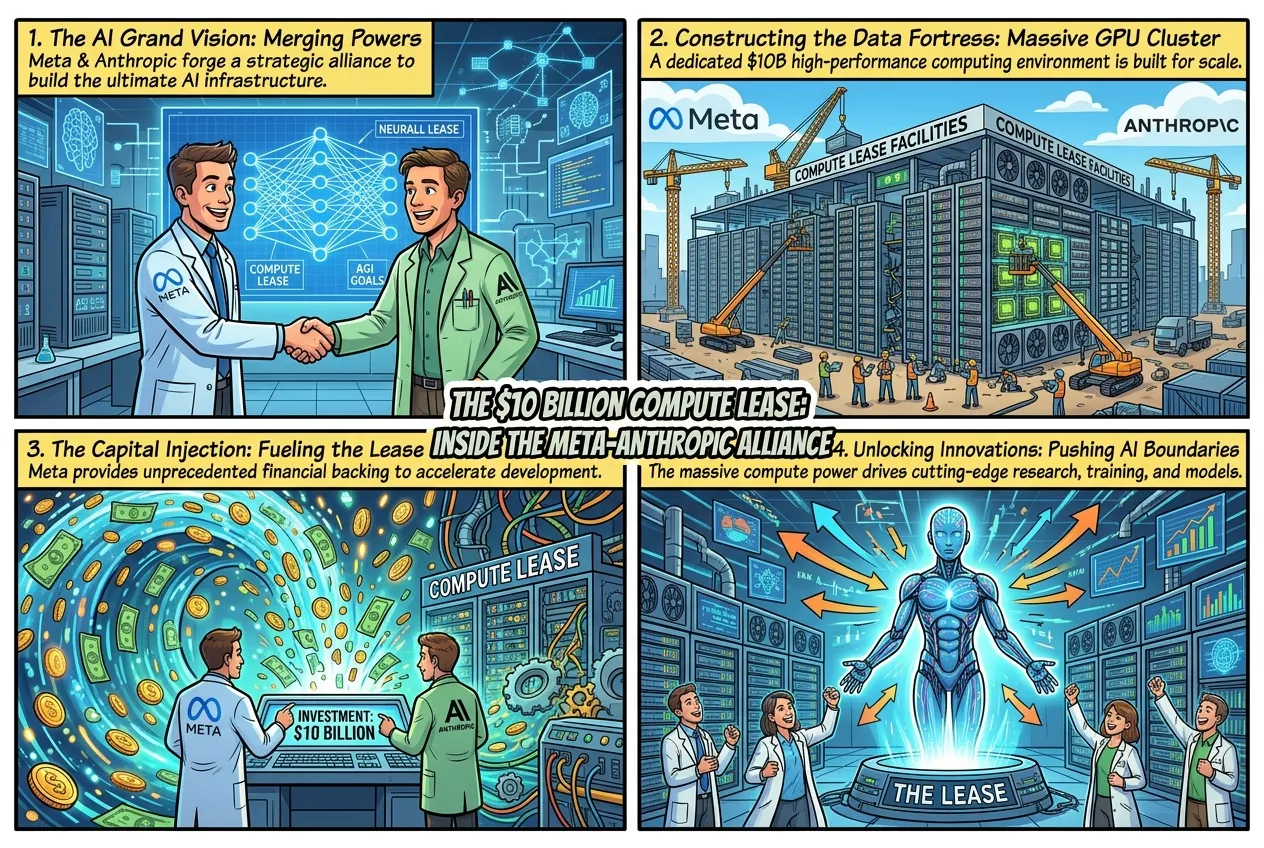
The landscape of the artificial intelligence industry is undergoing a tectonic shift, moving from a race for algorithmic superiority to a desperate scramble for physical infrastructure. At the center of this transition is a reported $10 billion deal between social media titan Meta and AI research lab Anthropic. This potential alliance, as reported by Cloud Computing News, represents one of the largest private infrastructure agreements in tech history. It signals a new era where the ability to scale AI models is no longer just about code, but about who controls the vast clusters of H100 and B200 GPUs required to train the next generation of intelligence.
Anthropic’s Quest for Scaling Supremacy
For Anthropic, the creator of the Claude series of large language models, the need for compute is existential. As the industry moves toward 'frontier' models that require exponentially more floating-point operations (FLOPs) to achieve incremental gains in reasoning and capability, the capital requirements have ballooned. While Anthropic has previously secured significant investment and cloud credits from giants like Amazon and Google, the sheer scale of their roadmap appears to have outstripped traditional cloud availability.
By seeking a $10 billion compute lease from Meta, Anthropic is looking to secure a dedicated pipeline of processing power. This move is designed to ensure that Claude remains competitive with OpenAI’s GPT series and Google’s Gemini. In the AI arms race, downtime or lack of capacity is equivalent to obsolescence. This deal would provide Anthropic with the stability needed to commit to long-term training runs that could last months, involving tens of thousands of GPUs working in parallel without the risk of preemption or resource throttling common in shared cloud environments.
Meta: From Social Network to AI Landlord
Perhaps the most surprising element of this alliance is Meta’s emergence as a major infrastructure provider for its own potential rivals. Under Mark Zuckerberg’s leadership, Meta has spent the last several years aggressively stockpiling Nvidia’s high-end chips, building what is arguably the world's most formidable private AI infrastructure. While this was initially intended to power Meta's internal recommendation engines and its own Llama models, the company has found itself in a unique position of having excess capacity that is highly liquid in the current market.
Leasing this capacity to Anthropic allows Meta to monetize its massive capital expenditures immediately. A $10 billion influx helps offset the staggering costs of building and maintaining these data centers. Furthermore, it positions Meta as a foundational layer of the AI ecosystem. By becoming the 'landlord' for other AI labs, Meta gains a strategic foothold in the industry that extends beyond its own consumer-facing products. It is a pivot from being a pure software and social media company to becoming a primary utility for the AI age.
The Strategic Shift in AI Infrastructure
This deal highlights a broader trend: the decoupling of model development from infrastructure ownership. In the early days of the AI boom, it was assumed that the winners would be those who built everything from the ground up. However, the sheer cost of building a top-tier data center—potentially exceeding $20 billion for a single 'AI factory'—has made that path impossible for all but the wealthiest corporations. Leasing allows labs like Anthropic to stay light on physical assets while heavy on research and development.
Moreover, this partnership suggests that the traditional 'Big Three' cloud providers (AWS, Azure, and Google Cloud) are facing new competition from unexpected quarters. Meta’s specialized, high-density AI clusters are often more optimized for large-scale training than general-purpose cloud instances. This specialization makes Meta an attractive partner for labs that need raw performance over the broad feature sets of a traditional cloud provider.
Risks and Competitive Dependencies
The alliance is not without its risks. For Anthropic, relying on a competitor for its most critical resource creates a strategic vulnerability. Meta also develops Llama, a direct competitor to Claude in the open-weights and enterprise space. Should Meta decide to prioritize its own training runs or change the terms of the lease, Anthropic could find itself in a precarious position. The agreement likely includes stringent service-level agreements (SLAs), but the underlying tension of competitive dependency remains a factor.
From Meta’s perspective, the risk is enabling a rival to leapfrog its own technology. However, the $10 billion price tag is a powerful incentive that provides Meta with the capital to further accelerate its own hardware acquisitions. This creates a feedback loop where Meta uses the revenue from its rivals to further solidify its lead in infrastructure, potentially making it the indispensable backbone of the entire AI sector.
Conclusion: A New Paradigm for Scaling
The Meta-Anthropic deal, if finalized, will serve as a blueprint for the future of the AI industry. We are moving toward a world of 'Mega-Leases,' where the boundaries between social media, cloud computing, and AI research become increasingly blurred. As Anthropic seeks the horsepower to push Claude to new heights, Meta is proving that in the AI gold rush, sometimes the most profitable business isn't just mining for gold, but owning the land and the tools that everyone else needs to dig.


Comments
No comments yet — be the first to share your thoughts.
Join the discussion