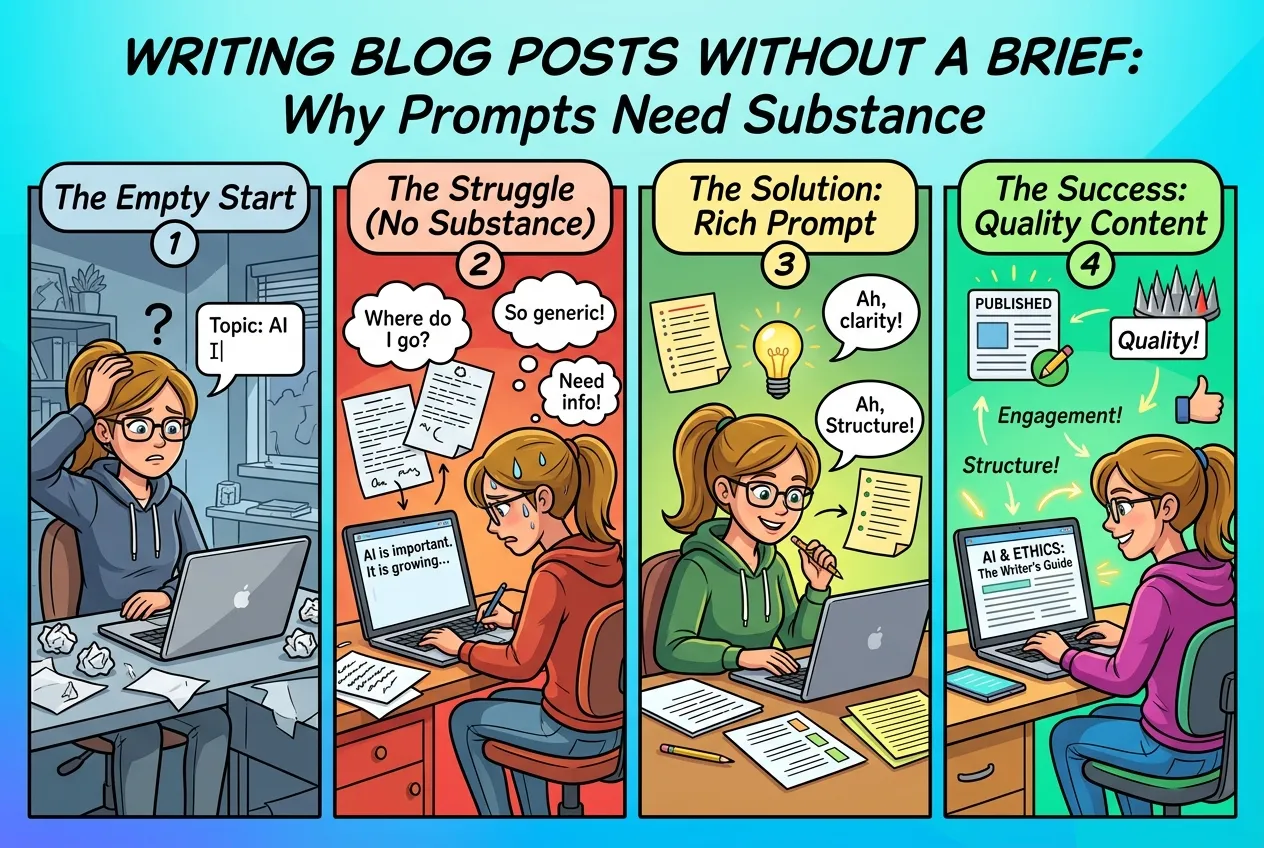
The Empty Prompt Problem
Every content workflow eventually runs into the same wall: a request arrives asking for a "complete blog post," but the fields that would actually shape that post — the topic, the angle, the sources to cite — are blank. What looks like a fully-formed instruction is really just a template with the important parts missing.
This post exists because that is exactly what happened here. The request specified a minimum word count, HTML structure, and a long list of metadata fields to populate, but left the subject, the perspective, and the citation empty. Rather than invent facts to fill the gap, it is more useful to talk about why that gap matters.
Why AI Writers Cannot Fill In the Blanks
A responsible AI assistant will not fabricate statistics, quotes, or events to satisfy a length requirement. That principle is not a technical limitation — it is a design choice. The moment a model starts inventing sources to hit a word count, everything else it writes becomes suspect.
When a brief says "cite the source" but names no source, the honest answer is not to invent a plausible-sounding study or attribute a quote to a made-up expert. It is to stop and ask what the source should be. Content that looks authoritative but rests on invented citations does more damage to a publication than a missing post ever could.
What a Useful Brief Actually Contains
A workable blog brief needs three things at minimum. First, a topic — the concrete subject the post will address. "Artificial intelligence" is not a topic; "how small law firms are using AI to draft discovery requests" is. Specificity is what lets a writer, human or otherwise, produce something that says more than the headline.
Second, an angle. Two posts about the same topic can be completely different depending on whether they are framed as a warning, a how-to, a case study, or a rebuttal. The angle is the argument the post is going to make, and without it, the writing drifts.
Third, sources. Real ones. A URL, a report title, an interview transcript, a dataset — anything that grounds the piece in something checkable. Sources are what separate analysis from opinion, and citation is what lets readers verify the claims for themselves.
Implications for Content Teams
Teams that rely on AI-assisted writing tend to discover this the hard way. A generic prompt produces generic output; a vague prompt produces content that sounds confident but cannot survive fact-checking. The fix is upstream, in the brief itself, not in the generation step.
The practical implication is that editors and content managers should treat the brief as the actual creative work. Once a topic is specified sharply, an angle is chosen, and sources are attached, the drafting becomes mechanical. Skip those steps and no amount of prompt engineering will rescue the result.
What to Do Next
If you landed here because you sent an empty template and got this post back, that is the intended behavior. Send the request again with the blanks filled in: what is the post about, what point should it make, and which source or sources should it draw from. Even a single sentence in each slot is enough to change the output completely.
Good writing starts with a real question. Give it one, and the rest of the process — structure, length, metadata, tone — becomes straightforward. Leave the question blank, and no word count in the world will produce something worth publishing.



Comments
No comments yet — be the first to share your thoughts.
Join the discussion