The Land of Happiness Faces an Emptying Nest
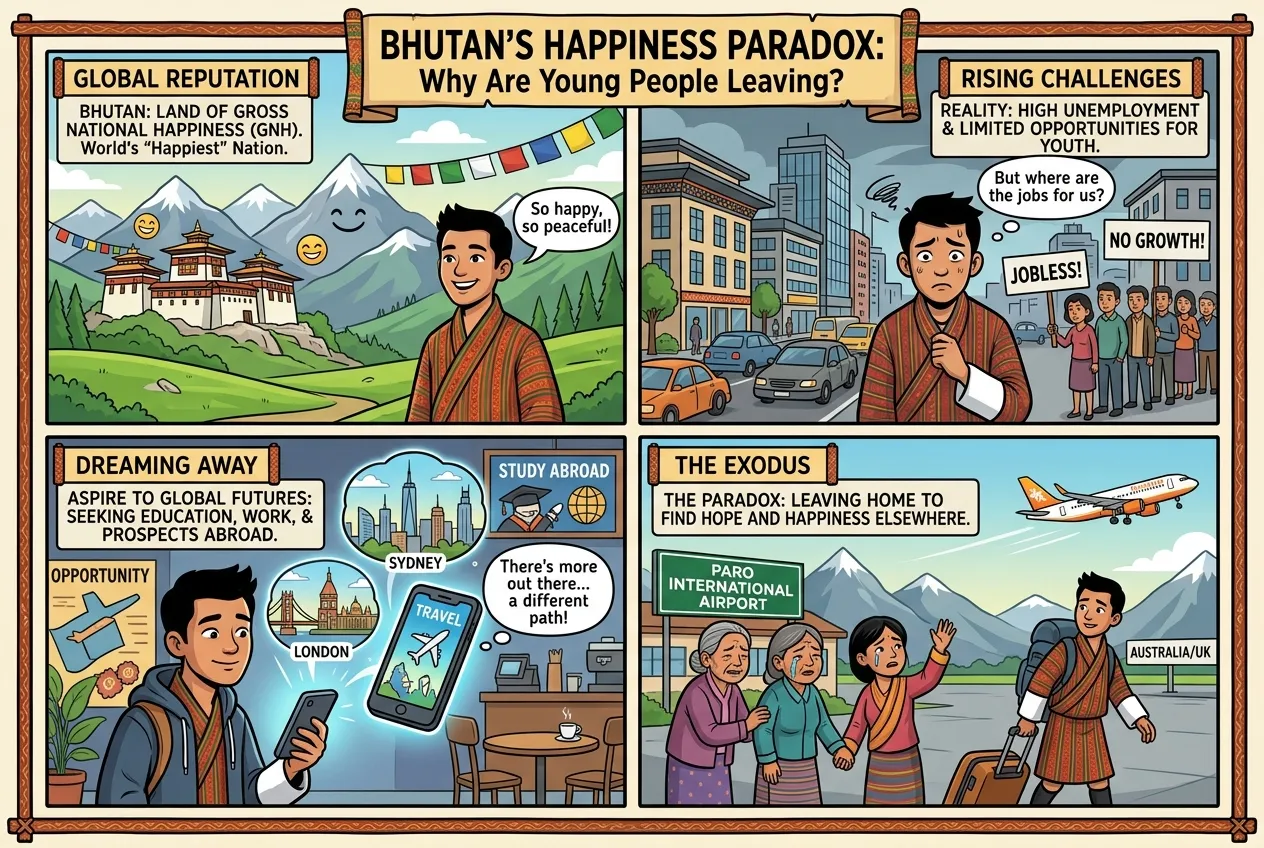
For decades, the Kingdom of Bhutan has captured the world's imagination. Nestled in the Himalayas, it famously rejected Gross Domestic Product (GDP) as the ultimate measure of success, pioneering instead the concept of Gross National Happiness (GNH). This philosophy prioritizes the holistic well-being of its citizens, balancing material wealth with spiritual health, cultural preservation, and environmental conservation. Yet, beneath this serene image lies a growing paradox: the very generation that grew up under the GNH philosophy is leaving in unprecedented numbers. This youth exodus presents a critical challenge to the nation's future, forcing a profound national conversation about what happiness means in the 21st century.
The allure of opportunities abroad, particularly in countries like Australia, has created a powerful pull. Young Bhutanese, armed with education and ambition, look beyond their borders and see higher salaries, diverse career paths, and the promise of economic mobility that feels out of reach at home. This isn't a rejection of their culture or heritage, but a pragmatic response to a lack of high-quality, well-paying jobs within the kingdom. The result is a 'missing generation' that threatens to drain the country of its most valuable resource: its people.
A Daring Vision: The Gelephu Mindfulness City
In response to this existential threat, Bhutan is making an audacious bet on its future. The kingdom has unveiled plans for the Gelephu Mindfulness City, a massive, multi-billion dollar development project that aims to transform a 1,000-square-kilometer area into a vibrant economic hub. This is not just another city; it's envisioned as a Special Administrative Region designed to create the opportunities that will convince young talent to stay and even return.
The scale of the ambition is staggering. Positioned strategically on the border with India, the project plans include an international airport, railway connections, and infrastructure built on principles of sustainability and green energy. The goal is to attract 'quality investment' in key sectors like technology, education, and climate science. The project seeks to create a self-sustaining ecosystem of innovation and enterprise, generating the kinds of jobs that can compete with what's offered abroad. It is a direct and powerful answer to the economic pressures driving the youth exodus.
The Tightrope Walk: Modernity Meets Mindfulness
The true challenge of Gelephu lies not just in its construction, but in its concept. The project is a delicate tightrope walk between embracing modernity and preserving the unique identity that defines Bhutan. The 'Mindfulness' in its name is a crucial component, signaling an intent to embed the core principles of GNH into the very fabric of this new city. The aim is to build a metropolis that is not only economically prosperous but also spiritually and culturally resonant.
This represents a significant evolution in Bhutan's historically cautious approach to globalization. For years, the kingdom deliberately limited outside influence to protect its traditions. Gelephu is a calculated opening, an attempt to harness the forces of global commerce without being consumed by them. It raises critical questions: Can a city designed to attract foreign investment and foster a fast-paced tech economy coexist with the tranquil, reflective values of Bhutanese Buddhism? Can Bhutan create wealth without sacrificing its soul?
Redefining Happiness for a New Generation
Ultimately, the Gelephu Mindfulness City is more than an infrastructure project; it's a referendum on Bhutan's future. It is a bold, perhaps risky, attempt to reverse the brain drain by building a future for its youth within its own borders. The project acknowledges that for the younger generation, happiness is intrinsically linked to opportunity, purpose, and the ability to build a prosperous life. By creating a space where modern aspirations can flourish within a framework of traditional values, Bhutan hopes to solve its happiness paradox. The world will be watching to see if this mindful metropolis can truly become a beacon of hope, proving that a nation can modernize, prosper, and remain, by its own unique measure, the happiest place on Earth.







Comments
No comments yet — be the first to share your thoughts.
Join the discussion