In the ever-evolving landscape of web development, where new frameworks and libraries emerge with dizzying frequency, it is easy to overlook the foundational technologies that hold the web together. Among these, semantic HTML remains one of the most critical yet frequently misunderstood aspects of building robust digital experiences. As we navigate the complexities of modern web design in 2026, understanding and implementing semantic HTML is no longer just a best practice—it is an absolute necessity for developers who care about accessibility, maintainability, and optimal performance.
What Exactly is Semantic HTML?
Semantic HTML refers to the practice of using HTML markup to reinforce the meaning of the information in web pages, rather than merely using it to define its presentation. In the early days of the web, developers often relied heavily on generic tags like <div> and <span> to structure their content, using CSS to make these elements look like headings, buttons, or navigation bars. While this approach achieves the desired visual result, it strips the document of its underlying meaning.
By contrast, semantic HTML employs specific tags that clearly describe their purpose to both the browser and the developer. Tags such as <article>, <section>, <nav>, <header>, and <footer> carry inherent meaning. When a browser or an assistive technology encounters these tags, it immediately understands the role that the enclosed content plays within the broader context of the page. This structural clarity is the bedrock upon which accessible and highly optimized websites are built.
Practical Analysis: Structuring Your Document
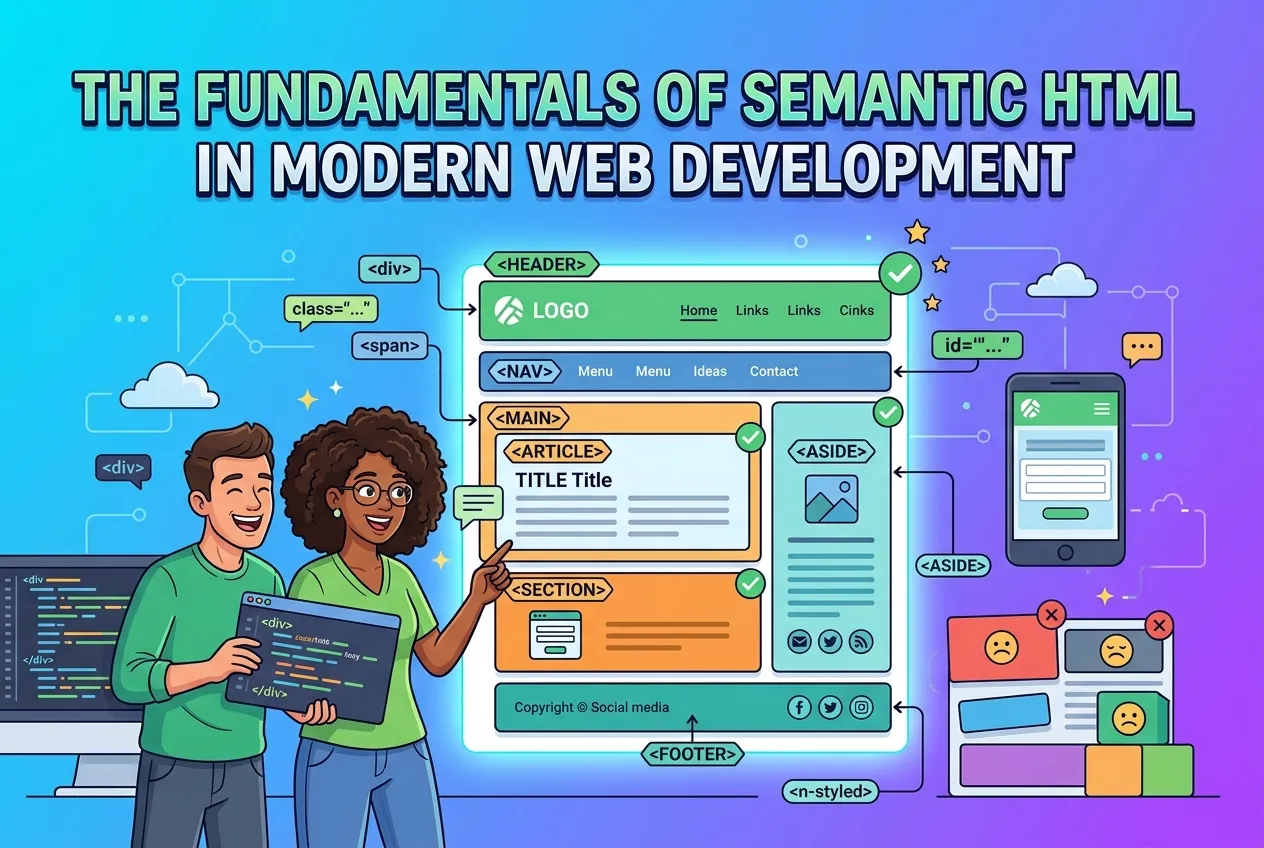
To truly grasp the power of semantic HTML, we must engage in a practical analysis of how a modern web document should be structured. Consider a typical blog post page. Instead of wrapping the entire layout in a series of nested <div> containers, a semantic approach dictates a more thoughtful hierarchy.
The top of the page, containing the site logo and primary navigation, should be enclosed within a <header> tag. The navigation itself belongs inside a <nav> element, signaling to users and machines alike that this section contains the primary routing links for the website. The main content of the page—the blog post itself—should be wrapped in a <main> tag, which should only appear once per page. Within this main section, the specific blog post is best represented by an <article> tag, indicating that the content is self-contained and could theoretically be syndicated or read independently of the rest of the site.
Furthermore, if there is a sidebar containing related links or author information, the <aside> tag is the perfect semantic choice. Finally, the bottom of the page, typically housing copyright information and secondary links, should be placed within a <footer>. This practical, logical structuring transforms a meaningless wall of code into a highly organized, easily parsable document.
The Accessibility Imperative
Perhaps the most compelling reason to adopt semantic HTML is its profound impact on web accessibility. For users who rely on assistive technologies, such as screen readers, the visual layout of a page is entirely irrelevant. These technologies depend entirely on the underlying HTML structure to navigate and interpret the content.
When a developer uses a <button> tag instead of a stylised <div>, they are automatically providing screen readers with crucial information. The screen reader will announce the element as a button, letting the user know that it is interactive and can be clicked. It also automatically handles keyboard focus, allowing users who cannot use a mouse to navigate to the button using the Tab key and activate it using the Enter or Space key.
If a developer were to use a generic tag instead, they would have to manually add complex ARIA (Accessible Rich Internet Applications) attributes and custom JavaScript to replicate this native functionality. By simply choosing the correct semantic tag, developers can ensure that their websites are inclusive and usable by individuals with varying abilities, fulfilling a critical ethical and often legal obligation in modern digital design.
SEO and Machine Readability
Beyond human accessibility, semantic HTML plays a vital role in machine readability, particularly concerning Search Engine Optimization (SEO). Search engines deploy automated bots, often called crawlers or spiders, to index the vast expanse of the internet. These bots cannot see a website in the way a human does; they rely entirely on the code to understand the content and context of a page.
When you use semantic tags, you are essentially providing a clear, well-labeled map for these search engine crawlers. An <h1> tag tells the crawler that this is the most important topic on this page. An <article> tag signals a distinct piece of content that might be relevant to specific search queries. By clearly defining the structure and hierarchy of your information, you make it significantly easier for search engines to accurately index and rank your pages.
As search algorithms become increasingly sophisticated, relying more heavily on artificial intelligence and natural language processing, the importance of structural clarity will only grow. Clean, semantic HTML ensures that your content is perfectly positioned to be understood and surfaced by the search engines of today and tomorrow.
Implications for Future-Proofing Web Projects
The implications of using semantic HTML extend far beyond immediate accessibility and SEO benefits; it is a fundamental strategy for future-proofing web projects. Technologies change, design trends evolve, and the devices we use to access the web are constantly shifting. However, the core principles of structured data remain constant.
A website built with strict adherence to semantic HTML is inherently more maintainable. When a new developer joins a project, they can quickly understand the layout and purpose of the code without having to decipher a tangled web of generic containers and custom classes. Furthermore, if a site requires a complete visual redesign, a solid semantic foundation means that the underlying structure can remain largely untouched while the CSS is completely overhauled. This separation of content and presentation saves countless hours of development time and significantly reduces the risk of introducing errors during major updates.
Key Takeaways
As we look toward the future of web development, it is clear that the fundamentals still matter. Here are the key takeaways for developers looking to optimize their workflow:
- Prioritize Meaning: Always choose the HTML tag that best describes the content, rather than the one that provides a specific visual style.
- Embrace Accessibility: Remember that semantic tags provide native accessibility features that are crucial for users relying on screen readers and keyboard navigation.
- Optimize for Machines: Use semantic structure to provide clear signals to search engine crawlers, improving your site's visibility and ranking.
- Build for the Future: Invest time in structuring your documents correctly to ensure long-term maintainability and ease of redesign.
By committing to the principles of semantic HTML, developers can create digital experiences that are not only visually stunning but also deeply robust, inclusive, and prepared for whatever the future of the web may hold.
Source: Original Brief










Comments
No comments yet — be the first to share your thoughts.
Join the discussion