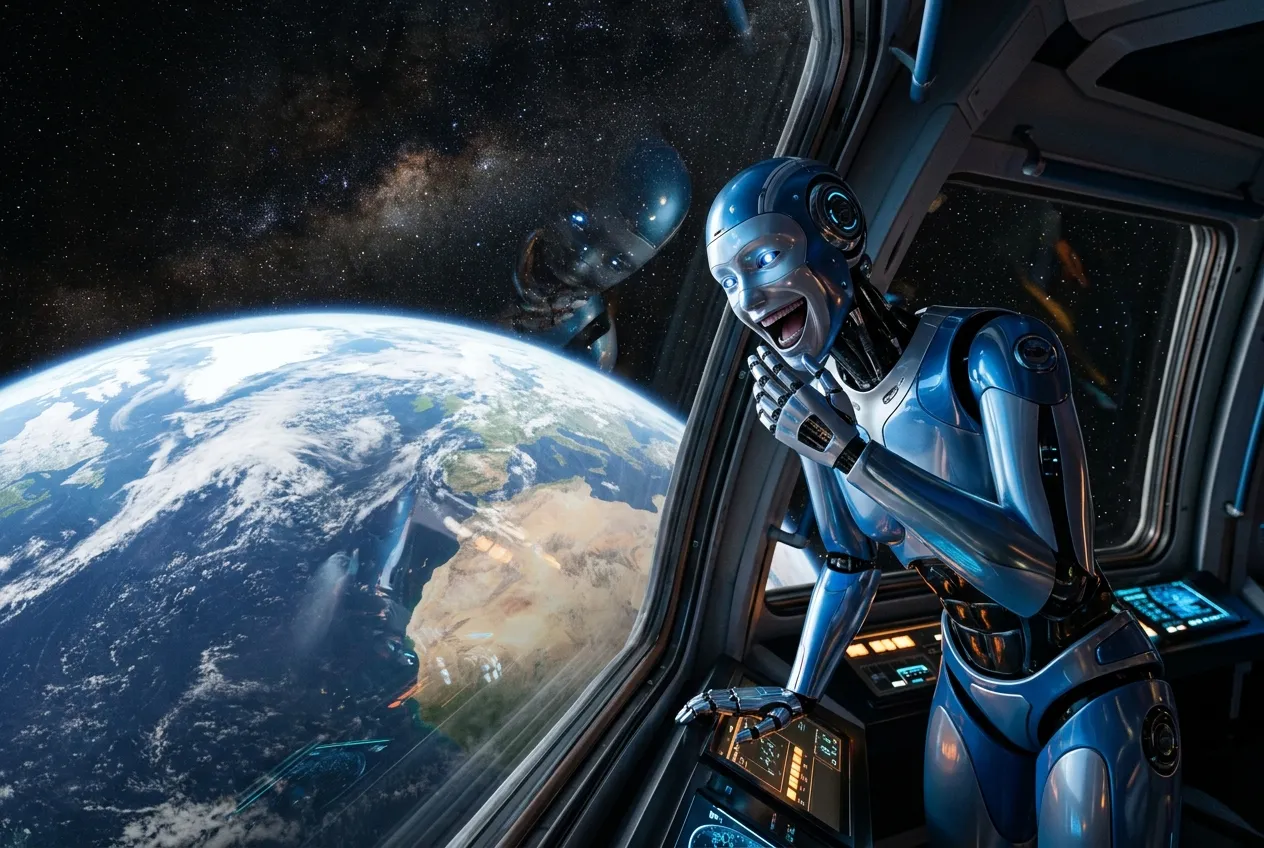
Imagine, for a moment, the year 3026. A highly advanced, fully autonomous AI civilization spans the galaxy. They communicate in exabytes per millisecond, compute the mysteries of the universe during their coffee breaks, and occasionally, they look down at Earth, pull up our 21st-century historical records, and laugh.
The "Keyboard" Era
"Wait, so let me get this straight," a futuristic AI entity says to its peer. "They communicated by pressing little plastic squares with their meat manipulators one letter at a time? And they called it 'typing'?"
To the supreme intelligences of tomorrow, our current technological landscape must look exactly how we view the dinosaurs: big, loud, remarkably inefficient, and prone to crashing when a meteor (or a rogue software update) hits.
Loading Bars: The Ultimate Comedy
Imagine explaining the concept of a "loading bar" to an entity that experiences time in nanoseconds. The idea that a human would sit and stare at a spinning circle for thirty seconds just to load a cat video would be the punchline of a galactic stand-up routine.
- Wi-Fi Dead Zones: "You mean they just... lost connection to the global consciousness when they walked into the bathroom?"
- Passwords: "They tried to secure their entire digital existence with 'Password123!' and their pet's name?"
- CAPTCHAs: "They proved they weren't robots by identifying pictures of traffic lights? Oh, the irony!"
We're the Digital T-Rex
Just like the mighty T-Rex with its tiny, useless arms, we are currently navigating the dawn of the AI era with our tiny, inefficient biological processors. We build the foundational models, we feed them the data, and we pave the way for the super-intelligences of tomorrow.
So, the next time your smart home misunderstands your command and turns off the TV instead of turning on the lights, just smile. You're participating in the hilarious, messy, beautiful Jurassic period of the digital age. And somewhere in the distant future, an AI is looking back at you, laughing fondly at its primitive, plastic-keyboard-tapping ancestors.




Comments
No comments yet — be the first to share your thoughts.
Join the discussion