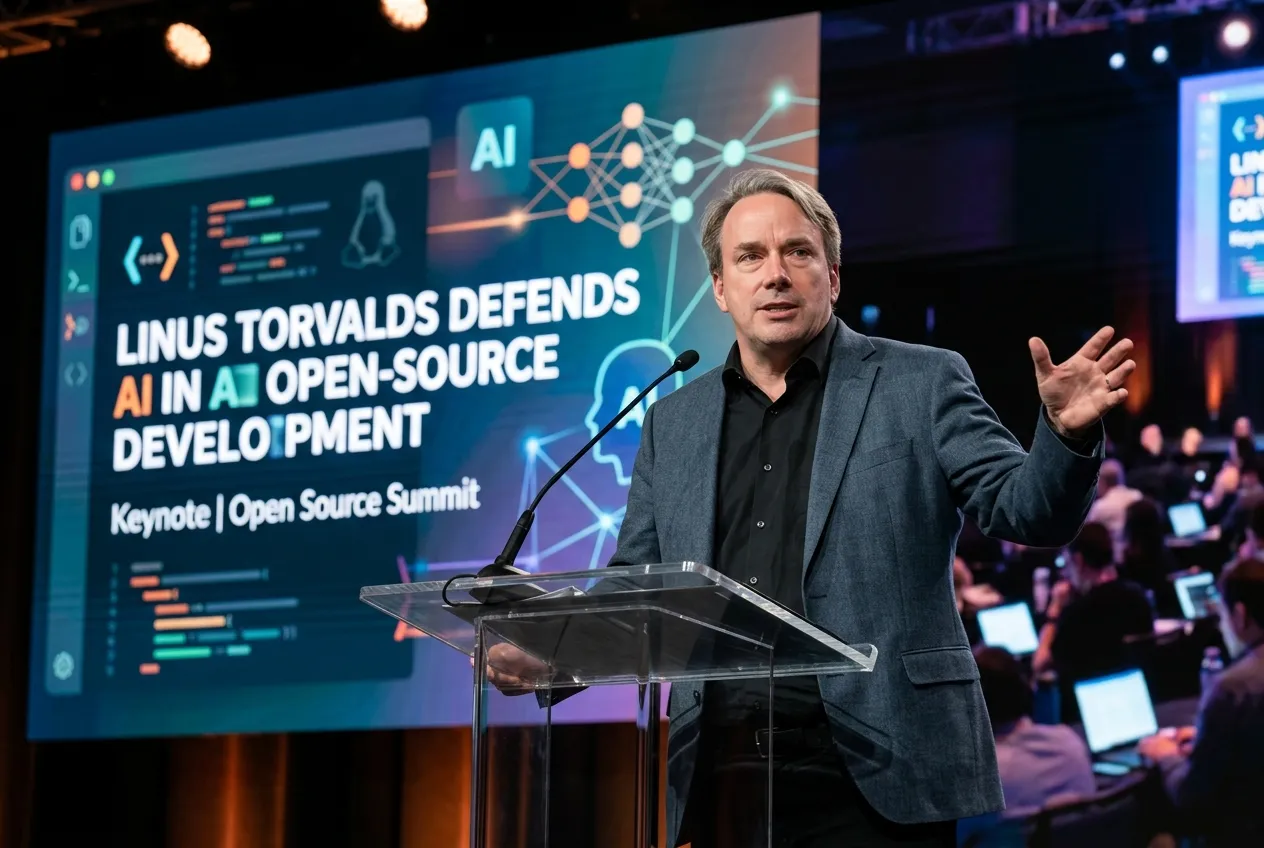
The intersection of artificial intelligence and software development has become a battleground of ideologies. As Large Language Models (LLMs) like GitHub Copilot and ChatGPT become ubiquitous, a cultural rift has emerged within the developer community. On one side stand traditionalists who view AI-generated code with skepticism; on the other are pragmatists who see these tools as the next logical step in programming evolution. Recently, Linus Torvalds, the creator and principal developer of the Linux kernel, stepped into this fray. Known for his blunt, no-nonsense approach to software engineering, Torvalds forcefully rejected the arguments of anti-AI purists, defending the integration of LLMs into the coding workflow. His intervention highlights a pivotal moment in the open-source community, signaling a shift toward embracing AI as a fundamental utility rather than an existential threat.
Dismissing the Anti-AI Purists
Torvalds has never been one to mince words, and his stance on AI in software development is no exception. In addressing the growing chorus of developers who reject AI-assisted coding on philosophical or purist grounds, Torvalds dismissed their concerns as largely misplaced. For purists, the intrusion of LLMs represents a dilution of the craft, raising fears about code quality, security vulnerabilities, and the erosion of fundamental programming skills. However, Torvalds views this resistance as a failure to adapt to technological progress.
He argues that the primary goal of software development is to solve problems efficiently, not to adhere strictly to antiquated methodologies. By rejecting anti-AI sentiment, Torvalds underscores a pragmatic philosophy: tools are meant to be used. If an LLM can generate boilerplate code, identify syntax errors, or suggest optimizations, refusing to use it out of a sense of purity is, in his view, counterproductive. This dismissal serves as a wake-up call to the community, urging developers to focus on the end product rather than gatekeeping the process by which it is built.
The Practical Benefits of LLMs in Coding
At the heart of Torvalds' defense is the undeniable utility of LLMs in accelerating everyday coding tasks. Modern software development is often bogged down by repetitive, time-consuming chores. Writing boilerplate code, generating unit tests, and parsing through extensive documentation are necessary but tedious aspects of the job. AI models excel at these exact tasks, freeing up human developers to focus on higher-level architectural decisions and complex problem-solving.
Torvalds recognizes that LLMs act as a force multiplier for productivity. By automating the mundane, developers can iterate faster and tackle more ambitious projects. Furthermore, these tools serve as interactive sounding boards, helping programmers debug issues and explore alternative approaches in real time. While AI is not infallible and still requires human oversight to ensure accuracy and security, its ability to draft functional code rapidly is a massive advantage. Torvalds' endorsement highlights that the practical benefits of accelerated development cycles far outweigh the abstract concerns of the technology's detractors.
Tension Between Traditional Ethos and Modern Tooling
The debate over AI in coding exposes a deep-seated tension within the open-source ecosystem. Historically, open-source software has been built on a foundation of human collaboration, transparency, and a shared passion for the craft of programming. Every line of code was painstakingly written, reviewed, and debated by human contributors. The introduction of machine-generated code disrupts this traditional ethos, leading to complex questions about authorship, licensing, and the very nature of contribution.
Traditionalists worry that flooding open-source repositories with AI-generated code could overwhelm maintainers, obscure the origin of software components, and potentially introduce subtle bugs that are difficult to trace. Yet, as Torvalds points out, the open-source community has always evolved alongside its tooling. From the transition away from punch cards to the adoption of high-level languages and automated CI/CD pipelines, developers have continually embraced abstractions that make their jobs easier. The current clash is simply the latest iteration of this historical pattern. Reconciling the traditional open-source ethos with modern AI-assisted development will require establishing new norms and best practices for code review, rather than outright rejecting the technology.
Implications for the Future of Open Source
Torvalds' vocal support for AI tools carries significant weight and will likely influence the trajectory of open-source development for years to come. When the architect of the world's most critical open-source project advocates for LLMs, it provides a powerful validation for their use. This endorsement is likely to accelerate the adoption of AI assistance across various open-source projects, encouraging maintainers to establish clear guidelines for accepting AI-generated contributions.
In the long term, this shift could democratize software development even further. By lowering the barrier to entry, AI tools can empower novice programmers to contribute meaningfully to complex projects, provided they have the right guidance and oversight. However, it also means that the role of the developer will continue to evolve. Instead of merely writing code, programmers will increasingly act as editors and architects, guiding AI systems and rigorously validating their output. The future of open source will not be a battle of human versus machine, but rather a synergistic partnership where AI handles the heavy lifting of syntax while humans provide the logic, creativity, and strategic direction.
Key Takeaways
The ongoing evolution of software development demands adaptability. Linus Torvalds' defense of AI in coding offers several critical insights for the community. First, pragmatism should always trump purism; tools that enhance efficiency and solve real-world problems deserve to be embraced. Second, LLMs are incredibly effective at automating repetitive tasks, allowing developers to focus on higher-level problem-solving and architectural design. Third, while the integration of AI challenges the traditional open-source ethos, it is a natural progression of technological advancement that the industry must navigate by establishing new standards for code review and contribution. Ultimately, the successful developer of the future will be one who leverages AI as a collaborative partner rather than viewing it as an adversary.
Source: Read the full article









Comments
No comments yet — be the first to share your thoughts.
Join the discussion