Automation and AI for Browser Game Teams: Lessons from BuildNow GG
What BuildNow GG’s frictionless, competitive design means for modern browser game teams—and where automation and AI fit into daily work.
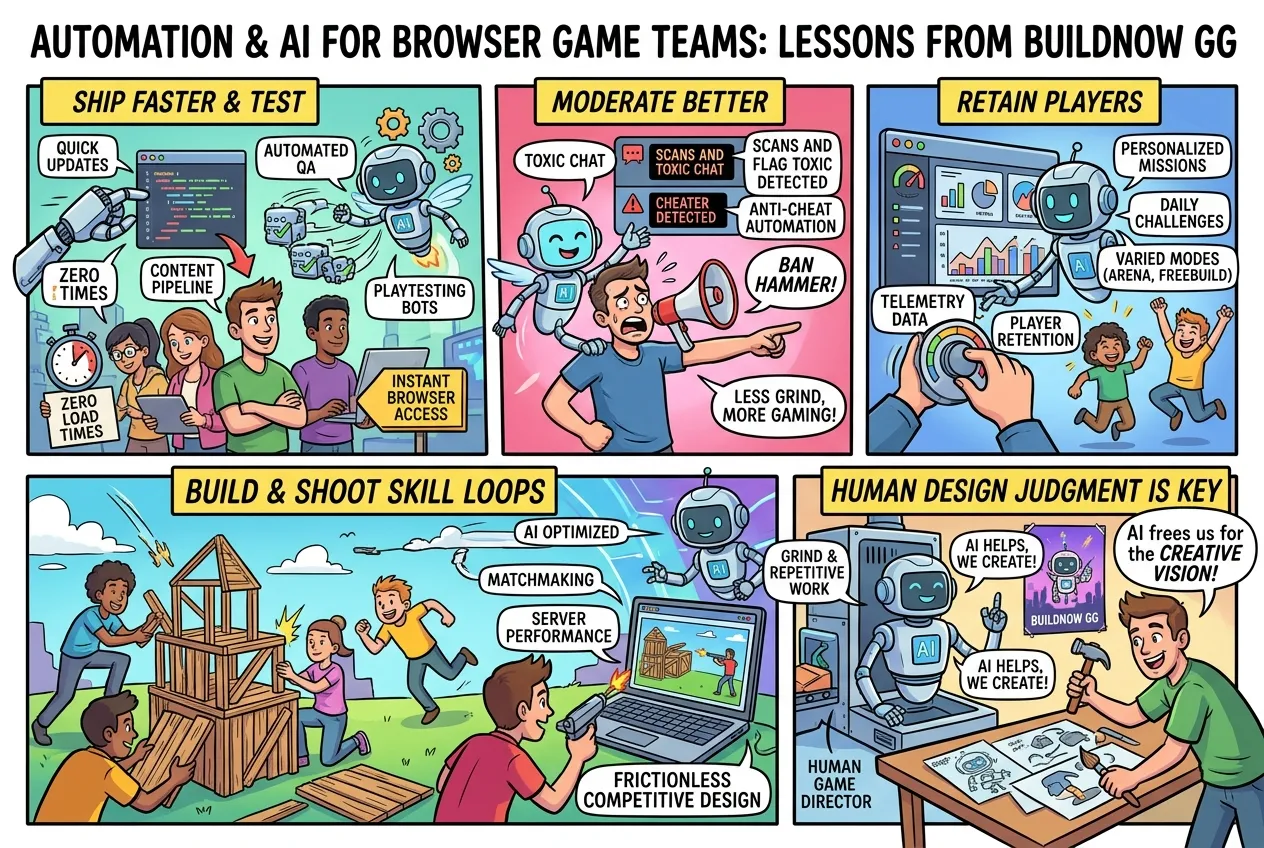
BuildNow GG is an online build‑and‑shoot game that runs in the browser, offers various modes, weapons, and maps, and centers competitive skill expression around building mechanics. That mix—instant access, content variety, and a tight competitive loop—sets clear expectations for modern web titles. For browser‑game professionals, it also sharpens where automation and AI can streamline work without supplanting human creative decisions.
What this profession does today
Browser game development teams span design, programming, art, QA, live operations, and community management. Day to day, they:
- Prototype and refine core loops (e.g., build‑and‑shoot interactions) to make skill expression immediate and satisfying.
- Produce and tune modes, weapons, and maps to keep variety high and learning curves fair.
- Optimize for low‑latency inputs and fast load times, since frictionless browser play sets a high performance bar.
- Ship frequent updates across a wide browser/device matrix and manage regression risk.
- Operate live services: deploy safely, monitor telemetry, triage crashes, and respond to player reports.
- Moderate communities, handle support tickets, and communicate balance changes transparently.
How build‑and‑shoot expectations shape the work
In a build‑and‑shoot game, players craft cover, edit terrain, and outplay opponents through rapid construction and aim. This raises specific delivery demands:
- Precision and feel: Input buffering, frame pacing, and predictable building placement are non‑negotiable. Minor hitches read as unfair.
- Readable state: With fast building, players need clear feedback for piece placement, durability, and line‑of‑sight—driving UI iteration and accessibility checks.
- Retention via mastery: Competitive loops around building mechanics reward practice. Teams must surface skill ladders in onboarding, challenges, and matchmaking.
Modes, weapons, and maps multiply operational overhead
Variety keeps sessions fresh, but each new mode or item inflates testing and balance surfaces:
- Combinatorial testing: Every weapon interacts with materials, cover angles, and map sightlines; QA matrices expand quickly.
- Config sprawl: Damage values, cooldowns, and build costs shift frequently; manual spreadsheets don’t scale.
- Content pipelines: Art, audio, and level data must package into lightweight bundles to honor browser bandwidth and caching constraints.
Instant browser access sets a zero‑friction bar
Frictionless play lowers entry barriers and raises expectations for “click to fun” timelines. Teams feel this in:
- First‑contentful‑paint budgets: Aggressive code‑splitting, compression, and progressive loading are part of the craft.
- Device diversity: Performance must hold across integrated GPUs and variable mobile CPUs, complicating QA.
- Resumable sessions: Quick reconnects and state sync reduce churn during brief network blips.
Repetitive admin tasks ripe for automation
Automation can absorb the toil that surrounds creative and systems work:
- Build and release: Continuous integration that lints, type‑checks, runs unit tests, produces minified bundles, and publishes to a staging CDN.
- Browser matrix smoke tests: Headless runs for key flows (load, match join, build piece place, fire, respawn) across a maintained browser/device grid.
- Asset hygiene: Automated texture/audio compression thresholds with fail‑the‑build if budgets are exceeded.
- Config validation: Schema‑checked JSON/YAML for weapons, maps, and modes to catch missing fields and out‑of‑range values before QA.
- Release notes and changelogs: Auto‑generate player‑facing summaries from tagged commits and merged pull requests.
- Moderation triage: Routing reports to the right queue (chat abuse vs. exploit report) with templated acknowledgments.
Workflow bottlenecks software can improve
Beyond pure automation, better tooling loosens constraints that slow delivery:
- Balance iteration: Replace manual sheets with a config‑as‑data editor, live reload in a sandbox, and snapshot tests for deltas (e.g., “build material HP −10%”).
- Mode QA coverage: Scenario generators that spawn bots with scripted behaviors to stress building under fire across maps.
- Content approvals: Lightweight review flows that gate by schema health, performance budgets, and localization coverage.
- Crash forensics: Symbolized crash capture with automatic bucketing and owner assignment to close the loop faster.
Where AI can assist responsibly
Used carefully, AI speeds up tasks without dictating design:
- Bot playtesting: AI agents that can build, shoot, and pressure‑test cover mechanics to surface degenerate strats or map exploits before players do.
- Telemetry summarization: LLMs or analytics heuristics that condense session logs into designer‑ready insights (e.g., “Piece X dominates early fights on Map Y”).
- Content tagging and search: Auto‑classify assets and map features to accelerate reuse and discoverability.
- Player support drafting: Suggest first‑response drafts for common issues; humans review and send.
- Performance anomaly alerts: Detect regressions in load time, memory, or input latency after a content drop.
Where AI should not replace human judgment
Some calls hinge on taste, empathy, and responsibility:
- Core game feel: Tuning building placement speed, weapon recoil, and camera sensitivity requires hands‑on play and designer intent.
- Balance decisions: Data informs, but meta‑health depends on human tradeoffs between mastery and accessibility.
- Safety and enforcement: Escalations, bans, and appeals need human review to avoid false positives and bias.
- Community voice: Patch notes, dev diaries, and roadmap explanations build trust best when authored by people.
Risks, ethics, and trust considerations
Automation and AI touch sensitive areas. Keep safeguards front‑and‑center:
- Privacy by design: Collect only gameplay telemetry you need, minimize retention, and communicate plainly what’s gathered and why.
- Fairness and anti‑cheat: If AI flags suspicious play, use it as a lead, not a verdict. Provide clear appeal paths.
- Transparency: Disclose when moderation or support replies are AI‑assisted. Avoid dark patterns that exploit competitive drive.
- Security hygiene: Protect pipelines and config stores; compromised balance files can wreck a competitive meta overnight.
Practical automation ideas a small team can implement
You don’t need a huge budget to get leverage. Start with:
- One‑click staging deploys: Every pull request spins a temporary URL with seeded lobbies to test building interactions.
- Budget gates in CI: Fail builds if bundle size, shader counts, or texture atlases exceed thresholds that threaten load time.
- Schema‑first content: Define JSON schemas for weapons, maps, and modes; validate on commit and pre‑release.
- Scripted stress bots: Simple agents that place, edit, and shoot structures at target APM to reveal desyncs and frame drops.
- Release checklists: Auto‑verify localized strings exist, patch notes are generated, and client/server versions align.
- Moderation macros: Pre‑approved templates for common reports; escalate only when signals cross a confidence threshold.
- Post‑release telemetry digest: Automatic next‑morning summary: retention curves, crash buckets, hotspots in building engagement.
- Rollout safeguards: Feature flags with percentage rollouts and instant kill‑switches if latency or crash metrics spike.
Balanced conclusion: augmentation, not replacement
BuildNow GG’s combination of browser‑based instant access, varied content, and a high‑skill build‑and‑shoot loop captures what players increasingly expect from web games: zero friction, meaningful mastery, and steady novelty. Meeting that bar is a multi‑discipline effort. Automation removes toil around builds, tests, configs, and releases; AI can accelerate discovery and pressure‑testing. But the heart of the work—how building feels, how modes unfold, how communities are stewarded—belongs to humans.
Treat automation and AI as force multipliers for the browser‑game craft: they keep the runway clear so designers, engineers, and live‑ops teams can focus on the moments that make competitive play sing.



Comments
No comments yet — be the first to share your thoughts.
Join the discussion