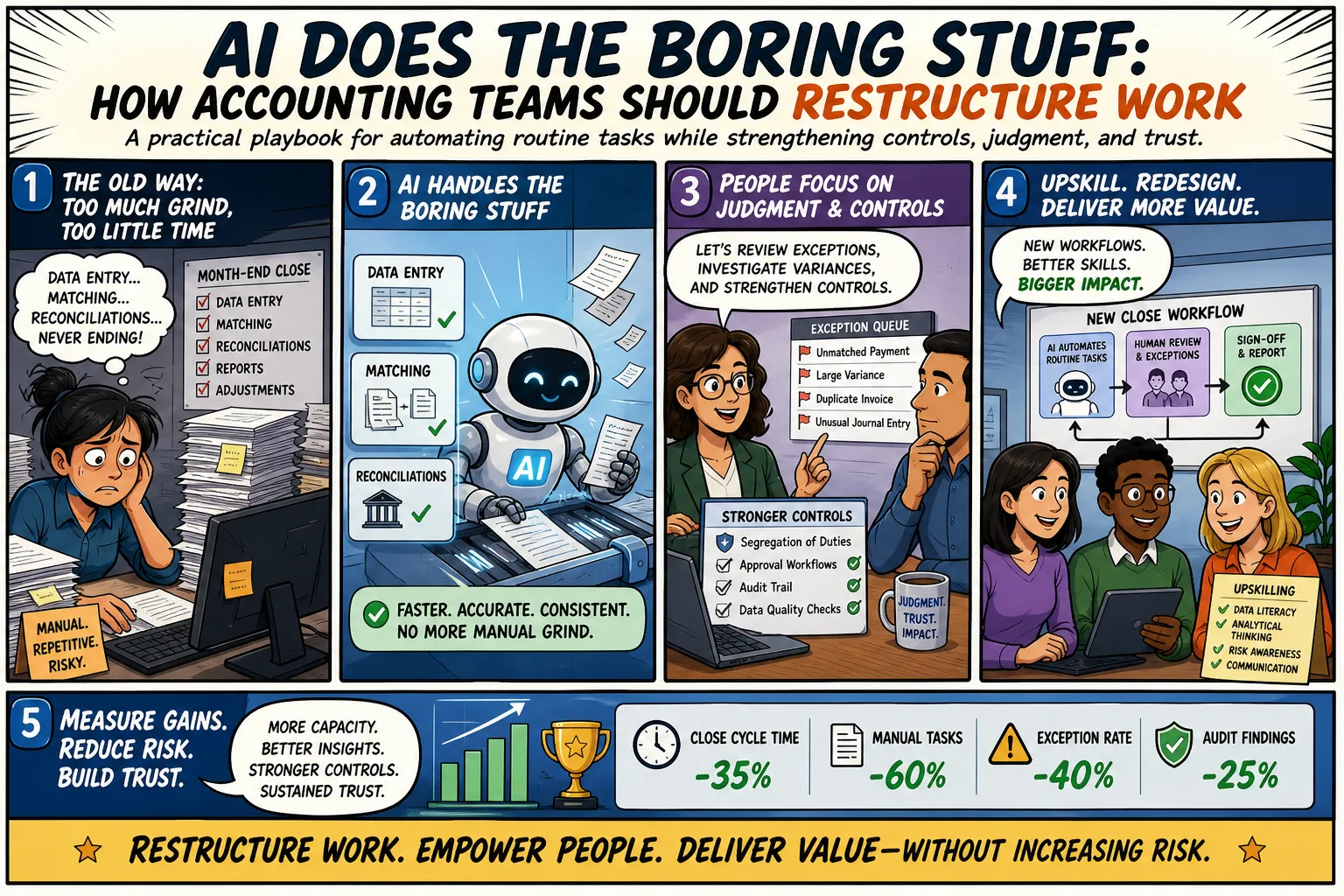
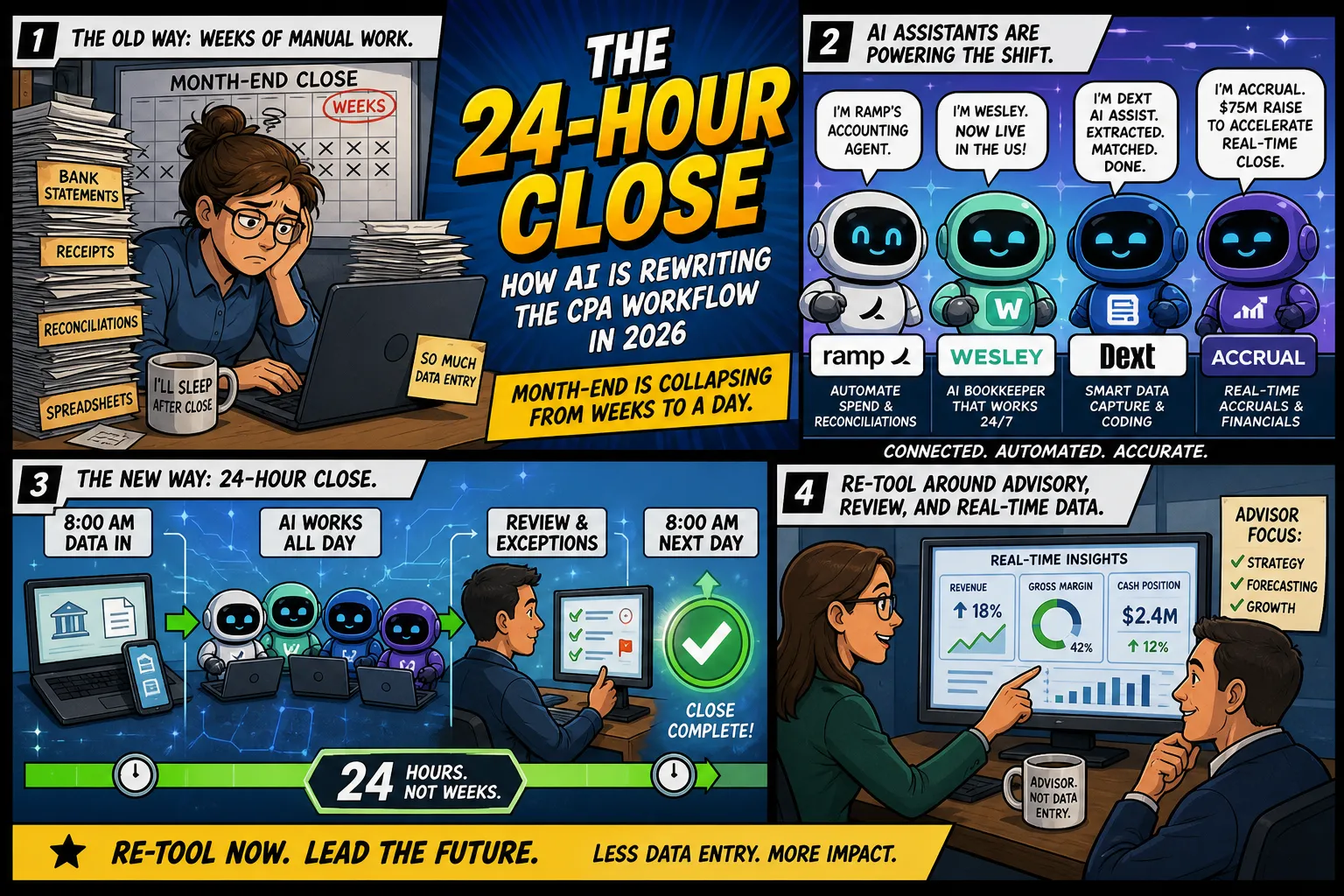
Accounting has always been a profession of both mechanics and meaning: the mechanics of capturing transactions, and the meaning of interpreting them correctly, consistently, and defensibly. The current wave of automation and AI is pushing that split into the foreground. The most useful mental model isn’t “AI replaces accountants.” It’s “AI does the boring stuff” so accountants can spend more time on review, exceptions, analysis, and decisions that require context and accountability.
But that outcome doesn’t happen automatically when you buy software. If you simply bolt AI onto today’s processes, you can end up with faster throughput and more risk—especially the risk of subtle, “silent” errors that look plausible and therefore slip past tired humans. The better approach is to restructure work: redesign roles, add new control points, and define how AI outputs are verified before they become financial truth.
What accounting teams do today (the real day-to-day)
In most organizations, accounting is a system of record and a system of assurance. Day-to-day work commonly includes:
- Transaction processing: capturing invoices, bills, expenses, deposits, payroll entries, and journal entries.
- Reconciliations: matching bank activity to the ledger, reconciling subledgers, and investigating variances.
- Close and reporting: month-end close routines, accruals, financial statements, management reporting, and supporting schedules.
- Controls and compliance: approvals, documentation, audit trails, retention, and consistent policy application.
- Partnering: explaining results, flagging risks, advising on cash flow, and translating numbers into decisions.
Much of this work is repetitive and rules-based—but the stakes are high. A small error can cascade into incorrect reporting, misinformed decisions, or loss of stakeholder trust.
Which tasks are most automatable vs. judgment-heavy
To avoid hype, start with a simple classification: high-volume pattern work versus contextual judgment work. The “AI does the boring stuff” framing fits best when you target the pattern work first.
Most automatable (high-volume, structured, repeatable)
- Data entry and coding: extracting vendor, date, amount, and line items from invoices/receipts; suggesting GL codes and classes based on history.
- Reconciliation and matching: proposing matches between bank transactions and ledger entries; identifying likely duplicates; grouping related items.
- Routine validations: checking required fields, basic arithmetic, and standard policy rules (e.g., missing approvals, out-of-range amounts).
- Document routing and reminders: chasing missing receipts, prompting approvers, tracking status of open items.
- Standardized close checklists: assembling recurring schedules, rolling forward templates, and preparing first-draft variance explanations for review.
Judgment-heavy (should remain human-led, AI-assisted at most)
- Accounting policy interpretation: deciding how to treat unusual transactions and applying policies consistently in new scenarios.
- Materiality and risk decisions: determining what matters, what to escalate, and what tradeoffs are acceptable.
- Estimates and accruals: assumptions, forecasting inputs, and deciding when evidence is sufficient.
- Exception resolution: investigating discrepancies, negotiating with vendors/customers, and determining root cause.
- Sign-off and accountability: approving entries, certifying completeness, and owning the final numbers presented to stakeholders.
The practical takeaway: automate the first draft (capture, match, propose) and elevate humans to adjudication (review, decide, document why).
Workflow bottlenecks software can improve (without weakening controls)
Many accounting bottlenecks aren’t “hard accounting problems.” They’re coordination problems: missing documents, unclear ownership, and back-and-forth that drags close timelines. Automation can reduce friction if you redesign the workflow around it.
- Intake bottleneck: invoices and receipts arrive through email, paper, portals, and chat. Centralize intake and standardize required fields so AI extraction has consistent inputs.
- Approval bottleneck: approvals stall because approvers lack context. Provide AI-generated summaries (what it is, why it changed, what policy applies) plus a clear approve/reject workflow.
- Reconciliation bottleneck: matching is time-consuming and mentally draining. Let AI propose matches, but require a review step for anything outside defined thresholds.
- Close bottleneck: the same “where are we?” questions repeat. Use automated status dashboards and exception queues so leadership can see what’s blocking close.
Where AI can assist responsibly (and how to structure it)
Responsible assistance means defining what the AI is allowed to do, what it must show, and what humans must verify. In practice, that looks like shifting from “AI autoposts” to “AI proposes with evidence.”
- Propose, don’t finalize: AI suggests coding, matches, and explanations; humans approve posting for anything above low-risk thresholds.
- Show the evidence: every suggestion should link to source documents, extracted fields, and the reasoning (e.g., prior similar transactions).
- Work from an exception queue: default to straight-through processing only for truly routine items; route anomalies to a prioritized queue.
- Standardize narratives: AI can draft memos and variance notes, but require humans to confirm claims and attach supporting documentation.
This is how “boring stuff” gets removed: humans stop spending hours on repetitive matching and instead spend minutes validating the handful of items that actually need attention.
Where AI should NOT replace human judgment
Accounting outcomes need to be defensible to managers, auditors, regulators, and customers. That defensibility relies on a chain of reasoning and accountability that cannot be delegated to a black box.
- Final approvals and sign-offs: humans must own the final ledger, the close, and the reporting package.
- Novel or high-impact transactions: anything unusual, high-value, or policy-sensitive should be human-led from the start.
- Dispute handling: vendor/customer disputes require negotiation, empathy, and careful documentation.
- Ethical calls: decisions involving fairness, transparency, or stakeholder impact should not be automated.
New control points to prevent “silent errors”
Automation changes risk. Manual work is slow but often noisy—errors are visible because people stumble. AI can be fast and quiet—errors can look clean and consistent. That’s why teams need new control points designed specifically for AI-assisted workflows.
- Segregation of duties for AI: separate who configures automation rules from who approves exceptions and who reviews outputs.
- Confidence thresholds: define when AI can auto-suggest versus when it must escalate (e.g., new vendor, new GL account, unusual amount, missing PO).
- Sampling with intent: don’t only review exceptions; also sample “normal” items to catch systematic misclassification.
- Change management logs: track model/rule changes, prompt changes, and mapping changes the same way you track accounting policy updates.
- Three-way tie-outs: for key cycles, require tie-outs between source systems (bank/ERP/AP) and the ledger, not just internal consistency.
- Reconciliation drift checks: monitor whether reconciliation differences are shrinking for the right reasons (true matching) versus being forced into matches.
- Audit-ready trails: store the “why” behind decisions: what the AI suggested, what the human changed, and what evidence supported it.
Upskilling plan: from processors to reviewers, exception handlers, and analysts
If AI removes repetitive work, the team’s value shifts upward. That requires a deliberate upskilling plan, not an assumption that people will “just do more analysis.” A practical plan can be staged:
Phase 1: Review discipline (weeks 1–4)
- Create review checklists for AI-suggested coding and matching.
- Train staff to validate against source documents, not against the AI output.
- Define escalation paths and response time expectations.
Phase 2: Exception handling (weeks 4–8)
- Teach root-cause analysis for recurring exceptions (vendor setup issues, unclear expense policies, missing approvals).
- Build playbooks: “If X happens, do Y, document Z.”
- Assign ownership for top exception categories and track resolution quality.
Phase 3: Analytics and business partnering (weeks 8–12)
- Develop variance analysis habits: what changed, why, and what decision it affects.
- Standardize management reporting packs and narratives.
- Train on communicating insights with appropriate caveats and evidence.
The goal is a new operating model: fewer hours spent on keystrokes, more hours spent on judgment, communication, and control.
How to measure productivity gains without increasing risk
Measuring success purely by “hours saved” can incentivize dangerous shortcuts. A better scorecard pairs efficiency with quality and control outcomes.
- Cycle time: time from invoice receipt to approval to posting; days to close.
- Exception rate: percentage of items requiring human intervention (should fall as upstream processes improve).
- Rework rate: number of corrected entries, reversals, or recodes after posting.
- Reconciliation quality: number and age of unreconciled items; frequency of forced matches.
- Control adherence: approvals completed, documentation completeness, and traceability of decisions.
- Stakeholder trust signals: fewer disputes, faster responses to questions, and clearer explanations during reviews.
Set explicit guardrails: productivity gains only “count” if rework and exception severity do not rise. If they do, the automation is shifting cost into future cleanup—or into risk.
Practical automation ideas for small teams (high impact, low drama)
You don’t need a massive transformation program to start. Small teams can implement targeted changes that reduce grind while strengthening controls:
- Centralize document intake: one inbox or portal, with required metadata fields (vendor, date, category) to reduce ambiguity.
- Bank feed rules + AI suggestions: use rules for truly repetitive items; use AI for first-pass categorization, with a mandatory review for new payees.
- Automated reconciliation proposals: let software suggest matches, but require human approval for partial matches or unusual timing.
- Exception dashboard: a daily queue that highlights missing approvals, unmatched payments, and outliers—owned by named staff.
- Close checklist automation: auto-generate tasks, due dates, and dependencies; track completion and blockers.
A balanced conclusion: augmentation beats replacement
AI and automation can absolutely change accounting work—especially the repetitive administrative tasks like data entry and reconciliation. But the most durable advantage will go to teams that redesign the job, not teams that simply buy tools. When AI does the boring stuff, humans should be repositioned as reviewers, exception handlers, and analysts—supported by stronger control points that prevent silent errors and preserve trust.
In other words: the future accounting team is not smaller by default; it’s structured differently. The winning play is an operating model where automation accelerates the routine, humans own the judgment, and the system makes it easy to prove that the numbers are right.
Source: Stanford Graduate School of Business — “AI Is Reshaping Accounting Jobs by Doing the Boring Stuff”

Comments
No comments yet — be the first to share your thoughts.
Join the discussion