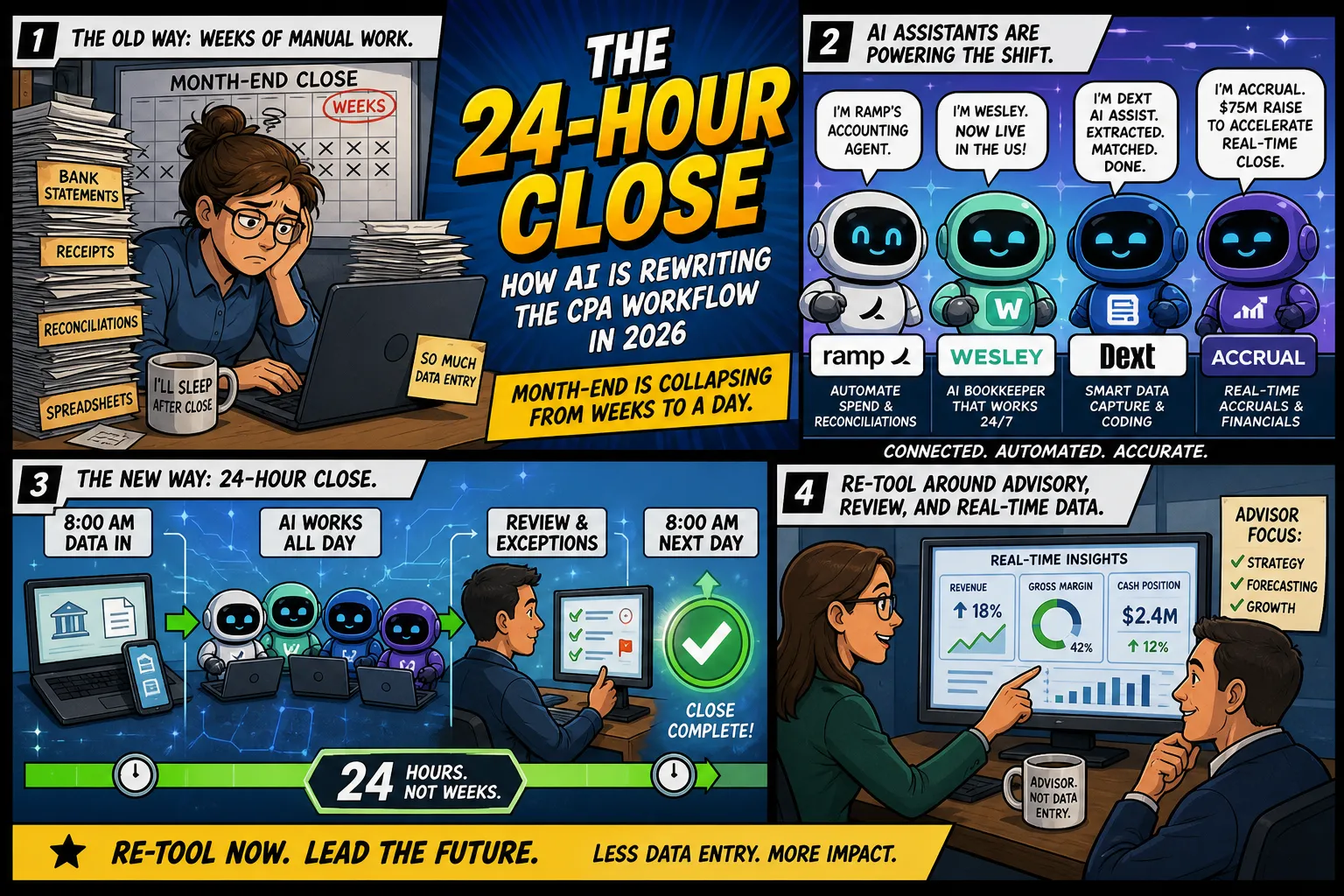
For most of the last two decades, the day-to-day of a CPA or staff bookkeeper has looked remarkably similar: pull bank feeds, chase receipts, categorize transactions, reconcile accounts, tie out balances, and then — usually one to three weeks after month-end — produce a set of financials the client actually reads. 2026 is the year that pattern breaks.
Within a five-month window, Ramp shipped its Accounting Agent (February 2026) to automate bookkeeping and push toward a real-time close, followed by Ramp Stack in June 2026 as an "AI OS" aimed squarely at accounting firms. In July 2026, Wesley launched in the US promising to compress month-end from weeks to roughly 24 hours. Dext AI Assist is now handling the small judgment calls bookkeepers make hundreds of times a week, and Accrual raised $75M to build AI-native firm workflows. The direction of travel is unmistakable.
What the profession actually does today
Strip away the job titles and a modern accounting practice spends its billable hours on a fairly predictable stack of work:
- Transaction coding and bank/credit-card reconciliation
- Accounts payable and accounts receivable processing
- Payroll journal entries and benefit accruals
- Month-end and quarter-end close, including accruals, prepaids, and intercompany
- Sales tax, use tax, and multi-state filings
- Financial statement preparation and management reporting
- Client communication: document chasing, question lists, variance explanations
- Advisory: cash flow, budgeting, entity structure, tax planning, M&A support
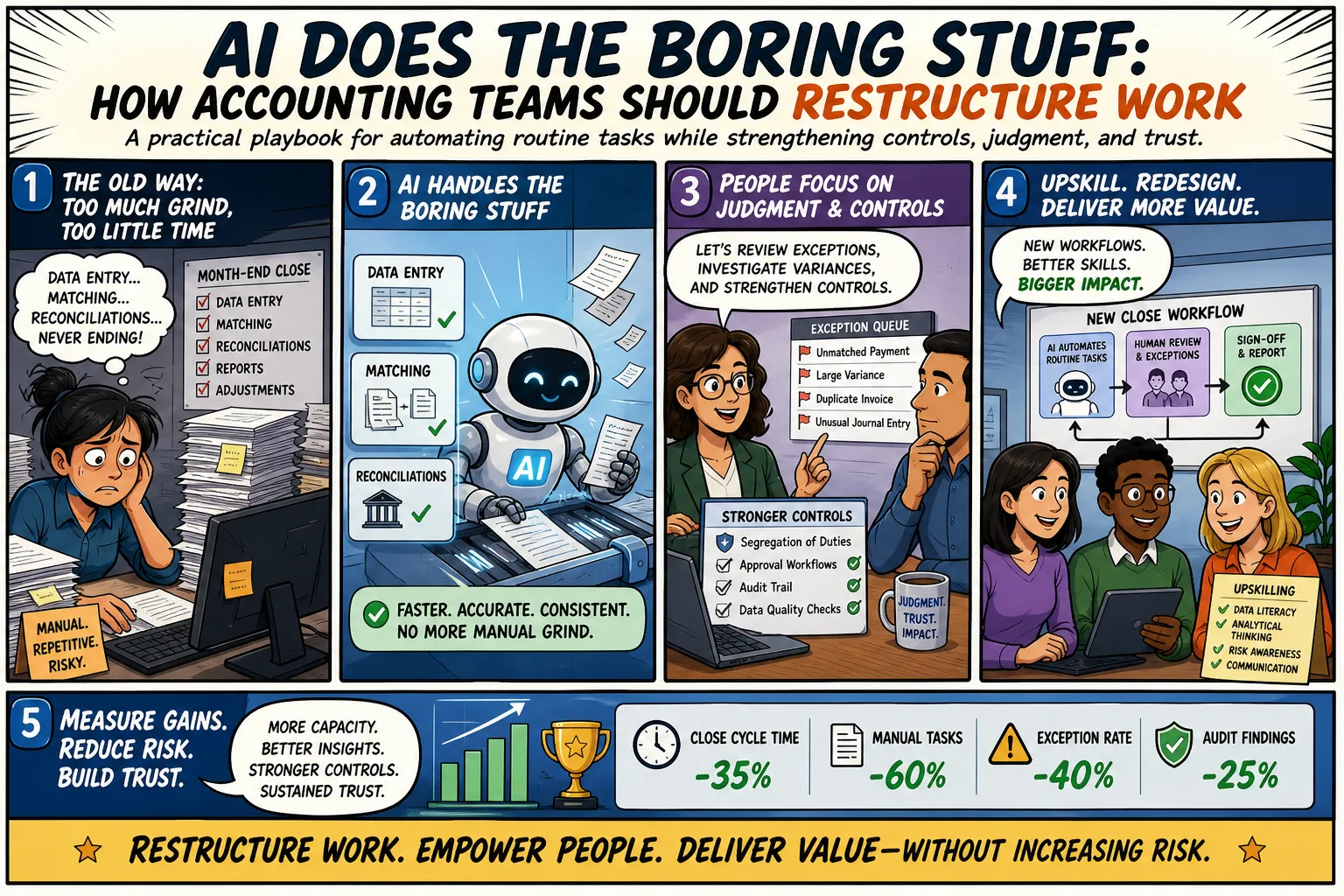
Historically, the first six items eat 70–80% of staff hours, leaving advisory — the highest-value work — squeezed into whatever time is left. That is exactly the ratio the new tools are attacking.
The repetitive tasks AI is now genuinely good at
The 2026 wave of tools is not chasing "AI-generated insights." It is automating the mechanical layer under the ledger. Concretely:
- Coding transactions based on vendor history, memo text, and prior CPA overrides — the core of Dext AI Assist and Ramp Accounting Agent.
- Matching receipts and invoices to card and bank activity without human touch.
- Auto-generating recurring journals for rent, depreciation, prepaid amortization, and payroll accruals.
- Drafting the close checklist and running variance analysis against prior periods and budgets.
- Producing first-draft financial statements and management narratives ready for CPA review.
Wesley's pitch — a ~24-hour close — only works because these steps run continuously during the month instead of being crammed into the first week after it ends.
Bottlenecks software can finally break
Every firm knows where the month-end process stalls. It is almost never in the ledger itself:
- Waiting on clients for missing receipts, contracts, or explanations
- Uncategorized owner or credit-card transactions
- Payroll and benefits data that lands late
- Intercompany or multi-entity eliminations done in spreadsheets
- Manual handoffs between bookkeeper, senior, and reviewer
Tools like Ramp Stack and Accrual's workflow platform target these coordination gaps: automated client requests, AI-drafted follow-ups, and a shared workspace where the reviewer sees exceptions rather than the whole ledger.
Where AI can assist responsibly
The safe zone for automation right now is anything that is rules-driven, auditable, and reviewable: coding, matching, reconciliations, standard journals, first-draft reports, and client-request drafting. Every one of these produces an artifact a CPA can inspect and sign off on. That is the "review-first workflow" firms are converging on — the AI does the first pass, the human owns the final call.
Where human judgment must stay
No responsible firm should hand these to an agent unsupervised:
- Revenue recognition on complex or non-standard contracts
- Materiality decisions, adjustments, and going-concern assessments
- Tax positions with interpretive risk
- Fraud detection and unusual related-party activity
- Advisory conversations — pricing, structure, hiring, financing
- Anything that will be signed, attested to, or filed with a regulator
An AI can flag a suspicious pattern; only a licensed professional should decide what it means and what to do about it.
Risk, ethics, and client trust
Compressing the close is only a win if the underlying controls survive the compression. Firms adopting these tools in 2026 should think hard about:
- Data privacy: client financial data flowing through third-party models — what is logged, what is used for training, where it is stored.
- Auditability: every AI-made coding decision needs a traceable reason and a reviewer stamp.
- Independence and professional standards: AI-drafted work is still the firm's work product.
- Client disclosure: engagement letters should describe how AI is used in the service.
- Model drift: a vendor changing its model mid-year can quietly change your coding behavior.
Practical automation a small firm or in-house team can implement now
- Turn on AI coding suggestions in your existing ledger or bill-pay tool and require reviewer approval before posting.
- Move recurring journals (depreciation, prepaids, payroll) to auto-post with an exception report.
- Replace email document chasing with an automated client request portal.
- Build a standardized close checklist where AI marks items complete and humans sign off exceptions only.
- Adopt a variance-analysis template so month-end reviews focus on what moved, not what tied.
- Reprice at least one client from hourly bookkeeping to a fixed-fee advisory retainer, using the freed time for CFO-level conversations.
Rising client expectations
The quieter effect of Ramp, Wesley, and Accrual is on the demand side. Once a founder sees a 24-hour close at one company, three-week financials at another firm start to look negligent. Advisory conversations shift from "here is what happened last month" to "here is what is happening this week." Firms that cannot deliver current numbers will lose the advisory seat to firms that can.
Augmentation, not replacement
The 2026 tools do not eliminate the CPA. They eliminate the parts of the CPA's day that were never the point: keying, matching, chasing, and formatting. What remains — judgment, interpretation, planning, and the trusted-advisor relationship — is exactly the work most accountants said they wanted more of. The firms that thrive in the next two years will be the ones that treat AI as a very fast, very literal junior staffer: give it clear instructions, review its work, and take responsibility for what goes out the door.
Source: Wesley launches AI bookkeeping platform — Yahoo Finance


Comments
No comments yet — be the first to share your thoughts.
Join the discussion