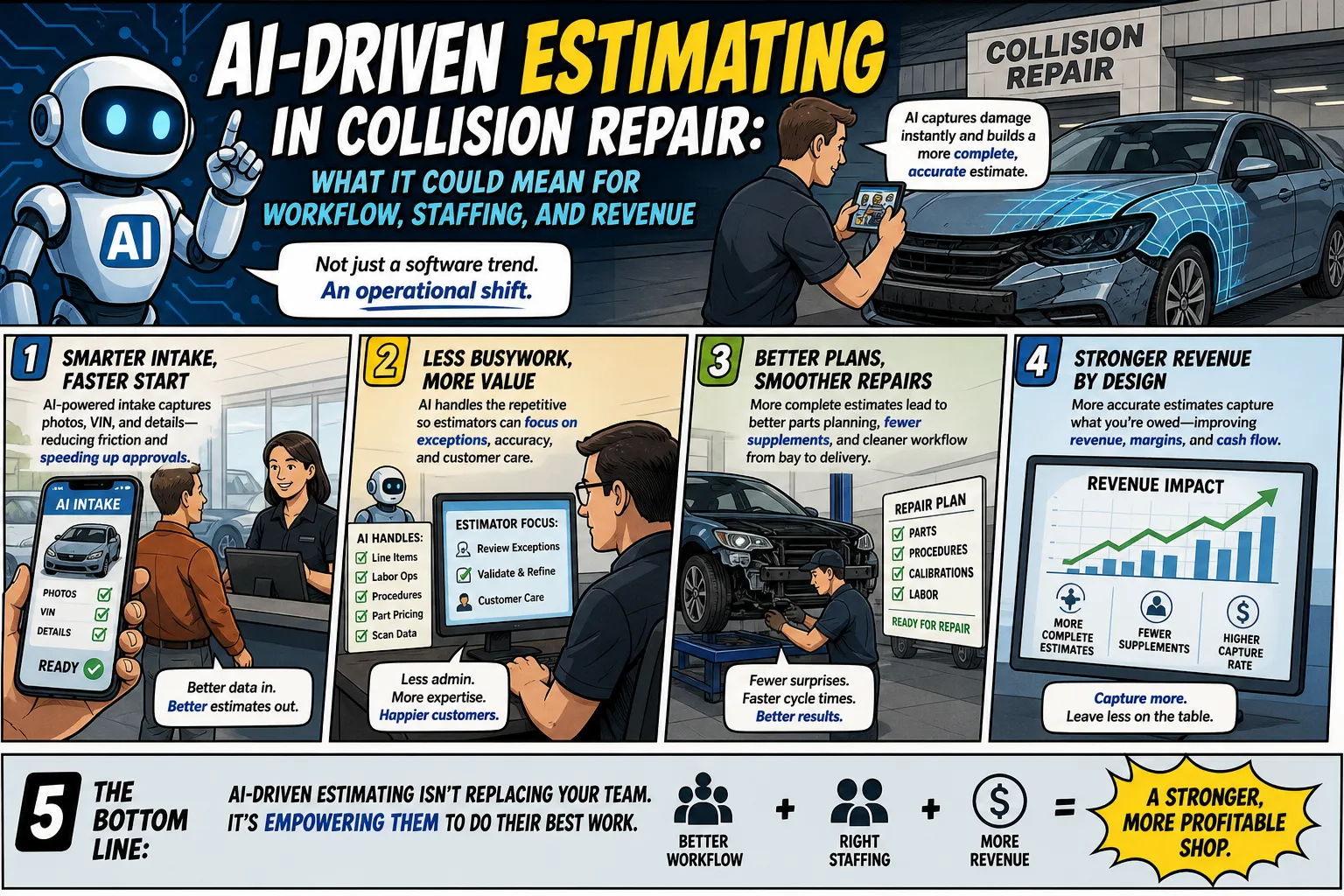
Artificial intelligence is often discussed as a broad technology trend, but in collision repair the more useful question is practical: what changes inside the shop when estimating starts to shift? That is the real business issue raised by discussion around AI-driven estimating in collision repair. As highlighted by BodyShop Business, the topic is not simply about faster software. It is about how estimating may reshape who performs key tasks, when those tasks happen, and how repairers document and recover revenue tied to the work they do.
For collision repair operators, that makes AI estimating a workflow question before it becomes a technology question. If estimate generation begins earlier in the customer journey, if intake becomes more automated, or if certain line-building tasks move upstream or downstream, the effect will ripple through front-office processes, production planning, staffing models, and financial performance. Shops that treat this only as a tool purchase may miss the larger operational redesign taking place around it.
Why AI-driven estimating is a workflow issue first
In many collision repair businesses, estimating does more than produce a number. It acts as the trigger for scheduling, parts planning, insurer communication, repair authorization, and customer updates. Because of that, any change to estimating changes the pace and order of work across the business.
The source frames AI-driven estimating as something that may alter who does the work and when it happens. That matters because collision repair workflows are often built around a familiar sequence: customer contact, vehicle intake, damage review, estimate creation, approvals, disassembly, supplements, and production. If AI tools begin handling part of the estimate-building process earlier, some of those steps may compress, overlap, or move to different team members.
That could create several operational shifts:
- Earlier information capture: Basic estimate inputs may begin before the vehicle reaches the shop.
- Faster intake decisions: Shops may be able to triage repair opportunities sooner and route jobs more efficiently.
- Changed handoffs: Estimators, CSRs, technicians, and production staff may interact differently as information enters the system earlier.
- Different supplement patterns: If early estimates become easier to generate, shops will need disciplined processes to ensure speed does not weaken repair accuracy.
In other words, AI estimating should be viewed as part of process design. The important question is not whether a platform can generate estimate content, but whether the shop has a reliable operating model for using that content without creating confusion, duplication, or missed repair opportunities.
How intake automation could reshape the front end of the shop
One of the clearest implications of AI-driven estimating is at intake. The front end of collision repair is often burdened by delays, repeated data entry, photo collection issues, and uneven communication between customers, insurers, and shop staff. If AI helps structure estimate data earlier, intake could become less reactive and more standardized.
That does not mean the human role disappears. It means the nature of the role may change. Instead of spending as much time assembling basic estimate inputs from scratch, staff may spend more time validating information, clarifying repair needs, setting expectations, and preparing the vehicle for a cleaner production handoff.
For shop operators, this could improve consistency in several ways:
- Quicker initial response to leads from customers seeking repair direction.
- Better scheduling discipline because jobs can be screened and prioritized earlier.
- Cleaner documentation at the start of the repair process.
- Less administrative friction in moving from inquiry to active repair planning.
Still, intake automation also raises a management challenge. Shops will need clear standards for when an AI-assisted estimate is sufficient for next-step planning and when a deeper in-person review is required. Without that discipline, a faster intake process could simply push uncertainty downstream, where it becomes more expensive to correct.
What this could mean for staffing and role design
The source points to a central concern: AI-driven estimating may reshape who does the work. For collision repair businesses, that is a staffing design issue, not just a software feature list.
Traditionally, estimating expertise sits with a specific role. But if AI changes how estimate information is gathered and assembled, some responsibilities may spread across the organization. Customer-facing staff may become more involved in intake data capture. Estimators may spend less time on repetitive line construction and more time on review, negotiation, and repair strategy. Production leaders may become more active earlier in the process if estimate information reaches them sooner.
This kind of shift does not automatically reduce headcount. More often, it changes the value of existing labor. Shops may need people who can:
- Validate AI-generated estimate content against real repair conditions.
- Identify missed operations that affect safety, quality, or billing.
- Coordinate earlier between intake and production teams.
- Use estimate data to support scheduling and parts readiness.
- Communicate clearly with customers and payers when automated outputs require human correction.
That suggests a practical staffing takeaway: collision repair businesses should prepare for role evolution, not just task automation. Training may need to focus less on manual data assembly alone and more on judgment, documentation quality, process control, and revenue awareness. Shops that redesign responsibilities thoughtfully may gain efficiency without weakening repair oversight.
The revenue capture opportunity and risk
The most important business implication may be revenue capture. The source specifically notes that AI-driven estimating could affect how shops capture revenue. That deserves close attention because estimating quality has direct financial consequences in collision repair.
If AI allows shops to move faster at intake and estimate creation, there is a potential upside: less delay, more throughput, and more consistent documentation of billable operations. Faster early-stage handling can also reduce administrative drag that keeps vehicles from entering production promptly.
But speed creates risk if shops assume an AI-generated estimate is complete simply because it is fast. Revenue leakage in collision repair often comes from missed operations, weak documentation, or process gaps between the first estimate and the actual repair plan. An automated starting point can help, but only if the shop has controls in place to review what is present, what is absent, and what must be added as repair knowledge deepens.
From a management perspective, the revenue question becomes twofold:
- Can AI help the shop identify and document work sooner?
- Can the shop maintain enough human oversight to prevent under-scoping and missed billing opportunities?
The strongest operators will likely treat AI estimating as a revenue-discipline tool rather than a shortcut. Used well, it may support cleaner capture of legitimate repair operations. Used poorly, it may create false confidence that leads to omissions, rework, and margin erosion.
How shops can prepare without overreacting
Collision repair businesses do not need to assume that AI estimating will instantly transform every process. But they do need to recognize that its significance lies in operations, not hype. The right response is measured preparation.
Practical steps include:
- Map the current estimate workflow from first contact through production handoff.
- Identify bottlenecks at intake where earlier information capture could help.
- Define review checkpoints so AI-assisted estimates are validated before key decisions are made.
- Clarify staff responsibilities if intake, estimating, and production begin to overlap more.
- Track missed operations and supplements to understand whether speed is improving or weakening revenue capture.
This approach keeps the focus where it belongs: on shop performance. The real promise of AI-driven estimating is not that it sounds advanced. It is that it may help collision repair businesses redesign workflows, reduce friction at intake, deploy staff more effectively, and support stronger revenue recovery on the work they already perform.
That is why this is such a strong B2B topic for the industry. It sits at the intersection of process, labor, and profitability. As the discussion develops, the shops that benefit most will likely be those that ask operational questions early: Where should estimating begin? Who should touch it? What needs human review? And how do we make sure faster information leads to better business outcomes, not just faster paperwork?
Source: BodyShop Business — HD Repair Forum: AI in collision repair





Comments
No comments yet — be the first to share your thoughts.
Join the discussion