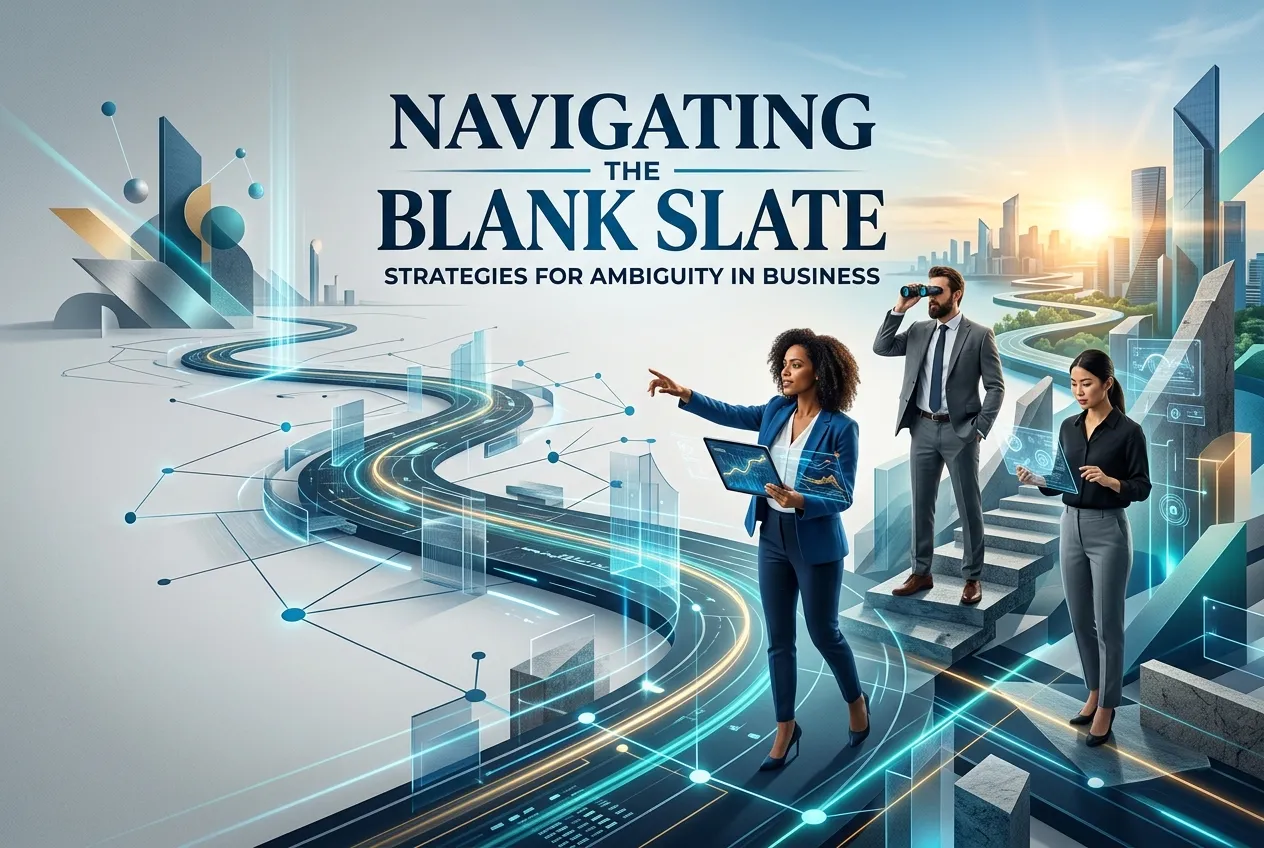
In the fast-paced world of modern business, professionals are occasionally handed a project brief that is essentially a blank slate. Whether it is an open-ended mandate to innovate, a completely undefined project scope, or a literal empty prompt, starting from absolute zero can be one of the most daunting challenges a team can face. Without a predefined angle, a specific cover topic, or a detailed set of instructions, the initial reaction is often paralysis. However, this absence of constraints also presents a unique opportunity. By embracing the blank slate, organizations can foster unprecedented creativity and build foundational strategies from the ground up. This article delves into the methodologies for navigating absolute ambiguity, offering practical analysis and strategic frameworks for transforming empty spaces into structured, actionable outcomes.
The Psychology Behind the Blank Page
The human brain is naturally wired to recognize patterns and solve problems based on existing data. When presented with a void—a scenario where the parameters are entirely undefined—cognitive friction occurs. This phenomenon is commonly referred to as the "blank page syndrome." Without a starting point, individuals often struggle to anchor their thoughts, leading to analysis paralysis. The sheer volume of infinite possibilities becomes overwhelming, making it difficult to commit to a single direction.
Overcoming this psychological hurdle requires a deliberate shift in perspective. Instead of viewing the lack of information as a deficit, it must be reframed as an unrestricted environment for first-principles thinking. By stripping away all assumptions and starting at the most fundamental truths of the task at hand, professionals can begin to construct their own constraints. Establishing artificial boundaries is a critical first step; it limits the scope of possibilities to a manageable subset, allowing the brain to engage its problem-solving faculties effectively.
Establishing Frameworks from Scratch
When the initial input is completely empty, the immediate priority is to build a structural scaffolding. You cannot analyze data that does not exist, but you can define the architecture of how you will process future information. This begins with asking fundamental questions: What is the ultimate purpose of the endeavor? Who is the intended audience or end-user? What resources are currently at our disposal?
By answering these foundational questions, a team begins to draw lines on the blank canvas. This methodology relies heavily on iterative development. You create a hypothesis, test it against the minimal viable context you have, and refine it. In the absence of a predefined angle, the framework itself becomes the guiding principle. It ensures that as soon as variables are introduced into the project, there is a systemic process for evaluating and integrating them without losing momentum.
Practical Analysis: Moving from Zero to One
Conducting a practical analysis without a specific subject matter requires focusing on the mechanics of execution rather than the content itself. Moving a project from zero to one is inherently different from scaling a project from one to one hundred. The practical analysis in this context involves evaluating the organizational readiness for ambiguity. Are team members equipped to operate without a rigid roadmap? Is leadership prepared to support experimental approaches that may pivot multiple times?
A core component of this practical analysis is risk assessment. When starting with a blank slate, the risk profile is inherently high because the path to success is unmapped. Teams must analyze their tolerance for failure and establish rapid feedback loops. By deploying small, testable increments of work, organizations can gather the missing data they need to inform their next steps. This empirical approach transforms the unknown into the known, replacing the initial emptiness with actionable insights and measurable progress.
Furthermore, practical analysis in a void necessitates a strong reliance on cross-functional collaboration. When a single department attempts to solve an undefined problem, they are limited by their own institutional biases. By bringing together diverse perspectives—ranging from engineering and design to marketing and finance—a team can synthesize a much richer set of preliminary boundaries. This collaborative synthesis acts as a proxy for the missing initial data, allowing the group to triangulate a viable starting position based on collective expertise rather than external directives.
Implications of Operating in Ambiguity
The implications of successfully navigating a blank slate are profound for any organization. On a micro level, it builds immense resilience and adaptability within teams. Employees who learn to thrive without micromanagement or highly prescriptive briefs develop stronger critical thinking and self-management skills. They become proactive architects of solutions rather than reactive processors of instructions.
On a macro level, the implications extend to the company's overarching culture of innovation. Organizations that can systematically tackle undefined challenges are better positioned to disrupt their industries. They are not reliant on existing market trends or competitor moves to dictate their strategy. However, there is also a cautionary implication: without eventually establishing clear parameters, a blank-slate project can easily fall victim to scope creep and resource drain. The transition from ambiguity to structured execution must be managed with absolute discipline.
Another significant implication is the shift in leadership style required to manage such initiatives. Leaders must transition from being taskmasters to facilitators. Instead of measuring success by adherence to a predefined timeline or checklist, success must be measured by the velocity of learning and the quality of the hypotheses being tested. This paradigm shift can be uncomfortable for traditional management structures, but it is absolutely essential for fostering an environment where blank-slate innovation can thrive.
Key Takeaways
Navigating a project that begins with no predefined angle or context is a test of strategic discipline and creative endurance. The key to success lies in rapidly establishing artificial constraints, utilizing first-principles thinking, and executing through iterative feedback loops. By transforming the paralysis of the blank page into a structured framework for discovery, teams can unlock innovative solutions that highly constrained briefs might otherwise stifle. Embrace the ambiguity, define your own boundaries, and build from the ground up.
Source: Original Brief




Comments
No comments yet — be the first to share your thoughts.
Join the discussion