
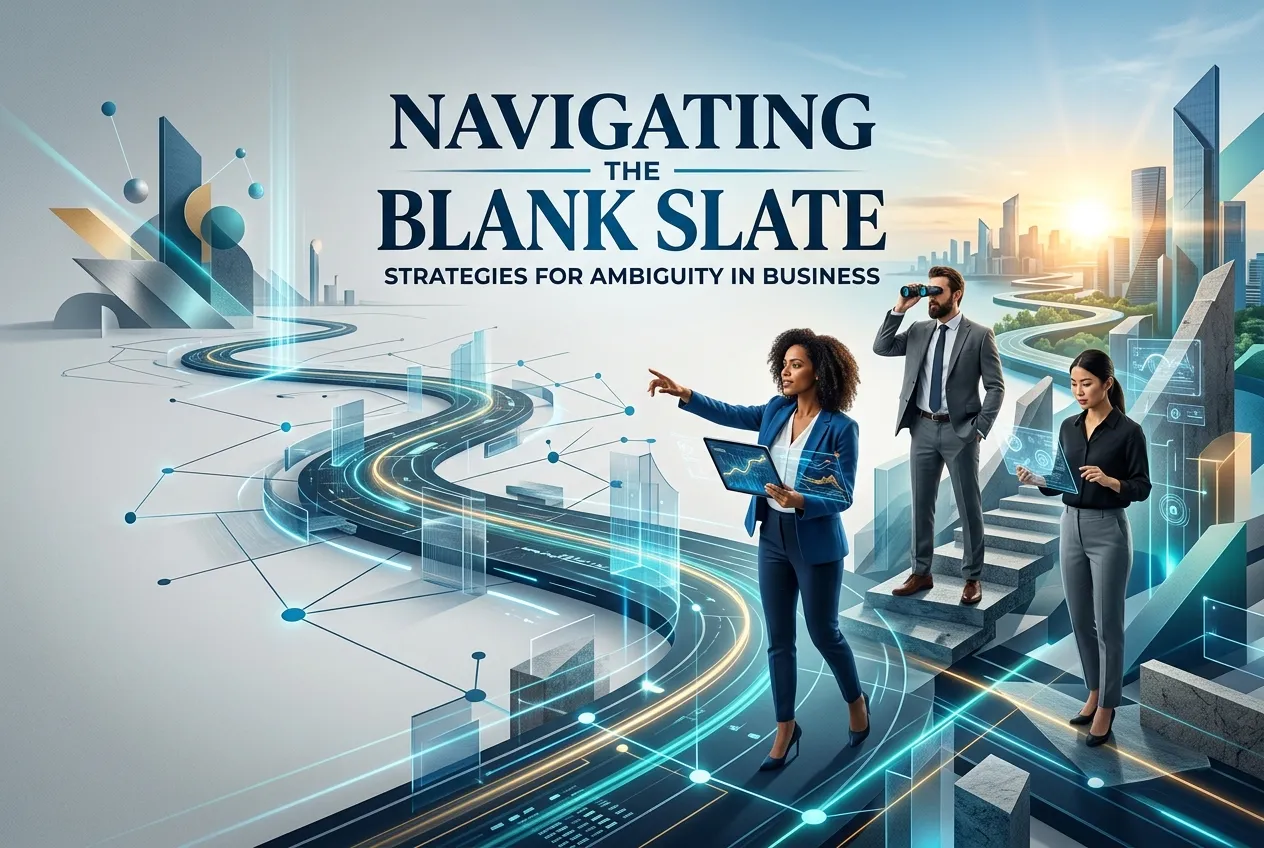
Have you ever stared at a completely blank screen, an empty prompt, or a project brief devoid of any specific direction? The absence of information—the ultimate blank canvas—can be one of the most intimidating challenges a professional or creative can face. When there are no parameters, no predefined angles, and no specific sources to draw from, the sheer volume of infinite possibilities often leads to paralysis. However, this void is also the birthplace of profound innovation. Navigating ambiguity is not just a survival skill; it is a critical competency for anyone looking to forge new paths, solve complex problems, or simply get started when given absolutely nothing to go on.
The Psychology of the Blank Canvas
Why does a lack of direction feel so daunting? Human beings are naturally pattern-seeking creatures. We thrive on context, guidelines, and existing frameworks to help us make sense of our environment and our tasks. When these frameworks are stripped away, we are forced to rely entirely on our internal cognitive resources to generate structure from thin air. This cognitive load can trigger a well-documented phenomenon known as the paradox of choice. When you can do literally anything, choosing the very first thing becomes an agonizing process. The fear of making the wrong choice in a sea of infinite options often results in complete inaction. Furthermore, without a clear target, there is no immediate feedback loop to tell us if we are moving in the right direction. Acknowledging this psychological friction is the crucial first step toward overcoming it. It is entirely normal to feel overwhelmed when the brief is completely empty.
Practical Analysis: Establishing Your Own Constraints
The most effective antidote to the paralysis of infinite choice is the deliberate introduction of artificial constraints. When a project lacks a defined angle or scope, you must become the architect of your own boundaries. Think of constraints not as limitations, but as the necessary scaffolding that allows you to build upward. If a task has no deadline, set a strict one for yourself. If a creative piece has no specified format, arbitrarily choose one and commit to it for the first draft. By artificially narrowing your field of vision, you force your brain to stop evaluating infinite possibilities and start solving a specific, localized problem. This practical approach transforms an abstract void into a concrete puzzle. For instance, if you are asked to write about nothing in particular, deciding to write specifically about the concept of navigating that nothingness immediately gives you a workable framework. Constraints breed creativity because they give your mind a solid surface to push against.
Moving from Zero to One: The Power of Iteration
In the absence of a clear starting point, the goal should never be perfection; the goal must simply be forward momentum. Moving from zero to one is exponentially harder than moving from one to ten. To bridge this gap, professionals must embrace the concept of the throwaway draft or the rapid prototype. Produce something—anything—as quickly as possible, knowing full well that it will likely be flawed, incomplete, or entirely off-base. Once something exists on the canvas, you are no longer dealing with a void; you are dealing with an object that can be critiqued, refined, and molded. Iteration is a much more comfortable process for the human brain than pure creation from nothing. You can look at a flawed idea and say, "This doesn't work because..." which immediately provides the direction and clarity you were initially lacking. Action always precedes clarity, not the other way around.
The Implications of Mastering Ambiguity
The ability to thrive in undefined spaces carries profound implications for long-term success. In today's rapidly shifting landscape, the most valuable professionals are not necessarily those who can perfectly execute a highly detailed set of instructions; rather, they are the individuals who can step into a chaotic, undefined situation and generate their own clarity. Mastering ambiguity builds profound resilience. It teaches you to trust your own judgment and adaptability rather than relying on external validation or perfect conditions. Organizations increasingly rely on these types of proactive thinkers to navigate unprecedented challenges where historical data or established playbooks simply do not exist. By learning to love the blank canvas, you position yourself as a leader who can guide others through the fog of uncertainty.
Key Takeaways
When confronted with an empty brief or a total lack of direction, remember these core principles to get moving. First, recognize that feeling overwhelmed by infinite possibilities is a natural psychological response, not a personal failing. Second, immediately impose artificial constraints on your work to narrow your focus and reduce decision fatigue. Third, prioritize momentum over perfection by generating a rapid, imperfect first draft to transition from creation to iteration. Finally, view ambiguity not as a barrier, but as a unique opportunity to define the rules of engagement and showcase your capacity for independent leadership.


Comments
No comments yet — be the first to share your thoughts.
Join the discussion