A New Frontier in Pharmaceuticals
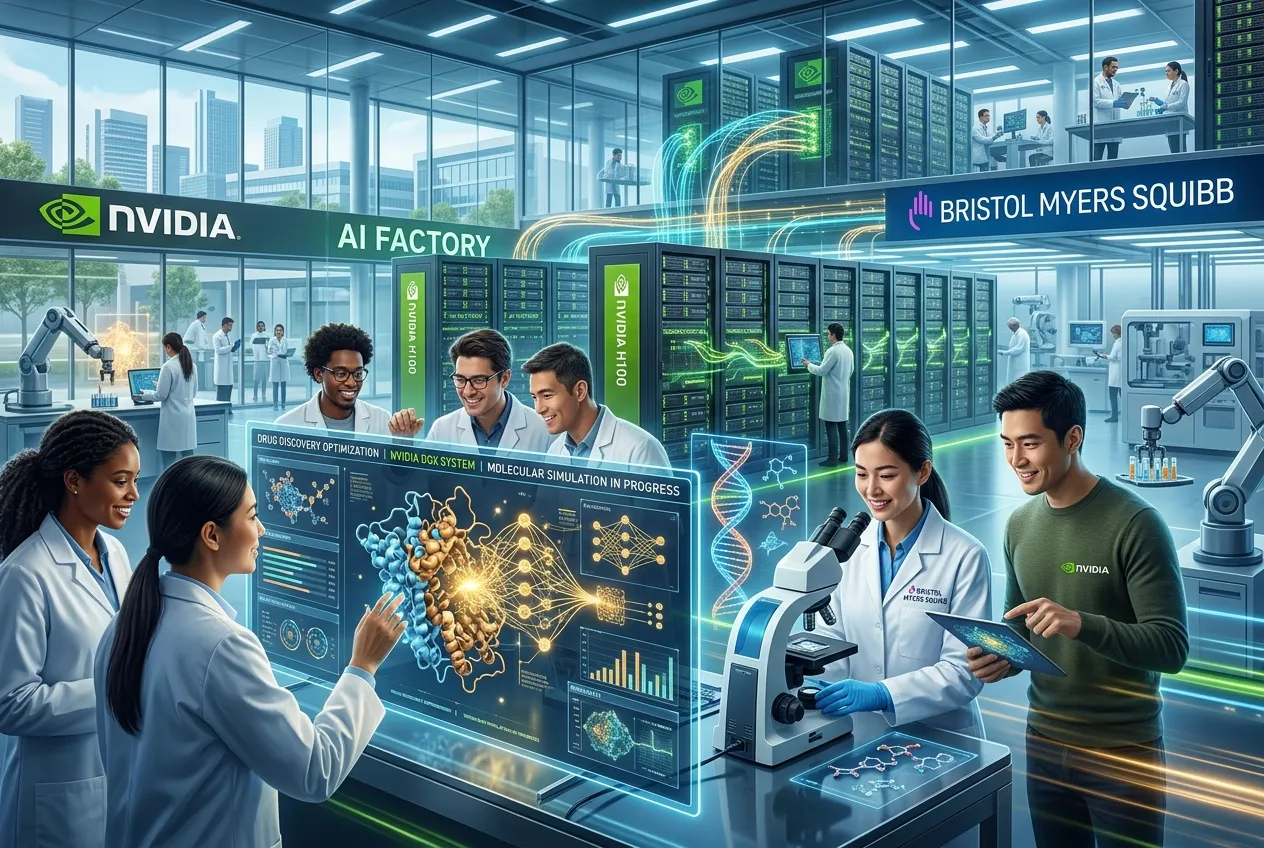
In a landmark move signaling a new era for medical research, pharmaceutical giant Bristol Myers Squibb has announced a major collaboration with AI and computing leader NVIDIA. The partnership aims to build one of the most powerful supercomputing systems in the life sciences industry, a dedicated "AI factory" designed to dramatically accelerate the complex and costly process of drug discovery and development.
This initiative represents a significant strategic investment by Bristol Myers Squibb, placing generative AI at the very core of its research and development pipeline. The goal is to move beyond traditional, often slow, and iterative research methods. By creating a centralized, high-performance computing platform, the company is equipping its scientists with unprecedented computational power to tackle some of the most challenging diseases.
The concept of an "AI factory" is pivotal. It's not just about buying powerful computers; it's about creating an integrated ecosystem where massive biological datasets can be processed, and sophisticated generative AI models can be trained, refined, and deployed at scale. This factory will serve as the engine for designing novel therapies, understanding disease mechanisms with greater precision, and ultimately, shortening the timeline from laboratory concept to patient treatment.
The Engine Room: NVIDIA's Supercomputing Power
At the heart of this collaboration is NVIDIA's state-of-the-art technology. Bristol Myers Squibb is adopting the NVIDIA DGX SuperPOD, a turnkey AI data center platform. This powerful system will be housed in a U.S.-based data center and will be built upon a foundation of 82 NVIDIA DGX H100 systems. These are interconnected to function as a single, massive GPU, providing the immense processing capabilities required for large-scale AI model training.
The raw power of this hardware is complemented by NVIDIA's specialized software stack. The collaboration will heavily leverage the NVIDIA BioNeMo platform, a generative AI framework specifically designed for drug discovery. BioNeMo allows researchers to train and customize foundation models using their own proprietary data. This is crucial for developing AI that can understand the unique and complex biological data relevant to Bristol Myers Squibb's therapeutic areas, such as oncology, immunology, and cardiovascular disease.
Essentially, NVIDIA is providing both the brute-force computational engine and the sophisticated software tools needed to direct that power effectively. This combination allows scientists to ask bigger, more complex questions and get answers faster than ever before, transforming the very nature of biological research from a process of physical experimentation to one of digital simulation and design.
From Years to Months: The Promise of Generative AI
The traditional drug discovery process is famously long, expensive, and fraught with failure. It can take over a decade and billions of dollars to bring a new drug to market. A significant portion of this timeline is spent identifying a biological target and then screening millions of chemical compounds to find one that has the desired effect without causing undue harm. It is a process of painstaking trial and error.
Generative AI promises to upend this paradigm. Instead of just screening existing molecules, these advanced models can design entirely new ones from scratch. By learning the fundamental rules of chemistry and biology from vast datasets, the AI can generate novel protein structures and drug candidates that are optimized for a specific target. This 'in silico' design process—meaning it's performed on a computer—can explore a vast chemical space far more efficiently than physical methods.
As Robert Plenge, Senior Vice President at Bristol Myers Squibb, noted, the collaboration aims to "harness the power of generative AI to discover and develop medicines for patients faster and with more precision." The potential impact is staggering: a process that once took years of lab work could potentially be condensed into a matter of months, allowing for the rapid development of more effective and safer therapies.
The Broader Implications for Healthcare
The Bristol Myers Squibb and NVIDIA partnership is more than just a single company's technological upgrade; it's a bellwether for the entire pharmaceutical industry. It demonstrates a clear commitment to an AI-driven future and sets a new standard for computational infrastructure in life sciences. As other major pharmaceutical companies watch, the pressure to adopt similar strategies will undoubtedly mount, leading to an industry-wide acceleration in AI adoption.
For patients, the implications are profoundly hopeful. Faster drug development means quicker access to treatments for debilitating conditions. Furthermore, AI's ability to analyze complex biological data can lead to more personalized medicine, where treatments are tailored to an individual's specific genetic makeup or disease subtype. This represents a shift away from one-size-fits-all medicine toward highly targeted, more effective interventions.
This collaboration is a testament to the convergence of biology and technology. By building this AI factory, Bristol Myers Squibb and NVIDIA are not just creating a powerful research tool; they are laying the groundwork for the future of medicine—a future where artificial intelligence is an indispensable partner in the quest to cure disease and improve human health.