A Half-Trillion-Dollar Bet on Korean AI Infrastructure
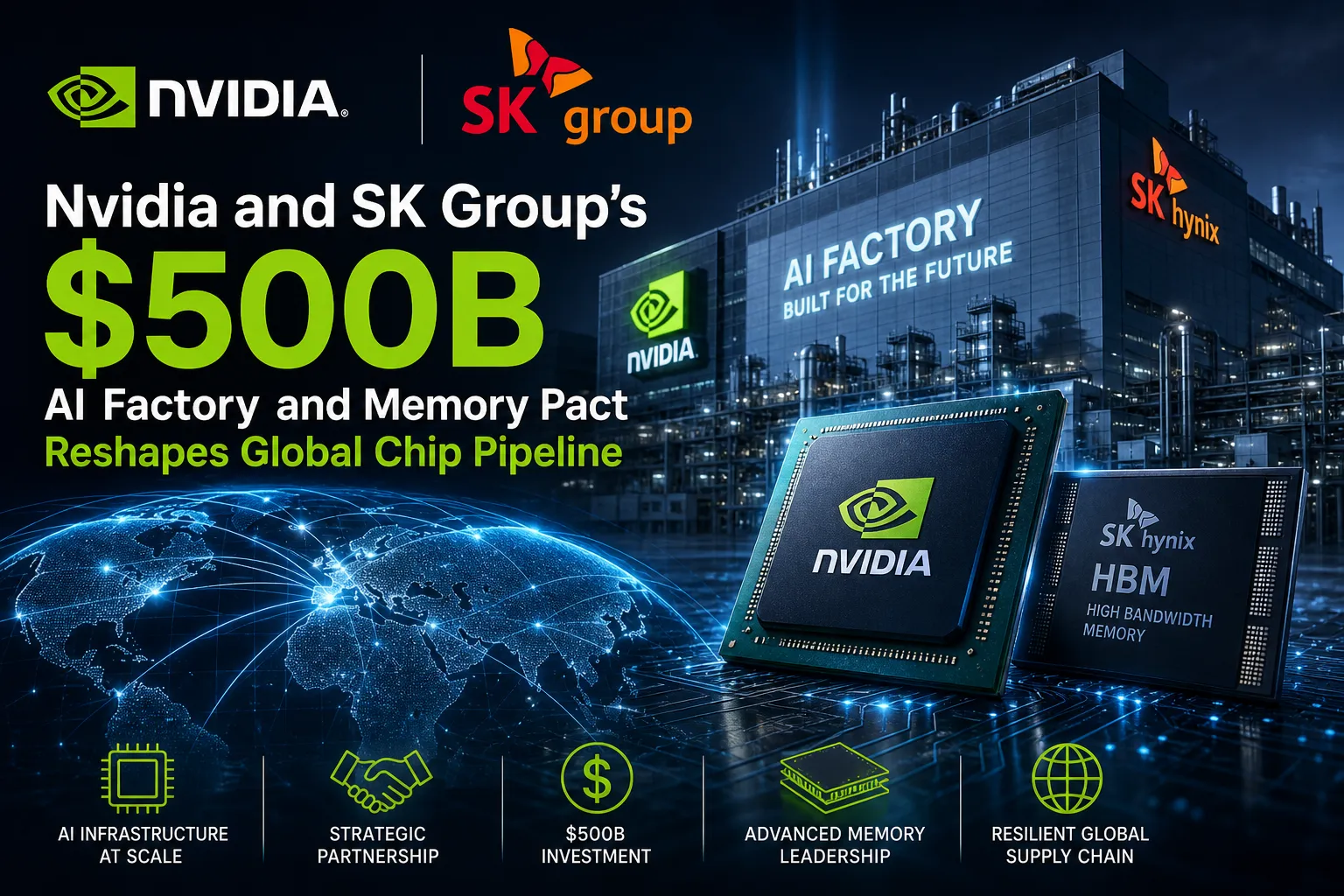
South Korea has emerged as the newest gravitational center of the global AI hardware race. In a sweeping set of announcements, Nvidia and SK Group unveiled a $500 billion-plus AI data-center initiative anchored on Korean soil, while Samsung simultaneously locked in a $200 billion foundry partnership with Broadcom to manufacture custom AI silicon. Taken together with adjacent commitments across the Korean semiconductor cluster, the combined deal flow approaches roughly $950 billion — a figure that would have been unthinkable even 18 months ago.
The scale is not just financial theater. It signals a structural shift in how AI infrastructure is being built, financed, and geographically distributed at a moment when compute and memory supply remain the binding constraints on the entire industry.
Why HBM Is the Real Prize
At the heart of the Nvidia–SK Hynix agreement is high-bandwidth memory, or HBM. These vertically stacked DRAM dies sit next to Nvidia's GPUs and, for large-model training and inference workloads, they are as important as the compute chip itself. SK Hynix has been the dominant HBM supplier to Nvidia through the H100 and Blackwell generations, and the new pact effectively extends that relationship into the next several product cycles.
For Nvidia, the deal removes one of the most persistent risks in its roadmap: HBM shortages that have repeatedly capped how many accelerators it could ship. By pre-committing to enormous volumes, Nvidia converts a scarce spot-market input into a contracted supply line — and, in the process, denies that same capacity to competitors.
Samsung's Broadcom Win Balances the Board
The parallel Samsung–Broadcom arrangement is equally consequential, but plays a different role. Broadcom has become the go-to design partner for hyperscalers building custom AI accelerators — the internal alternatives to Nvidia GPUs used by cloud giants for specific workloads. A $200 billion foundry commitment gives Samsung a durable slice of that custom-silicon boom and reasserts its relevance against TSMC, which has captured the bulk of leading-edge AI chip manufacturing to date.
For Broadcom, guaranteed capacity at a second advanced foundry is a hedge against TSMC bottlenecks. For Samsung, it is a lifeline to fund the capital expenditures required to keep its process nodes competitive at 2nm and below.
Supply Constraints and the Pricing Question
The immediate implication is that HBM and advanced-node foundry capacity will remain tight — and expensive — for years. When the two largest customers in each category sign multi-year, multi-hundred-billion-dollar commitments, smaller buyers move to the back of the queue. Startups building rival accelerators, sovereign AI programs in Europe and the Middle East, and second-tier cloud providers will all face harder allocation conversations.
Pricing power tilts toward the memory and foundry suppliers. SK Hynix and Samsung, long treated as commodity DRAM producers subject to brutal cyclical downturns, are being repositioned as strategic infrastructure providers with contracted revenue visibility. That has profound implications for their margins, their capital planning, and ultimately the cost curve of AI compute itself.
Geopolitical Concentration Intensifies
Perhaps the most striking dimension of the announcements is geographic. A staggering share of the world's most advanced AI hardware capacity is now committed to a handful of facilities in South Korea and Taiwan. The Nvidia–SK data-center build-out adds domestic AI compute capacity to Korea itself, but the manufacturing dependencies still concentrate in the same East Asian corridor that has drawn increasing scrutiny from Washington, Beijing, and Brussels.
That concentration cuts both ways. It gives Seoul significant leverage in trade and export-control discussions. It also raises the stakes of any disruption — regulatory, natural, or geopolitical — in the region. Efforts to diversify fabrication into the United States, Japan, and Europe continue, but the sheer scale of the Korean commitments underscores how far behind those alternatives remain.
What to Watch Next
Three questions will define whether these pacts deliver on their promise. First, can SK Hynix and Samsung actually build the fabs and HBM lines fast enough to meet the contracted volumes? Second, how will hyperscalers not named in these deals — including Google, Amazon, and Meta — respond to being effectively deprioritized on shared supply? And third, will regulators in any major market intervene to prevent what is beginning to look like an unprecedented concentration of AI infrastructure in the hands of a very small number of companies?
The answers will shape not just the next chip cycle, but the competitive landscape of artificial intelligence itself.