Introduction
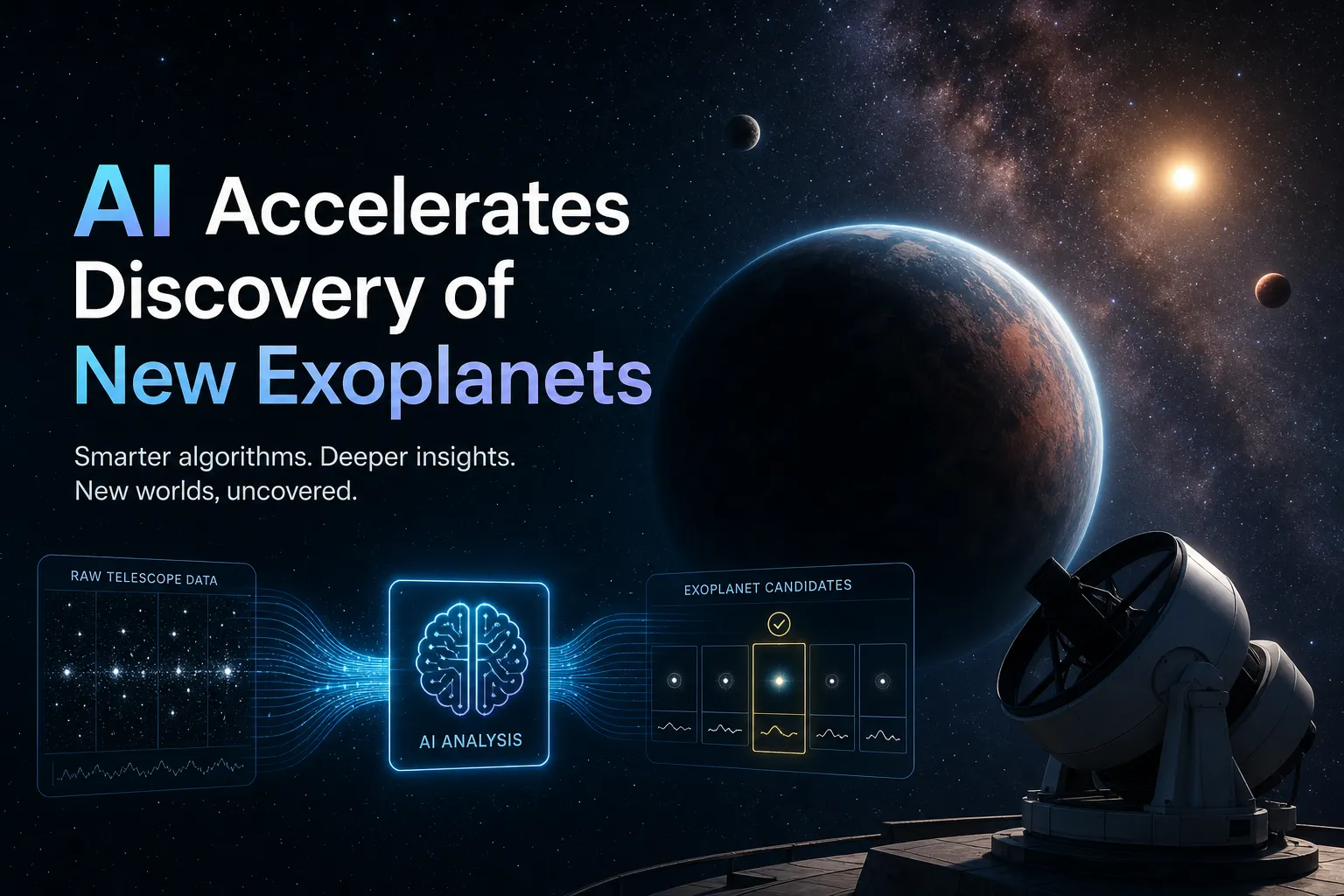
In recent years, artificial intelligence (AI) has become an indispensable tool in astronomical research, notably accelerating the discovery of new exoplanets. By automating the analysis of vast datasets, AI technologies have enabled astronomers to identify potential new worlds beyond our solar system at an unprecedented pace. This advancement is not only reshaping our understanding of the universe but also paving the way for future discoveries.
The Role of AI in Exoplanet Discovery
Traditionally, the search for exoplanets relied heavily on manual data analysis, which was both time-consuming and labor-intensive. However, AI has introduced a new era in this field by processing large volumes of data more efficiently than ever before. Machine learning algorithms, in particular, have proven to be highly effective in identifying patterns and anomalies that may indicate the presence of an exoplanet.
One of the primary methods used to detect exoplanets involves analyzing light curves from stars. When a planet passes in front of a star, it causes a temporary dimming of the star's light. AI technologies can rapidly sift through these light curves, identifying the subtle changes that might suggest an exoplanet's presence.
Super-Speed AI Technologies
The implementation of super-speed AI technologies has been a game-changer. These advanced systems can analyze data from telescopes and space missions like NASA's Kepler and TESS (Transiting Exoplanet Survey Satellite) with remarkable speed and accuracy. By automating these processes, AI reduces the likelihood of human error and increases the efficiency of exoplanet discovery.
Moreover, AI can continue learning and improving over time. As it processes more data, it becomes better at distinguishing between genuine exoplanet signals and other astronomical phenomena, further enhancing its effectiveness.
Implications for Astronomical Research
The implications of AI-driven exoplanet discovery extend far beyond merely identifying new planets. By accelerating the rate of discovery, AI provides astronomers with a wealth of data to analyze, offering new insights into planetary systems' formation and evolution.
Furthermore, the rapid identification of exoplanets with conditions similar to Earth's—such as those within the habitable zone—could have profound implications for the search for extraterrestrial life. AI's ability to quickly identify these planets allows researchers to focus their efforts on studying the most promising candidates.
Challenges and Future Prospects
Despite its advantages, the use of AI in astronomy is not without challenges. Data quality and the need for continuous algorithm refinement are significant concerns. As AI technologies become more integral to astronomical research, ensuring the reliability and accuracy of data interpretation remains critical.
Looking ahead, the integration of AI with other emerging technologies, such as quantum computing, could further revolutionize the field. By combining the strengths of these technologies, astronomers may unlock new levels of understanding about our universe.
Conclusion
AI has undeniably transformed the field of astronomical research, particularly in the discovery of new exoplanets. By automating data analysis and accelerating the identification process, AI technologies are enabling astronomers to explore the universe more thoroughly and efficiently than ever before. As AI continues to evolve, its role in expanding our cosmic knowledge is expected to grow, opening new frontiers in the quest to understand our place in the universe.