A New Round of Cuts, a Familiar Justification
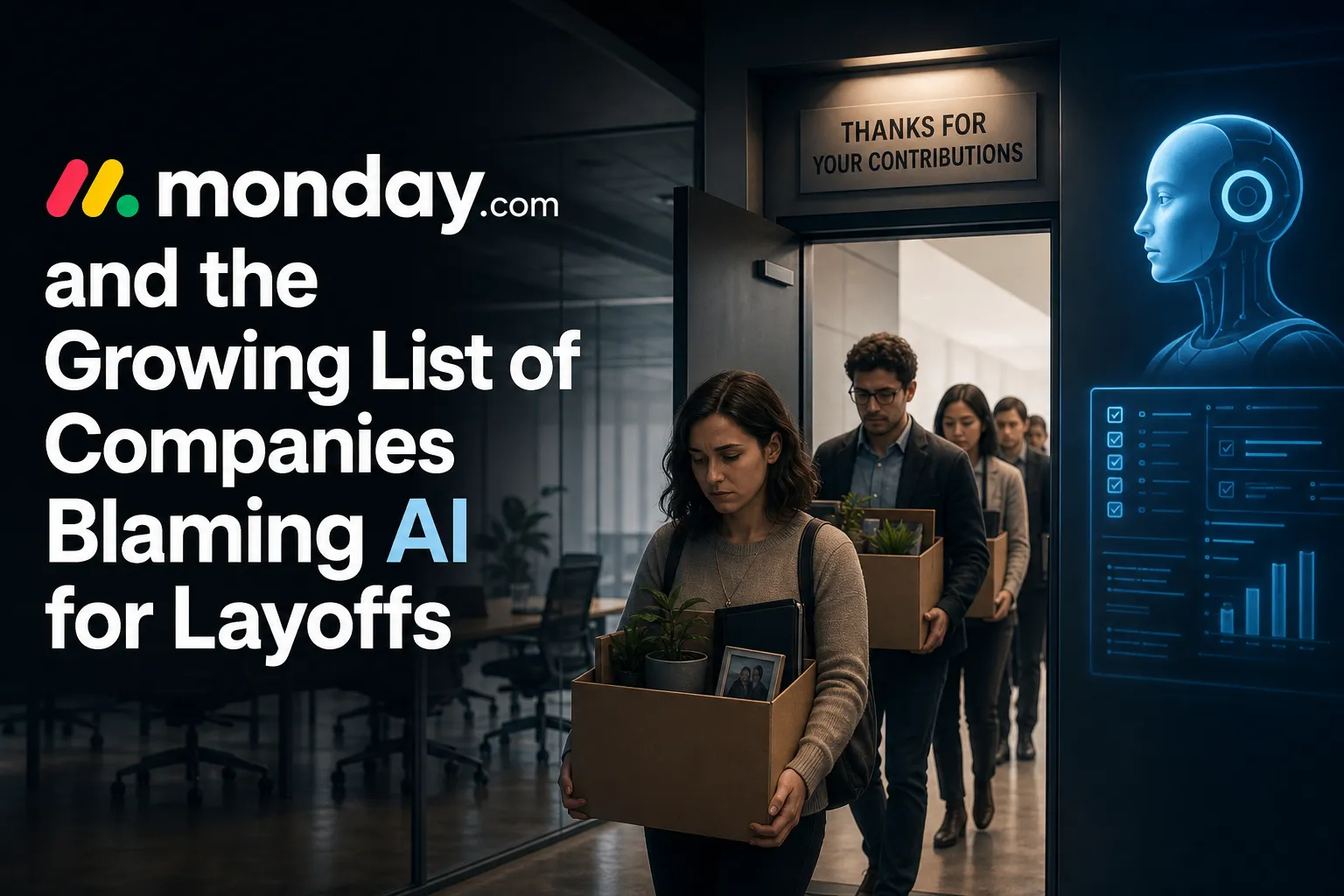
Monday.com has become the latest tech company to trim its workforce and point to artificial intelligence as a driving force behind the decision. The work-management software firm is cutting roughly 620 employees — about 20% of its staff — joining a rapidly expanding roster of companies attributing layoffs to AI adoption.
According to a TechCrunch roundup, more than 20 other firms have publicly cited AI as a factor in recent job reductions. What was once a fringe explanation is now a standard line in layoff memos, investor calls, and press statements across the tech sector.
The Executive Class Is Already 'Prepared'
The trend appears to have deep buy-in at the top. A Mashable-reported survey claims that 99% of executives say they are "prepared" for AI-driven layoffs within the next two years. Whether that preparedness reflects strategic vision or reputational cover, the number is striking: it suggests virtually no leadership class in surveyed companies is planning to resist restructuring around AI.
That statistic reframes what employees are seeing on the ground. If nearly every executive has already normalized the idea of AI-linked headcount reductions, the question is no longer whether cuts will come, but how they will be described when they do.
Is AI Really the Cause — Or a Convenient Scapegoat?
The narrative deserves scrutiny. The software sector has been contracting for more than two years, weighed down by post-pandemic overhiring, higher interest rates, slowing enterprise IT budgets, and cooling growth in cloud and SaaS categories. Many of the companies now citing AI were already under pressure to demonstrate margin discipline to public markets.
Blaming AI is, in many ways, a strategically clean explanation. It frames cuts as forward-looking rather than reactive. It positions the company as an early adopter rather than a struggling operator. And it deflects blame from earlier management decisions — such as aggressive hiring during the 2021–2022 boom — that may bear more direct responsibility for today's overcapacity.
The Counter-Narrative: The 'Apocalypse' May Not Arrive
Not everyone accepts the framing. The Guardian has argued that the "AI jobs apocalypse probably isn't coming," pointing out that sweeping predictions of mass technological unemployment have a poor historical track record. Automation has consistently reshaped labor markets rather than emptied them, and the productivity gains attributed to today's AI tools remain unevenly demonstrated across industries.
A Washington Post opinion piece has taken a related angle, suggesting that AI is currently creating bosses rather than replacing workers. In this reading, generative AI tools amplify the leverage of managers and senior individual contributors — letting them oversee more output — while the humans doing the underlying work remain necessary, at least for now.
What Actually Changes on the Ground
Both views can be true at once. AI may not eliminate jobs wholesale, but it can still be used as a rationale for cutting them. Roles built around repetitive documentation, first-line customer support, basic code scaffolding, and routine content production are the most obvious pressure points. Companies do not need AI to fully replace those functions to justify smaller teams; they only need it to make smaller teams plausible to shareholders.
For workers, that means the practical impact is arriving well ahead of any true technological displacement. Layoffs happen now; the productivity payoff is promised later.
Reskilling Becomes the Only Stable Bet
The implications for the workforce are significant. If executives are near-unanimous in their willingness to restructure around AI, employees cannot rely on categorical safety in any particular role. Reskilling — toward AI literacy, oversight of AI systems, higher-judgment work, and cross-functional problem solving — becomes less a career enhancement than a baseline requirement.
Employers, meanwhile, face their own reckoning. Companies that use AI as cover for poorly planned expansion risk hollowing out institutional knowledge they will later need. And those that genuinely restructure around AI will have to prove, eventually, that the productivity gains match the human cost.
The Bottom Line
Monday.com's 620 job cuts land in a moment when "AI made us do it" has become the industry's default explanation. Some of that is real. Much of it is narrative. The distinction matters — for the workers being let go, for the investors funding the transition, and for the broader labor market trying to figure out where AI ends and old-fashioned corporate contraction begins.