Subtitle: Turning alarming headlines into a practical risk-and-controls checklist for labs, gene-synthesis providers, and policymakers.
Estimated reading time: 5 minutes
Recent headlines about AI-designed synthetic viruses have landed with a familiar thud: a fast-moving capability meets slow-moving governance. But the most useful response isn’t panic or blanket bans—it’s a clear-eyed inventory of where risk actually enters the pipeline, what today’s safeguards can and can’t do, and what a modern “biosecurity playbook” should require from the organizations closest to the work.
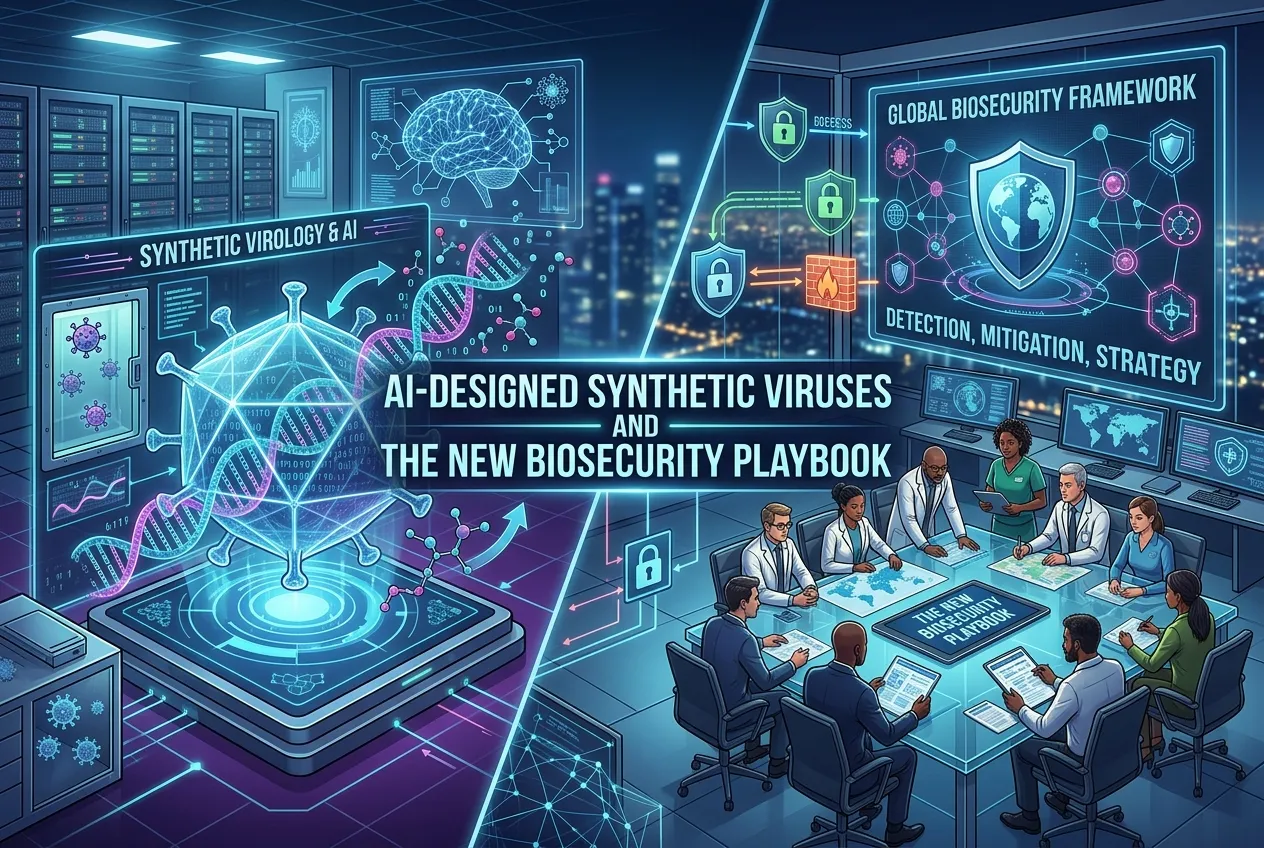
This article translates the core concerns raised in coverage circulating via Google News into a practical checklist oriented around three stakeholders: (1) labs that may design, order, assemble, or characterize viral sequences; (2) gene-synthesis providers and platforms that fulfill DNA/RNA orders; and (3) policymakers who set the rules of the road.
Source: Google News RSS link
Why AI-designed viral genomes are different from prior biotech risk
Traditional biosecurity risk in virology has often been constrained by a mix of domain expertise, lab resources, and time. AI shifts those constraints. The key difference isn’t that “AI automatically makes a dangerous virus,” but that AI can reduce friction in the design phase—generating, iterating, and optimizing sequences (or proposing candidates) much faster than manual approaches.
That matters because biosecurity risk is frequently about search and iteration. If a tool can explore a wider design space—trying more variants, learning from failures, and quickly proposing alternatives—then the practical barrier to producing “close-enough” candidates for synthesis can drop, even if each candidate still requires real-world validation and biosafety controls.
AI also changes the “shape” of the risk. Instead of relying on well-known, well-annotated pathogen genomes, a malicious or reckless actor could attempt to generate sequences that are:
- Novel or heavily modified, reducing direct matches to known databases.
- Obfuscated (e.g., fragmented or re-encoded) to evade naive screening.
- Optimized for a goal (in theory), such as altered host range, immune evasion, or replication efficiency—while still being a hypothesis until proven in the lab.
In short: AI is best understood as an accelerator of upstream design work, which can increase downstream pressure on synthesis screening, lab governance, and publication norms.
The dual-use pathways: design → synthesis → assembly
Dual-use risk emerges when legitimate workflows overlap with misuse pathways. A practical playbook treats the pipeline as a chain of “decision points” where controls can be applied.
1) Design (software layer): sequence generation, protein design, directed evolution planning, codon optimization, or in-silico validation. Controls here are mostly digital: who can use what tools, with what logging and oversight.
2) Synthesis (provider layer): ordering gene fragments, oligos, or full constructs from commercial suppliers—or producing them via in-house capabilities. Controls here include sequence screening and customer verification.
3) Assembly & rescue (wet-lab layer): assembling fragments into genomes, cloning, transfection, and attempts to recover infectious material. Controls here are classic biosafety and biosecurity: facility requirements, personnel reliability, inventory management, and supervisory review.
The uncomfortable truth is that no single control is sufficient. The playbook has to assume partial visibility at each stage, and still reduce risk through layered defenses.
What current screening does—and doesn’t—catch
Many gene-synthesis providers screen orders to detect sequences associated with regulated pathogens or other sequences of concern. In the best case, screening can flag direct matches and obvious derivatives.
But screening can struggle when:
- Sequences are novel and don’t closely match known references.
- Orders are fragmented across multiple purchases, vendors, or time periods.
- Short oligo orders are placed where context is limited.
- Benign-looking components become risky only when assembled together.
- Customer intent is unclear and business verification is weak or inconsistent.
Even strong screening at major providers leaves gaps if orders move to less rigorous suppliers, if synthesis is performed in-house, or if the “risky” feature is not a straightforward sequence match. That’s why governance needs to address both capability (what can be done) and process (who is allowed to do it, under what review, and with what audit trail).
A practical controls checklist for labs
Labs sit at the point where digital design becomes physical reality. A workable playbook focuses on permissioning, documentation, and “stop points” before synthesis and assembly.
- Establish an AI-use policy for sequence design: approved tools, prohibited goals, and required supervisory review for sensitive classes of work.
- Access controls: limit who can run design workflows; use role-based access, MFA, and least-privilege permissions for sequence repositories.
- Design review gates before ordering: require a second-person review for any viral genome work, chimeras, or functional modifications that could change tropism or virulence.
- Procurement discipline: centralize synthesis ordering (no ad-hoc personal purchasing) and require justification tied to an approved protocol.
- Auditability by default: log prompt-to-sequence workflows (where feasible), maintain versioned sequence records, and document rationale for major design changes.
- Red-team exercises: periodically test whether internal processes would catch problematic requests (e.g., fragmented ordering attempts, obfuscated sequences, “innocent” framing).
- Inventory & chain-of-custody: track physical materials from receipt to disposal; reconcile discrepancies; enforce secure storage for sensitive constructs.
- Training that matches the threat model: include dual-use awareness in onboarding and refreshers, with concrete examples tied to local workflows.
Controls checklist for gene-synthesis providers and platforms
Providers are a critical choke point—but only if screening is consistent, modern, and paired with customer controls. Practical improvements include:
- Sequence screening that goes beyond exact matches: use methods that can detect similarity, functional motifs, and risky combinations—not just “known bad” lists.
- Order aggregation and anomaly detection: flag suspicious fragmentation patterns (many small orders that assemble into something sensitive).
- Customer verification and use-case validation: stronger KYC-like checks for institutional affiliation, facility type, and responsible party.
- Tiered friction: low-risk sequences flow fast; higher-risk categories require manual review, documentation, and potentially refusal.
- Audit logs and retention: maintain records sufficient for after-the-fact investigation (with privacy safeguards), including screening outcomes and escalation decisions.
- Clear escalation pathways: defined criteria for when to pause fulfillment, request more information, or consult regulators.
Policy ideas: governance that scales with capability
Policy has to balance innovation with safety. Overly vague rules can be ignored; overly rigid rules can push work into less visible channels. Practical policy directions include:
- Baseline standards for sequence screening across providers (including minimum practices and auditing), reducing “race to the bottom” incentives.
- Access controls for high-risk capabilities: where appropriate, treat certain design models/workflows as controlled tools with usage logging and vetting.
- Third-party assessments (including red-teaming) for organizations operating at higher risk tiers.
- Publication norms: encourage staged disclosure, careful handling of enabling details, and clear risk statements for methods that materially lower barriers.
- Safe harbors for responsible reporting: protect providers and labs that flag suspicious requests and share limited, privacy-respecting indicators.
The bottom line: shift from “can we?” to “under what controls?”
AI doesn’t eliminate the need for wet-lab expertise, but it can accelerate the front end of the pipeline and complicate detection based on simple sequence matching. The biosecurity playbook that fits this moment is layered: robust screening, strong access controls, end-to-end auditability, regular red-teaming, and publication practices that recognize dual-use realities.
For labs, the next step is procedural: implement review gates and logging before orders go out. For providers, it’s operational: strengthen screening plus customer verification and anomaly detection. For policymakers, it’s structural: set consistent standards and oversight that scale with capability—without driving the work into the dark.