The New Frontier in AI: Beyond Raw Power
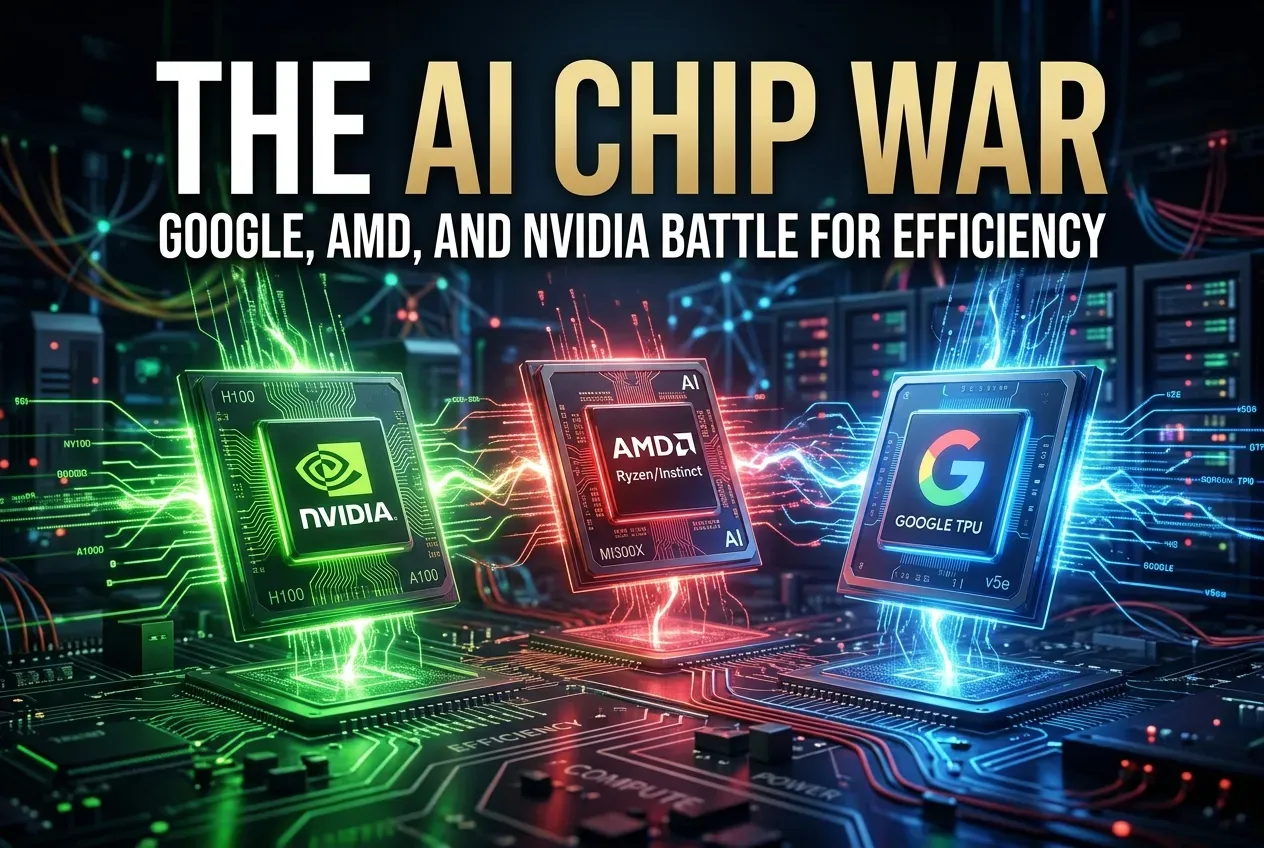
The artificial intelligence revolution has been fueled by a relentless pursuit of computational power. For years, the narrative was simple: bigger models and faster chips meant smarter AI. But as AI models become woven into the fabric of everyday technology, a new, more critical battleground is emerging. The war for AI supremacy is no longer just about who has the most powerful processor, but who can run it most efficiently. This shift is forcing tech giants like Google, AMD, and the reigning champion, NVIDIA, to innovate on fronts that directly impact data center economics, energy consumption, and the long-term sustainability of AI itself.
Google's 'Frozen' Initiative: In-House Efficiency at Scale
Google has long understood the value of custom silicon, developing its own Tensor Processing Units (TPUs) to power its vast AI workloads. Now, the company is doubling down on this strategy with a new, more efficient chip codenamed 'Frozen'. This next-generation hardware is specifically engineered to run Google's family of Gemini AI models with maximum efficiency. The focus isn't on topping benchmark charts for raw performance, but on minimizing the two things that plague large-scale AI deployment: cost and power consumption.
While training a massive model like Gemini is an incredibly expensive, one-time-per-version event, the real long-term cost comes from inference—the process of actually running the model to generate answers, translate text, or create images for billions of users. Every single Google search, every interaction with its AI assistants, and every API call from a Google Cloud customer adds to a colossal and continuous operational expense. By designing the 'Frozen' chip to perform these inference tasks using less energy, Google can significantly reduce its data center operating costs. This vertical integration provides a powerful competitive advantage, allowing the company to control its hardware and software stack to achieve an optimal balance of performance and efficiency that off-the-shelf components might not offer.
AMD and Microsoft's Alliance: Diversifying the AI Cloud
Meanwhile, the cloud computing arena is witnessing its own strategic power plays. Microsoft, a key player in the AI cloud space with its Azure platform, recently announced a significant expansion of its AI infrastructure by purchasing AMD's new Helios AI system. This move is a clear signal that the market is actively seeking powerful alternatives to NVIDIA's dominant hardware.
The Helios system, powered by AMD's advanced Instinct accelerators, is designed for the rigorous demands of large-scale AI training and inference. For Microsoft, this partnership is about more than just adding capacity; it's a crucial step in diversifying its supply chain. An over-reliance on a single supplier, even one as successful as NVIDIA, creates risks in pricing, availability, and negotiation leverage. By integrating AMD's competitive hardware into Azure, Microsoft not only mitigates these risks but also fosters a more competitive marketplace. This competition can lead to better pricing and more options for its own cloud customers, who will benefit from a broader ecosystem of high-performance AI hardware.
NVIDIA's Reign and the Shifting Battlefield
NVIDIA is, without question, the current king of the AI hardware hill. Its GPUs, underpinned by the mature and widely adopted CUDA software platform, have become the industry standard. However, the company is not immune to the changing tides. The immense success of its chips has created unprecedented demand, but it has also highlighted the market's hunger for alternatives and its growing sensitivity to cost and power draw.
The moves by Google and Microsoft/AMD show that the competition is heating up on multiple fronts. Google is attacking from the inside with custom-built, vertically integrated solutions, while AMD is challenging NVIDIA directly in the open market for enterprise and cloud deployments. NVIDIA continues to innovate at a blistering pace with its own new architectures, which also promise significant gains in performance-per-watt. The challenge for NVIDIA is to not only maintain its performance lead but also to defend its ecosystem against competitors who are now aggressively competing on the critical metrics of efficiency and total cost of ownership.
The Economics of Efficiency: The Future of AI Development
This escalating chip war has profound implications for the future of AI. As efficiency improves, the cost to run sophisticated AI models decreases. This could democratize access to powerful AI, allowing smaller companies and startups to build innovative applications that are currently only feasible for tech giants. Furthermore, the focus on power consumption addresses one of the most significant criticisms of the AI boom: its environmental impact. Data centers are voracious consumers of electricity, and building more efficient chips is a critical step toward creating a more sustainable AI infrastructure.
Ultimately, the battle between Google, AMD, and NVIDIA is evolving from a simple sprint for speed into a complex, multi-dimensional marathon. The winners will be those who can deliver not just groundbreaking performance, but a sustainable, scalable, and economically viable platform for the next generation of artificial intelligence.