IBM’s modular cryogenics milestone: what linking two quantum “fridges” really unlocks
IBM linked two cryogenic modules into a coordinated system—a modest-sounding step with outsized impact. Here’s why modular cryogenics is pivotal for scaling toward fault-tolerant quantum computing, and what to watch next.
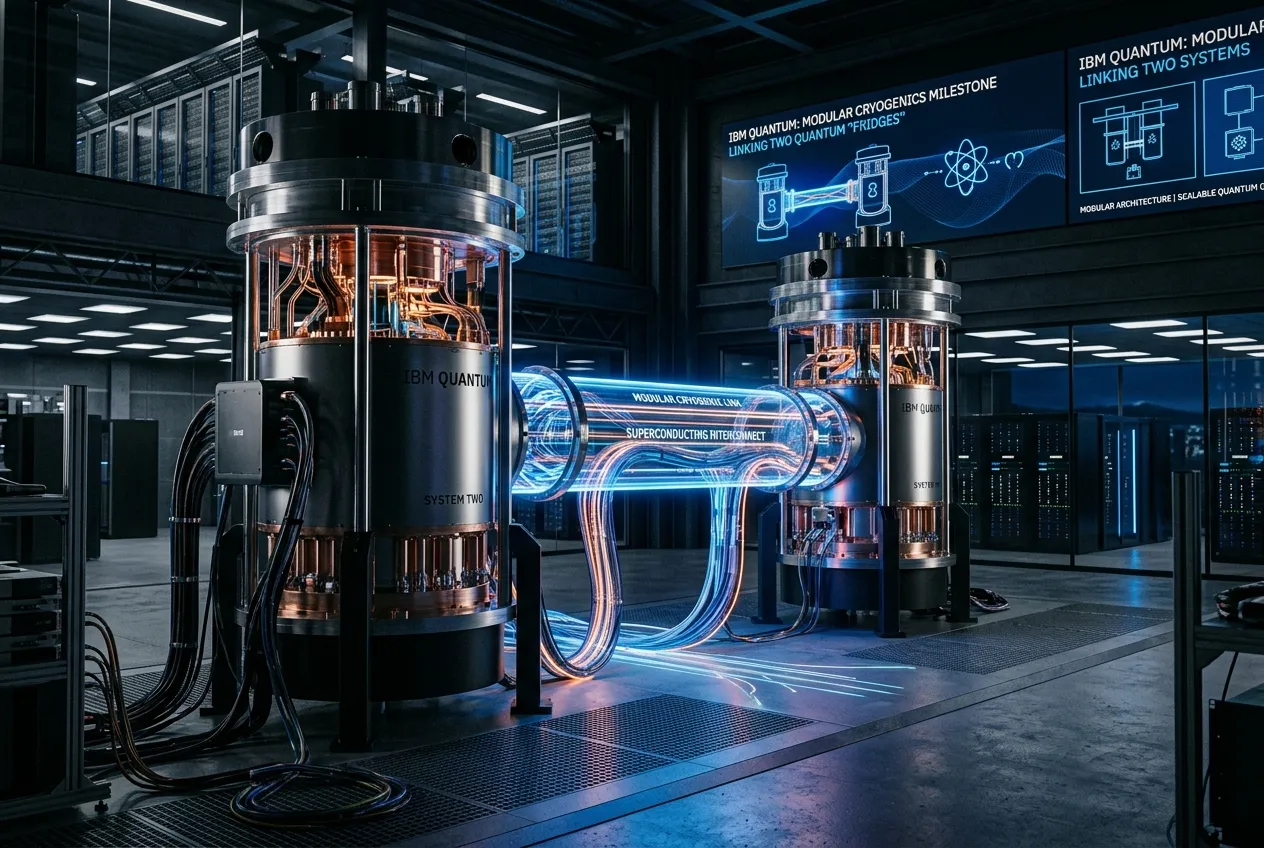
Engineer’s-eye explainer: why modular cryogenic systems matter for scaling toward fault-tolerant quantum computing—and what IBM’s two-fridge link actually enables next.
What IBM demonstrated—at a glance
IBM has announced that it connected two cryogenic modules—often nicknamed “fridges” in quantum labs—into a coordinated system. The company frames this as a milestone on the path to larger, more serviceable quantum machines. While the public announcement is high level, the essence is clear: two independent dilution-refrigerator stacks were integrated so they can operate as a managed whole rather than as entirely standalone units.
At a practical level, “linking” can include synchronized cooldown and operation, coordinated control and readout pathways, and mechanical and thermal provisions that anticipate cross-module quantum interconnects in the future. This step doesn’t make error-corrected, fault-tolerant quantum computing appear overnight, but it does begin addressing some of the least glamorous—and most consequential—engineering bottlenecks in scaling.
Source: Google News.
Why modular cryogenics matters
Today’s superconducting quantum processors live at millikelvin temperatures inside dilution refrigerators. As qubit counts rise, laboratories hit three interlocking constraints:
- Space: One cryostat offers finite physical volume and limited mechanical real estate for devices, filters, attenuators, and shielding. Scaling-up needs more cold real estate without rebuilding a monolith for every generation.
- Wiring: Control and readout lines multiply with qubits. Each coax adds heat load, assembly complexity, and failure points. Distributing I/O across modules helps keep heat budgets and cable management tractable.
- Serviceability: A single monolithic system can force whole-machine downtime for maintenance. Modularity enables partial service—warm one module, keep the rest running—improving overall availability.
Linking two cryogenic modules is a concrete move toward a data-center-like topology for quantum hardware: multiple cold nodes that can be operated, maintained, and (eventually) networked under one control plane.
What the two-fridge link actually unlocks
1) Headroom for qubit density. Even before perfect cross-module quantum links exist, modular cryogenics provides more mechanical volume and thermal budget to host chips, packaging, filtering, and microwave plumbing. That extra headroom eases layout pressure and reduces interference risks that come from cramming everything into a single can.
2) Better uptime and staged maintenance. If modules can be isolated, operators can rotate maintenance windows, swap components, or address a flaky cable tree in one unit without cold-stopping the entire fleet. Think hot-aisle/cold-aisle logic translated to milliKelvin infrastructures.
3) Pathways to networked quantum subsystems. A multi-module cryo environment is the natural staging ground for interconnect R&D—be it microwave buses, optical transduction, or chip-to-chip couplers. Even when initial links are classical (timing, synchronization, calibration), the physical cohabitation simplifies future quantum-grade plumbing.
What remains hard
Cross-module qubit coupling. High-fidelity entanglement across modules is the headline challenge. Whether via coaxial couplers, waveguides, or photonic transduction, links must preserve coherence and deliver gate fidelities competitive with on-chip neighbors. The longer and more complex the path, the tougher the job (loss, mode structure, reflections, vibrational sensitivity, and latency all creep in).
Error-correction overhead. Modularity helps you house more qubits and keep them running, but it doesn’t shrink the number of physical qubits per logical qubit or reduce decoding complexity by itself. Codes still demand stringent calibration uniformity, synchronized timing, and cross-talk control—now across module boundaries. Coordination between modules becomes part of the error budget.
Control electronics and cryo-CMOS integration. Pushing control closer to the qubits (e.g., at 4 K and above) reduces line count and latency but introduces nontrivial thermal engineering. Cryo-CMOS has to meet noise, drift, and reliability specs while sipping power so the cold stages stay cold. Packaging density, thermal anchoring, and electromagnetic hygiene are all more delicate in modular layouts with more boundaries and harnesses.
Implications for operations
Qubit density: More cold volume and distributed I/O let architects consider larger tiles, multi-chip modules, and shielded subassemblies without hitting immediate space ceilings. That, in turn, can improve floorplanning for error-correction blocks.
Uptime: A modular fleet can be orchestrated like a cluster: take one node down, keep others serving jobs. Queueing and scheduling software can target healthy modules while diagnostics run on the out-of-service unit. The operational experience starts to resemble classical HPC maintenance cycles rather than bespoke lab downtime.
Maintenance: Repeatable module build-outs encourage standardized harnesses, fixtures, and procedures. Over time, this supports inventorying spares, faster mean time to repair, and richer telemetry—each module becomes a productized subunit with its own health metrics and lifecycle.
Milestones to watch next on the 2029 horizon
Assuming a roadmap that targets fault tolerance late this decade, here are pragmatic waypoints that would signal real progress beyond a first two-fridge link:
- Demonstrated high-fidelity cross-module entanglement: Not just a lab curiosity, but repeatable, benchmarked gates with error rates compatible with leading on-chip operations.
- Coordinated calibration across modules: Automated routines that treat multiple fridges as a single calibratable system with stable cross-module phase/timing references.
- Cryo-CMOS control qualified in production: Validated controllers or multiplexers at cold stages that materially reduce room-temperature cabling without degrading qubit performance.
- Service-in-place workflows: Documented procedures for warming one module, swapping a harness or filter bank, and returning to operation while neighboring modules continue serving workloads.
- Logical-qubit demonstrations spanning modules: Error-corrected operations where data or ancilla resources are distributed, proving that modular boundaries do not break the code’s assumptions.
How to read this milestone
This is an infrastructure win. It signals a shift from one-off heroic refrigerators toward a modular, repeatable, maintainable platform. It does not, by itself, solve the algorithmic or physical-qubit fidelity gaps to reach fault tolerance. But system engineering wins compound: cleaner wiring, better thermal budgets, and higher uptime make it easier to chase the hard physics at scale.
IBM’s two-fridge link is thus best understood as a foundation: a way to keep scaling without painting the team into a thermal, spatial, or serviceability corner. The sooner quantum platforms adopt data-center-grade modular thinking, the more plausible it becomes to integrate the messy realities of control electronics, error correction, and maintenance into a single, operable machine.
Disclosure: This article is an engineering explainer based on the public announcement linked above; it does not rely on unpublished technical details.
Source: Google News