Webb Catches Mars-Sized Worlds Colliding Around Young Stars
The glassy dust around young stars reveals how violently newborn planets crash together

Somewhere out there, around a star still in its cosmic infancy, two worlds the size of Mars have just slammed into each other. The impact is so violent that solid rock turns to vapor, then cools into a glittering haze of glassy dust. Billions of years ago, something very much like this happened in our own neighborhood, and it gave us the Moon.
Now NASA's James Webb Space Telescope is catching the aftermath of these planet collisions around other young stars. In a study published October 1, 2026 in The Astrophysical Journal, astronomers used Webb's infrared vision to read the chemical "fingerprints" in the debris, and found that the dust itself can tell us how hard the worlds hit each other.
What Webb found: two kinds of cosmic wreckage
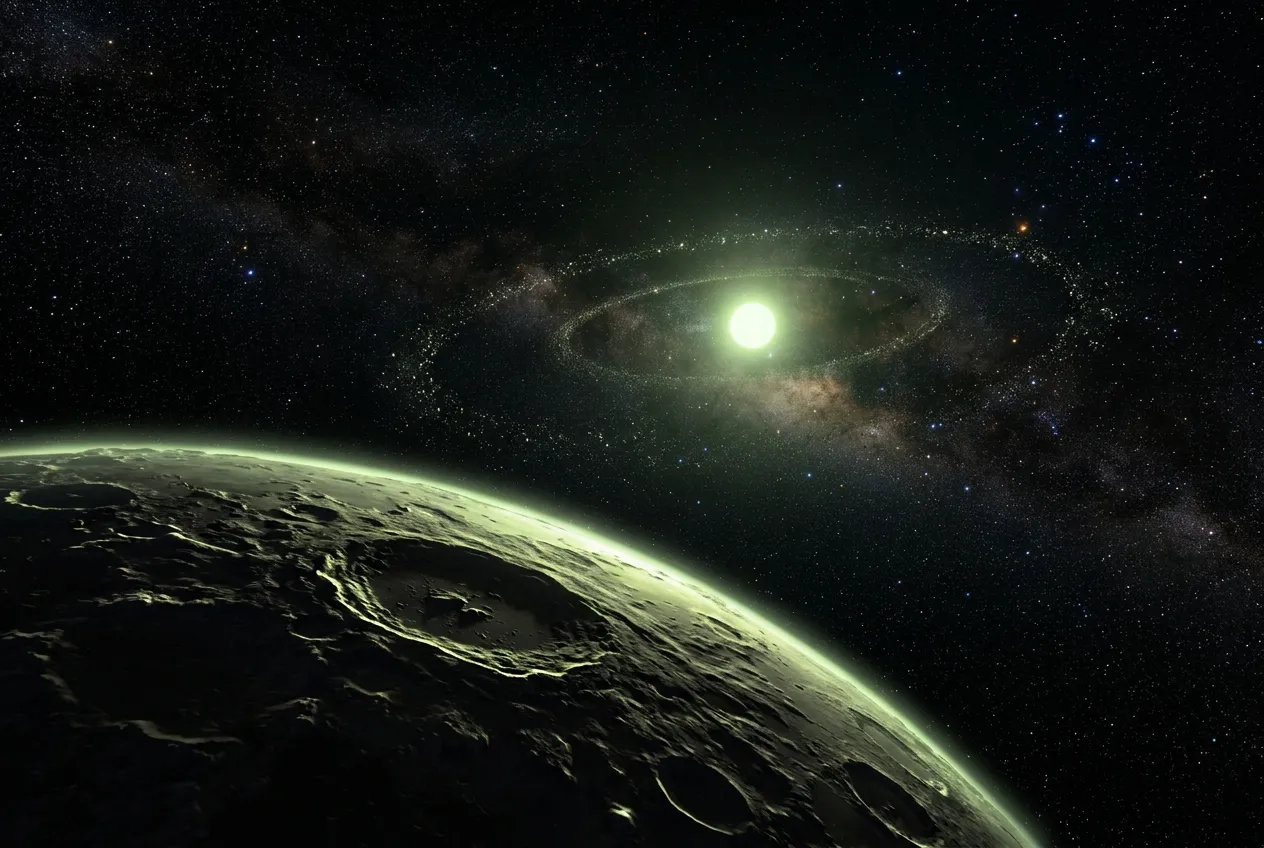
The team, led by Kate Su of the Space Science Institute in Boulder, Colorado, studied 21 rare systems called extreme debris disks. These are young stars surrounded by unusually large amounts of warm dust, packed close in, roughly where the rocky planets orbit in our solar system.
Extreme debris disks share three telltale traits:
- Tiny dust grains, mostly smaller than a micron, finer than the grains in the gas-rich disks where planets first form.
- Lots of warm dust sitting in the zone where Earth-like planets would live.
- Flickering brightness that rises and falls irregularly over time.
When the researchers split starlight from the dust into its component wavelengths, the disks fell into two clear groups.
Silica-rich disks: the head-on smashups
About a third of the sample (8 of the 21 systems) is rich in silica, the same basic compound found in quartz and glass. The team thinks these disks come from extremely energetic collisions between bodies about the size of Mars, impacts powerful enough to vaporize rock. As that rock vapor cools, it can condense into silica, much like the glassy beads found in impact debris on the Moon and Earth. Crucially, silica-rich disks turned up only around stars younger than about 300 million years.
Silica-poor disks: glancing blows and late chaos
The other two-thirds are silica-poor. The researchers propose these come from gentler impacts, such as collisions between Moon-sized objects or low-speed grazing hits. These disks appear around stars across a much wider range of ages, and they tend to flicker more, possibly because fresh debris keeps colliding and shifting orbits.
Kate Su sees the young and old disks as chapters in the same tale: "It's all one story."
How the telescopes did it
Dust this warm glows brightest in mid-infrared light, which is invisible to our eyes and largely blocked by Earth's atmosphere. Webb's Mid-Infrared Instrument (MIRI) observed 16 of the systems, including 12 for which astronomers obtained complete mid-infrared spectra for the first time. The other five came from the archives of NASA's retired Spitzer Space Telescope, which first identified this class of disk.
A spectrum works like a barcode. Different minerals absorb and emit light at specific wavelengths, so by reading the pattern, scientists can tell silica from other materials, such as crystalline silicates like forsterite, without ever touching a grain of dust. As Su put it, before Webb, the team "had limited information."
Why not just photograph the planets? The colliding bodies are far too small and distant to see directly. The debris cloud they leave behind, though, has an enormous total surface area, so it shines brightly in infrared light. The dust is the only witness we have.
Why it matters: a window on Earth's violent childhood
Scientists think a Mars-sized body, nicknamed Theia, struck the young Earth, and that the debris from that impact came together to form the Moon. That event is estimated to have happened about 100 million years after the Sun formed. Computer simulations suggest rocky planets like Earth assemble within the first few hundred million years of a star's life, which lines up neatly with the ages of the silica-rich disks.
In other words, Webb may be watching other planetary systems go through the same kind of brutal construction phase that built our own world. The silica-poor disks could tell a later chapter. If they reflect a period of orbital instability, when planets shift and stir up smaller bodies, the pattern could fit the Late Heavy Bombardment hypothesis, a proposed era when the giant planets migrated and sent debris flying across the inner solar system. The researchers frame this as a possible match, not a confirmed explanation.
This is a different kind of discovery than finding a single new planet. Instead of one snapshot, the study lines up many systems at different ages to reconstruct a timeline. If you enjoyed how astronomers piece together the sky from huge datasets, our story on how AI is helping astronomers find new planets and read the sky explores that side of modern astronomy.
Putting the scale in perspective
Mars is a little over half the width of Earth, and the Moon is about a quarter of Earth's width. Picture an object half the size of our planet crashing into another of similar size: the energy is enough to melt and vaporize enormous volumes of rock and to throw dust across a region comparable to the inner solar system.
The timescales are just as striking. Three hundred million years sounds like a long time, but it is only about 6.5% of the Sun's current age of roughly 4.6 billion years. If the Sun's whole life so far were squeezed into a single day, these silica-rich smashups would all happen in roughly the first hour and a half after midnight.
And these systems are rare. Only about 1% of young stars show observable signs of this phase, which is why gathering 21 of them is an achievement in itself.
By the numbers
| Measure | Value |
|---|---|
| Extreme debris disks studied | 21 |
| Observed with Webb (MIRI) | 16 (12 with first full mid-infrared spectra) |
| From Spitzer archive | 5 |
| Silica-rich systems | 8 of 21 (about one-third) |
| Silica-poor systems | 13 of 21 (about two-thirds) |
| Age limit for silica-rich disks | Stars younger than about 300 million years |
| Disks older than 300 million years | 3, all silica-poor |
| Young stars showing this phase | About 1% |
| Earth–Moon formation | About 100 million years after the Sun formed |
What comes next
The biggest caveat is sample size. Only three disks in the study are older than 300 million years, so the age pattern rests on a handful of systems. The team's coauthor Attila Moór of Konkoly Observatory in Budapest says they expect older disks to be silica-poor, a prediction more observations can test. Models also predict extreme debris disks should be more common than the roughly 1% astronomers actually see, a puzzle that remains open.
Other questions are still unsettled: whether the crystalline minerals form by condensing from vapor or by heating existing dust, and whether our own young Sun once hosted a silica-poor disk of its own. Expect more Webb time on these flickering systems, and longer monitoring to track how their dust evolves. For a very different kind of extreme astronomy, take a tour of what happens when you fall into a black hole.
FAQ
What is an extreme debris disk?
It is a disk of unusually abundant, fine, warm dust close to a young star, in the region where rocky planets orbit. Astronomers think it forms when large bodies collide and shatter.
Did Webb actually see planets crashing?
No. The colliding bodies are too small to see. Webb measured the infrared light from the debris, and its mineral makeup reveals how energetic the impacts were.
Why does silica matter?
Silica can form when vaporized rock cools and condenses, so its presence suggests extremely high-energy impacts between Mars-sized objects.
Is this how the Moon formed?
The leading idea is that a Mars-sized body called Theia hit the early Earth, and the debris formed the Moon. The silica-rich disks look like the kind of event that theory describes, but they are in other star systems.
Image credit: Artist's concept of an extreme debris disk. Artwork: NASA, ESA, CSA, Joseph Olmsted (STScI).
Sources
- NASA: Webb provides crash course on planet-shattering collisions (press release, October 1, 2026)
- Su et al. 2026, "Extreme Debris Disks: Insights into Violent Collisions in Planet Formation and Destruction," The Astrophysical Journal 1010:1
- Sci.News: Strange dusty disks around young stars may be wreckage of Moon- and Mars-sized collisions
- Space.com: Webb investigates what happens when planets crash together
- ScienceDaily: NASA's Webb finds signs of Mars-sized worlds smashing together
Comments
No comments yet — be the first to share your thoughts.
Join the discussion