The First Green Star? A Dead Star Tinted by the Planets It Ate
A white dwarf colored by the remains of its own planets may be the first known green star in the Galaxy
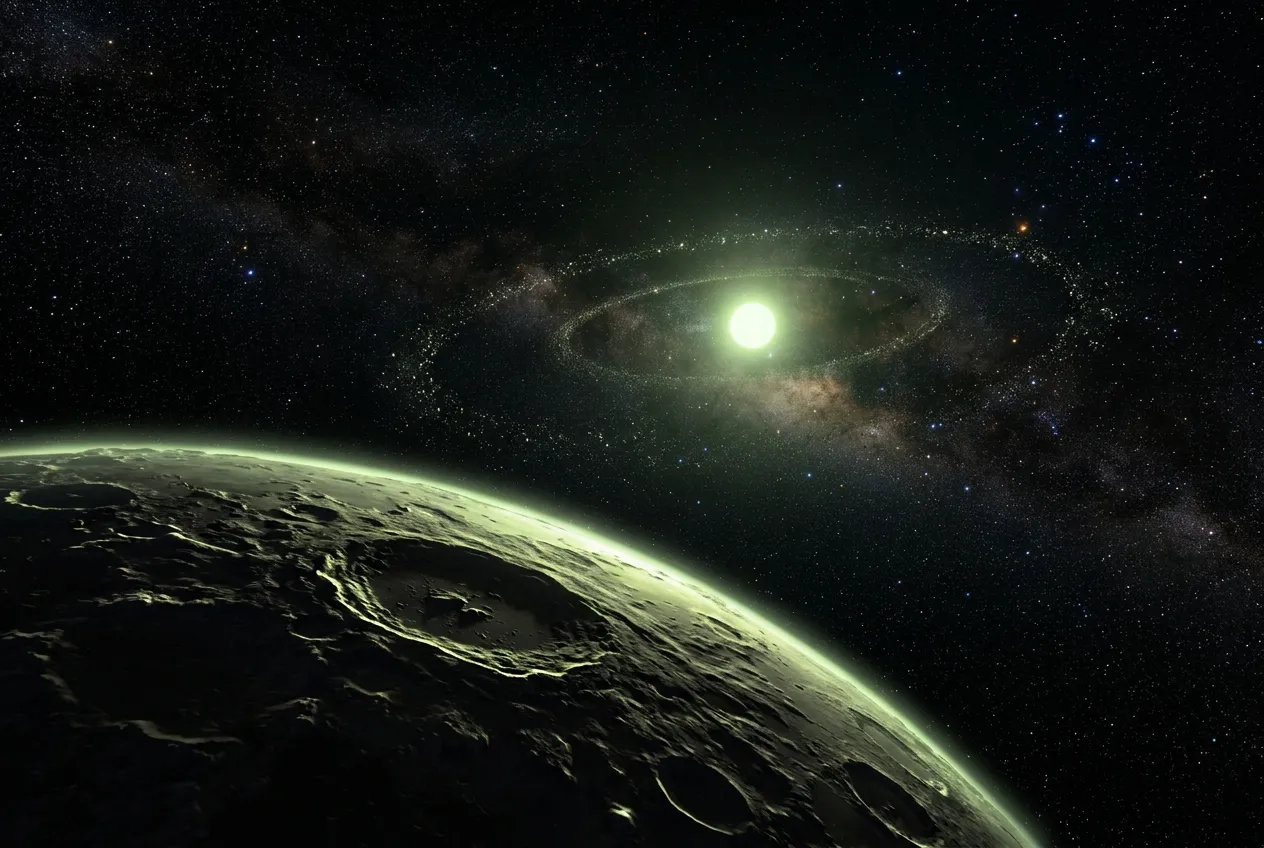
Look up at the night sky and you will see stars in red, orange, yellow, white and blue. You will never see a green one. Physics has long made sure of that. Now a team of astronomers says it has found the exception: a dead star whose last meal of shattered planets has tinted it a ghostly chartreuse.
The object is a white dwarf called WD J1330+6435, and according to a study published on October 15, 2026 in RAS Techniques and Instruments, it may be the first known green star in the Galaxy. The same research, led by Mark Hollands at the University of Warwick, also turned up what could be the reddest star on record, and showed that "white" dwarfs come in a surprising palette of pinks, yellows and cyans.
Why a green star was supposed to be impossible
Most stars behave like near-perfect "blackbody" radiators: glowing objects whose color is set almost entirely by temperature. Cool stars glow orange-red, hot stars glow blue-white, and in between sits the Sun. Because a star emits light across a broad spread of wavelengths at once, a temperature that peaks in green also pours out plenty of red and blue. Our eyes blend the mix into white. That is why the familiar color scale of stars runs from orange through white to blue and simply skips green.
To turn a star green, you need something to remove other colors from its light. That is exactly what the Warwick team found happening in a handful of white dwarfs.
What the green star discovery found
White dwarfs are the burnt-out cores left behind when stars like the Sun run out of fuel. They pack roughly the Sun's mass into a ball about the size of Earth. The coolest of them have atmospheres about as dense as water, millions of times denser than the visible surface of the Sun.
In such crushingly dense gas, trace elements like carbon, calcium and sodium absorb light far more broadly than they would elsewhere. Instead of nibbling thin slices out of the spectrum, they carve away whole bands of color, pushing the star's appearance off the usual orange-to-blue track.
WD J1330+6435: tinted by a planetary feast
This white dwarf, at roughly 4,000 °C, has been swallowing rocky debris from its own former planetary system. That material has seeded its atmosphere with calcium, lithium and sodium. The sodium soaks up orange light, and what is left over, in the team's models, reads as chartreuse green. Hollands described it as "a ghostly green glow." The researchers note that, as far as they know, this is the only known way to make a star appear green.
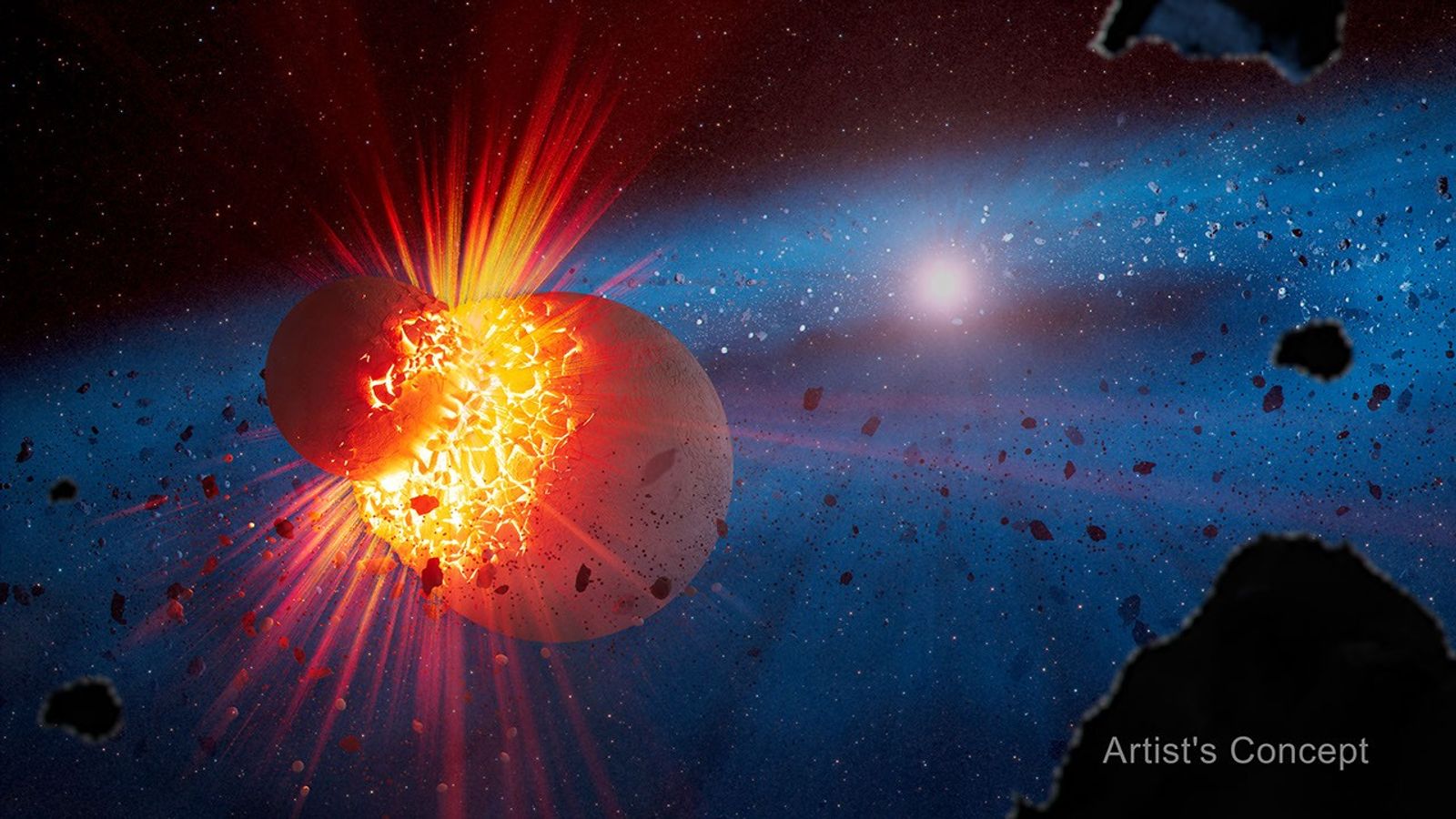
There is a poetic twist here. The green color is a direct fingerprint of destroyed worlds, the kind of planetary wreckage we explored in our story on Webb catching Mars-sized worlds colliding around young stars. At one end of a star's life planets are built in violent smashups; at the other, their remains can paint a dead star's face.
WD J1011+2845: possibly the reddest star known
About 48 light-years away, this white dwarf has a deep convection zone that dredges carbon up to its surface. Carbon molecules absorb so much of the shorter-wavelength light that most of what escapes lies beyond 600 nanometers, at the red end of the spectrum. The result is a deep salmon-pink glow and, in perceived color, likely the reddest star yet recorded.
A whole palette of dead stars
- Pink and purple: carbon-rich white dwarfs, such as WD J0902+2010, where carbon molecules absorb blue, green and yellow light.
- Yellow: white dwarfs polluted by debris from asteroids and comets.
- Cyan and pale blue: cool white dwarfs with mixed hydrogen-helium atmospheres, where colliding molecules and atoms filter the light.
- Vivid blue: WD J2356-2054, which looks strikingly blue despite a temperature of only about 4,000 K.
How do you see the color of a star nobody can see?
Here is the catch: nobody has actually looked at these stars and seen green. White dwarfs are small and faint, and none is close enough for us to simply look and judge its color. So the team worked from spectra, the rainbow-like breakdown of a star's light into its component wavelengths, which astronomers already collect routinely.
They then fed those spectra through a model of human color vision, effectively asking: if your eye could gather enough of this light, what color would your brain report?
Confirmed vs. modeled: The spectra are real measurements. The colors are calculated from them using a standard model of human vision. So "green" here means "what a human would perceive," which is a prediction rather than a direct sighting. The authors are careful with their wording, calling the green and red stars firsts "to our knowledge."
Why it matters
About 97% of the stars in the Milky Way, including the Sun, are expected to end their lives as white dwarfs. That makes these stellar embers one of the most common objects in the Galaxy, and a fossil record of how stars and their planets live and die.
The study also corrects a mental picture many of us carry. Popular images often show white dwarfs as blue-white. But hotter, bluer white dwarfs are brighter, so they dominate surveys limited by brightness. When the team looked at a complete local census instead, the typical white dwarf came out a plain white, close to the white of a computer screen. As coauthor Boris Gänsicke put it, "the average white dwarf really is white."
And because sodium and other elements in WD J1330+6435 came from rocky bodies, its color is a reminder that planetary systems leave traces long after their stars die. If you enjoy the stranger fates of dead stars, take a tour of what it would be like to fall into a black hole, the even more extreme end point for the most massive stars.
Putting the scale in perspective
Imagine compressing the entire Sun into a sphere the size of Earth. A single teaspoon of the result would weigh several tons here at home, and a person standing on the surface would feel hundreds of thousands of times their normal weight.
The "neighborhood" the team surveyed is a sphere about 65 light-years in radius around the Sun. That is tiny on a galactic scale, roughly a tenth of a percent of the Milky Way's width, yet it already holds around 150 white dwarfs.
By the numbers
| Measure | Value |
|---|---|
| White dwarfs in the local sample | 151 (within 20 parsecs, about 65 light-years) |
| Unusually colored stars found | 5 (two yellow, three pink) |
| Fraction with unusual colors | About 1 in 30 (roughly 3%) |
| Median color of the rest | About 6,800 K, perceived as white |
| WD J1330+6435 temperature | About 4,000 °C |
| WD J1330+6435 color | Chartreuse green (modeled) |
| WD J1011+2845 distance | About 48 light-years |
| Cool white dwarf atmosphere density | Up to about 1 g/cm³, similar to water |
| Milky Way stars expected to become white dwarfs | About 97% |
What comes next
The one-in-thirty figure comes from a small, nearby sample, so it is an extrapolation rather than a measured rate across the Galaxy. Larger spectroscopic surveys of white dwarfs will show whether colorful remnants are as common as this census suggests, and may uncover more green or red oddballs.
For now, Hollands invites a thought experiment: imagine standing on a planet and looking up at a green star. Somewhere in the Milky Way, that sky may be real.
FAQ
Why are there no green stars in the night sky?
Ordinary stars emit a broad mix of colors whose balance depends on temperature. Even a star peaking in green emits lots of red and blue too, so our eyes see white. A star only looks green if something removes other colors from its light.
What makes WD J1330+6435 green?
It has accreted rocky material from its planetary system. Sodium from that debris, in the star's very dense atmosphere, absorbs orange light, leaving a chartreuse green color in the team's models.
Could I see the green star with a telescope?
Not as a vivid green. The color is calculated from the star's spectrum using a model of human vision, describing how it would look up close. No white dwarf is near enough for us to simply look and judge its color.
Will the Sun become a white dwarf?
Yes. Like most stars, the Sun is expected to end as a white dwarf after its red giant phase.
Sources
- Hollands et al. 2026, "Any colour you like: the diverse chromaticities of white dwarfs," RAS Techniques and Instruments
- University of Warwick press release: Astronomers reveal surprising true colours of white dwarf stars
- Live Science: White dwarf stars can be purple, pink and even green
- Sci.News: White dwarfs really are white, but few are green, pink or vivid blue
- Space.com: Astronomers discover the first ever green star
- Space.com: White dwarfs, facts about the dense stellar remnants
Image: AI-generated artist's illustration of a green white dwarf surrounded by planetary debris, created for ZartonAi. Not an actual photograph.
Comments
No comments yet — be the first to share your thoughts.
Join the discussion