Falling Toward the Dark: A Journey Into a Black Hole
A story-driven guide to the universe's most extreme objects
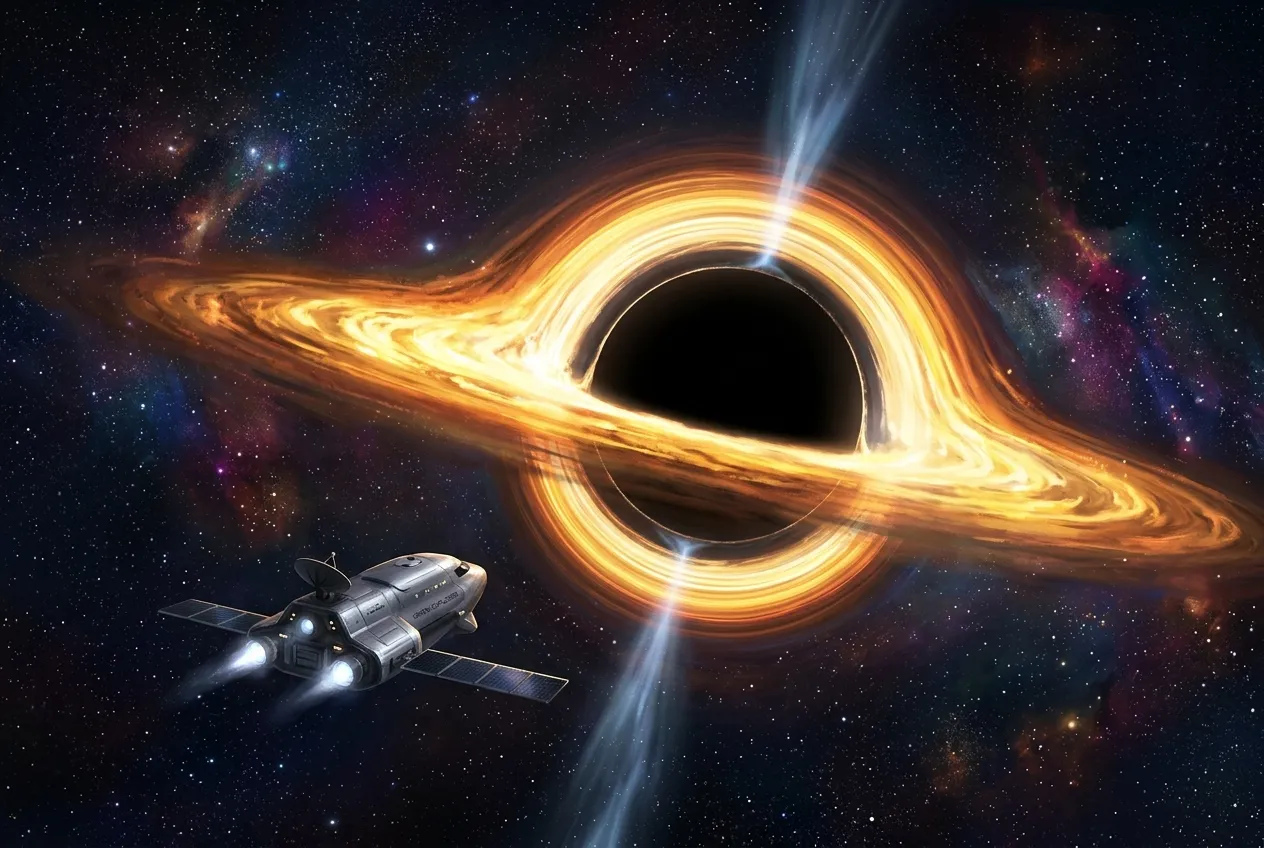
Imagine you are the pilot of a small research ship, drifting through deep space. Ahead of you, a ring of golden fire swirls around a perfect circle of nothing. No stars shine through it. No light escapes it. You are looking at a black hole, and you are about to get much closer than anyone ever has.
Chapter 1: Where Darkness Is Born
Every black hole has an origin story. The most common begins with a massive star, many times heavier than our Sun. For millions of years, the star balances two forces: gravity pulling inward and the energy of nuclear fusion pushing outward.
When the star finally runs out of fuel, that balance breaks. The core collapses in a fraction of a second while the outer layers blast away in a supernova. If the leftover core is heavy enough, nothing in nature can stop the collapse. Matter is crushed into an incredibly small region, and gravity becomes so strong that not even light can escape. A black hole is born.
Not all black holes are star-sized. At the center of nearly every large galaxy sits a supermassive black hole, millions or even billions of times the mass of the Sun. Our own Milky Way hosts one called Sagittarius A*, about four million times the Sun's mass.
Chapter 2: The Glowing Whirlpool
As your ship approaches, the first thing you see is not darkness but light. Gas and dust spiral around the black hole in a flattened, blazing disk called an accretion disk. Friction and compression heat this material to millions of degrees, making it glow brighter than entire galaxies in some cases.
Some black holes also launch powerful jets of particles from their poles, shooting out at nearly the speed of light and stretching across thousands of light-years. It's a strange irony: the darkest objects in the universe are often surrounded by some of its brightest fireworks.
Chapter 3: The Point of No Return
Past the glowing disk lies the boundary that defines a black hole: the event horizon. It isn't a solid surface. It's a one-way door. Once anything crosses it, light included, there is no path back out.
The size of the event horizon depends on the black hole's mass. A black hole with the mass of our Sun would have an event horizon only about 3 kilometers (roughly 2 miles) across in radius. Sagittarius A* has one larger than the orbit of Mercury would be if placed around it.
Time Starts to Bend
Here the story gets strange. Back home, mission control watches your ship on their screens. As you get closer to the horizon, your clocks seem to tick slower and slower from their point of view. Your radio signals stretch into longer, redder waves until they fade away entirely. To them, you appear to freeze at the edge forever.
From your seat, though, nothing feels unusual about time. Your watch ticks normally. This effect, called gravitational time dilation, was predicted by Einstein's general theory of relativity, and it's real. Even GPS satellites orbiting Earth must correct for tiny versions of it every day.
Spaghettification
Near a small, star-sized black hole, gravity pulls much harder on whatever part of you is closest. Your feet would be pulled more strongly than your head, stretching you long and thin. Scientists actually call this spaghettification.
Oddly, a supermassive black hole is gentler at its edge. Because its horizon is so huge, the difference in pull between your head and feet is small, so you could cross the event horizon in one piece, at least for a while.
Chapter 4: The Heart of the Mystery
At the very center lies the singularity, a point where our current physics says density becomes infinite. Most physicists believe this is a sign that our theories are incomplete, not a literal description of nature. Uniting general relativity with quantum mechanics, the science of the very small, may one day reveal what truly lies there.
In 1974, Stephen Hawking showed that quantum effects should let black holes slowly leak energy, now called Hawking radiation. Over unimaginable spans of time, black holes may evaporate completely. That raises a famous puzzle: what happens to all the information about what fell in? The question is still debated today.
Chapter 5: How We Learned to See the Invisible
For most of history, black holes were just math. Karl Schwarzschild found the first solution describing one in 1916, only months after Einstein published general relativity. The name "black hole" was popularized by physicist John Wheeler in the 1960s.
Then the evidence started arriving:
- 1970s: Astronomers identified Cygnus X-1, an X-ray source in our galaxy, as one of the first strong black hole candidates.
- 2015: The LIGO observatories detected gravitational waves, ripples in space-time, from two black holes colliding over a billion light-years away.
- 2019: The Event Horizon Telescope, a network of radio dishes spanning the planet, released the first image of a black hole's shadow, at the center of the galaxy M87.
- 2022: The same team revealed an image of Sagittarius A*, the black hole at the heart of our own galaxy.
Epilogue: Why Black Holes Matter
Black holes aren't just cosmic vacuum cleaners. Supermassive black holes help shape the galaxies around them, regulating how stars form. They are natural laboratories where gravity is pushed to its absolute limit, testing the laws of physics in ways no experiment on Earth can.
So as your imaginary ship slips quietly past the event horizon, remember: you're not just falling into darkness. You're falling into one of the biggest open questions in science, and every new observation brings us a little closer to the answer.
The universe keeps its deepest secrets in its darkest places, and black holes are where we're learning to look.



Comments
No comments yet — be the first to share your thoughts.
Join the discussion