The Night Shift: How AI Is Helping Us Read the Sky
A story of telescopes, oceans of data, and the algorithms that never sleep
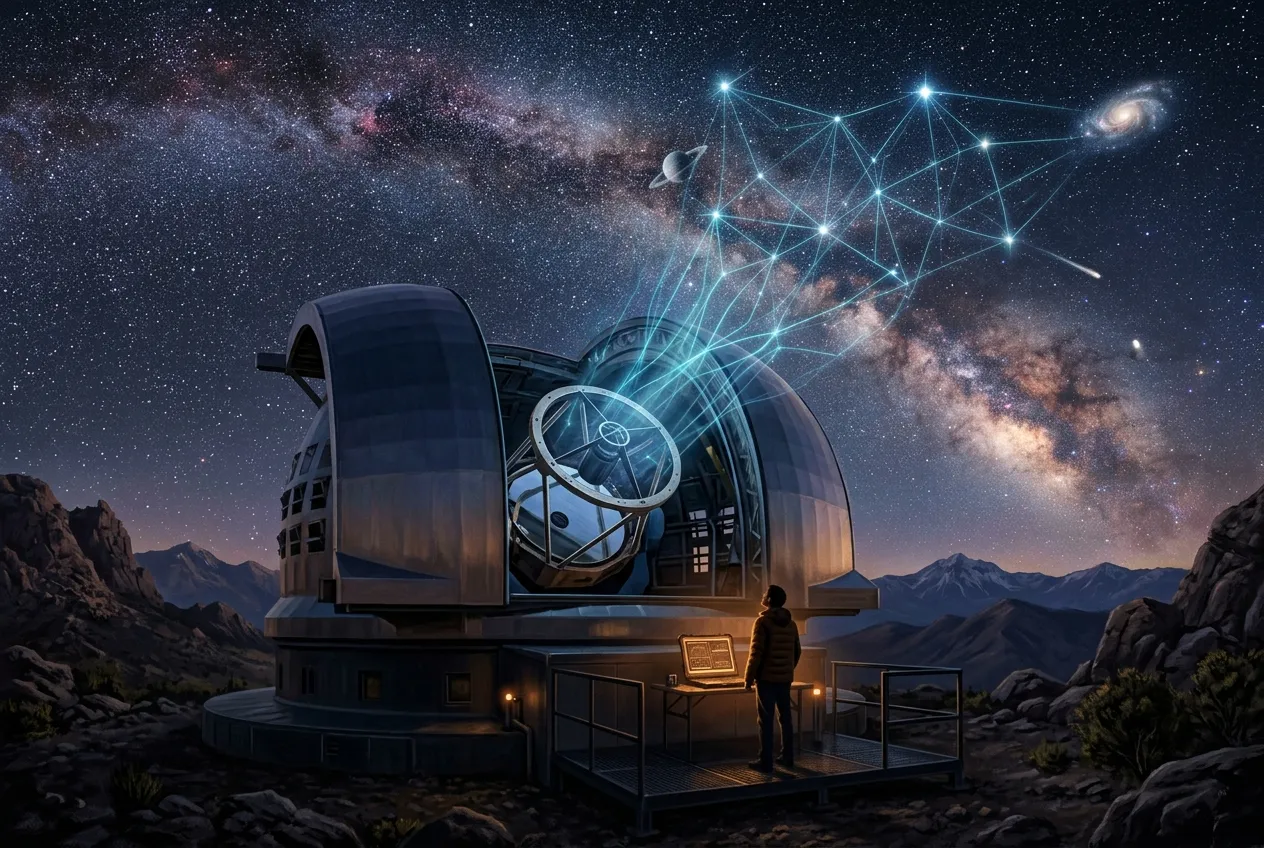
It's 2 a.m. on a mountaintop in Chile. The dome of a giant telescope slides open, and a camera the size of a small car begins photographing the sky. By sunrise it will have captured more data than one astronomer could study in years. Down the hall, nobody is staring at the images. Instead, an AI is quietly working through every one, looking for anything that moved, flickered, or wasn't there yesterday.
This is the new night shift in astronomy. And it's changing how we explore the universe.
Chapter 1: Drowning in Starlight
For most of history, astronomy's problem was not enough data. Today, it's the opposite. Modern observatories and space telescopes produce floods of images, spectra, and signals every day. The Vera C. Rubin Observatory in Chile, for example, is designed to scan the entire visible southern sky every few nights, producing tens of terabytes of data each night and sending out millions of alerts about things that changed.
No team of humans can look at all of that. This is where artificial intelligence comes in. AI, especially machine learning, learns patterns from examples and then finds those patterns in new data, fast and without getting tired.
Chapter 2: Finding Hidden Worlds
When a planet passes in front of its star, the star dims very slightly. NASA's Kepler and TESS missions watched hundreds of thousands of stars for these tiny dips. The challenge is that many things can look like a planet: starspots, binary stars, or instrument noise.
Machine learning has become a powerful filter. In 2017, a neural network trained on Kepler data helped uncover Kepler-90i, making Kepler-90 the first known system besides our own with eight planets. Later, NASA's ExoMiner deep learning tool helped validate hundreds of new exoplanets at once from the Kepler archive.
Application: sorting real planet signals from false alarms so astronomers can focus on the most promising worlds.
Chapter 3: Catching Things That Move
Back on our mountaintop, the AI flags a faint dot that shifted between two images. It could be a new asteroid. Spotting moving objects in huge sky surveys is a perfect job for software that compares images and links detections across nights.
In 2023, a new algorithm called HelioLinc3D, built for the Rubin Observatory, found its first potentially hazardous asteroid in older survey data that earlier methods had missed. Tools like this help with planetary defense, giving us more warning about objects that come near Earth.
Chapter 4: Sorting a Trillion Galaxies
Galaxies come in many shapes: spirals, ellipticals, merging pairs, and strange irregulars. Their shapes tell us how they formed and evolved. Volunteers in projects like Galaxy Zoo classified millions of galaxies by eye, and their labels became training data for AI that can now classify far more galaxies than humans ever could.
AI also hunts for rare gems, like gravitational lenses, where a massive galaxy bends the light of something behind it into arcs and rings. These lenses act like natural magnifying glasses and help measure dark matter.
Chapter 5: Listening to the Cosmos
Not all astronomy is pictures. Radio telescopes pick up mysterious fast radio bursts, flashes lasting just milliseconds from far across the universe. Machine learning has been used to dig through radio data and find bursts that earlier searches missed.
AI also helps gravitational-wave observatories separate the faint signals of colliding black holes from background noise, and it supports searches for technosignatures, possible signs of technology from other civilizations.
Chapter 6: Sharpening the Darkest Images
In 2019, the Event Horizon Telescope showed the world the first image of a black hole's shadow in the galaxy M87. A few years later, researchers used a machine learning technique to reconstruct that same data and produce a sharper view of the glowing ring. It's a reminder that AI can help us get more out of observations we already have.
Chapter 7: Simulating Universes
Some of the biggest questions in astronomy, like how the universe's large-scale structure formed, depend on huge computer simulations. These can take enormous computing time. AI models trained on simulations can approximate results much faster, letting scientists test many more ideas about dark matter, dark energy, and galaxy formation.
Other Ways AI Helps
- Space weather: predicting solar flares and storms that can affect satellites and power grids.
- Telescope scheduling: deciding what to observe next to get the most science out of limited time.
- Cleaning data: removing satellite trails, cosmic rays, and noise from images.
- Spacecraft autonomy: helping rovers and probes make decisions when signals from Earth take too long.
A Word of Caution
AI is a powerful assistant, not a replacement for scientists. Models can be fooled by unusual data or learn biases from their training examples. Astronomers still check, test, and confirm what AI finds. Sometimes the most exciting discoveries are the strange objects that don't fit any pattern, which is exactly why humans stay in the loop.
Epilogue: Sunrise
As dawn reaches the mountaintop, the dome closes. The AI has sorted through the night: a few new supernova candidates, a handful of moving objects, and one odd flicker it can't explain. That last one goes to the top of an astronomer's list. Tonight, the shift starts again.
The universe has always been full of stories. AI is helping us read more of them than ever before.


Comments
No comments yet — be the first to share your thoughts.
Join the discussion