US Readies AI 'National Champions' as IMF Flags $1T Loop
The US plans to name Nvidia, OpenAI, Anthropic and others AI 'national champions' as the IMF and Fed warn about debt-heavy AI financing. Plus: Vulcan's failure costs Amazon 40 satellites.
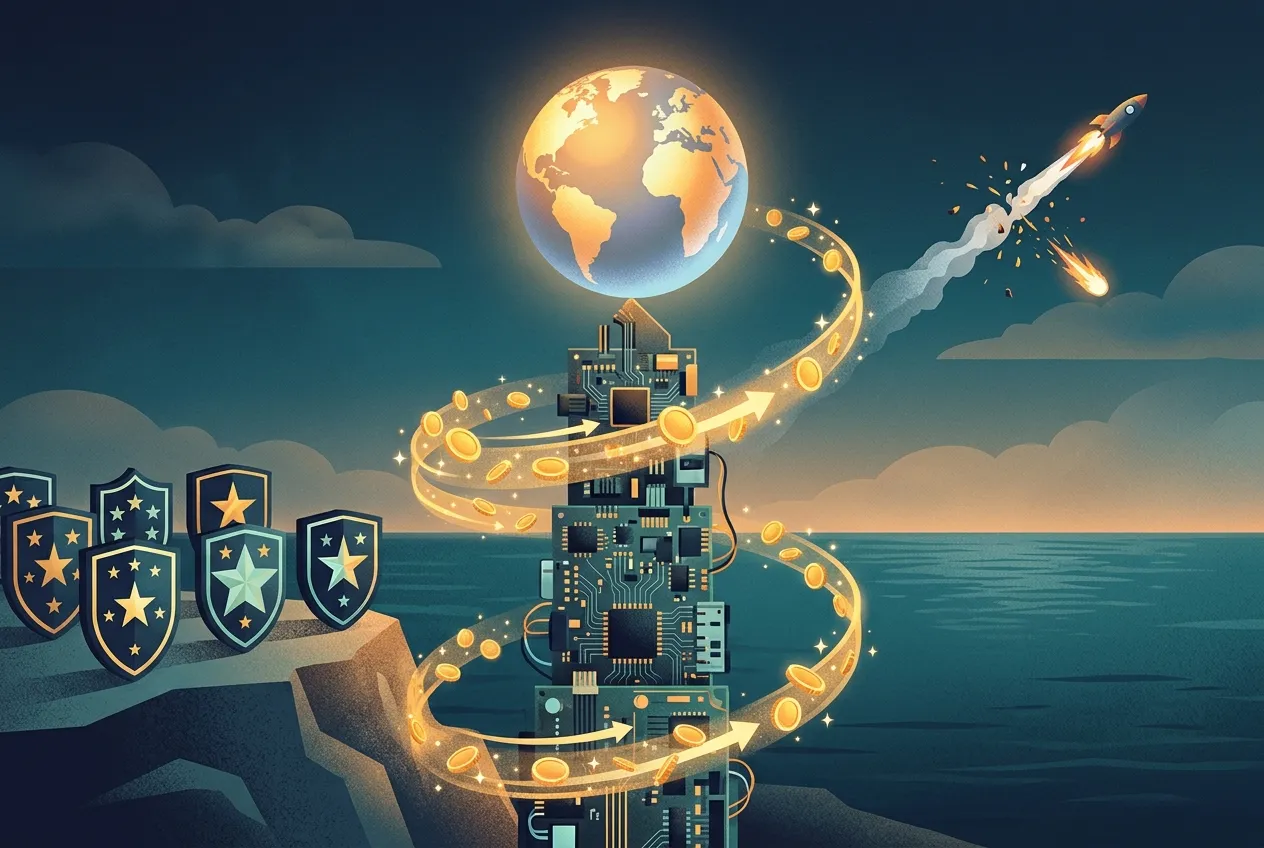
Washington is preparing to put an official seal of approval on America's biggest AI companies just as global financial watchdogs warn that the money holding the AI boom together is increasingly borrowed and increasingly circular. Meanwhile, a rocket failure over the Atlantic set back Amazon's bid to challenge Starlink. Here are the stories shaping tech and AI this Monday, November 16, 2026.
Trump administration to name more than two dozen AI "national champions"
The Trump administration plans to designate more than two dozen US companies, including Nvidia, Amazon, Microsoft, OpenAI and Anthropic, as AI "national champions," The Wall Street Journal reported on Sunday, citing people familiar with the plans. Reuters and The Next Web carried the report; the full list has not been published and no company or agency has confirmed it on the record, so for now it rests on the Journal's sourcing.
According to the report, Commerce Secretary Howard Lutnick would unveil the list, possibly within the next week, though the timing could slip. The program is designed to persuade foreign governments and companies to buy American AI instead of Chinese alternatives by bundling US chips, models and related products into packages that are simpler for overseas customers to purchase. It builds on the Commerce Department's existing American AI Exports Program, created by a July 2025 executive order, under which designated packages can receive government advocacy, federal financing and faster export-license reviews. It is not yet clear what extra benefits, if any, a "champion" label would add.
The timing is awkward. Nvidia's inclusion comes days after Jensen Huang resigned as CEO following his admission of an affair with a woman US officials suspect of spying for China. Critics argue the episode shows export controls have leaked and that national security should be weighed ahead of market share; the Journal also reported that critics have accused Lutnick's department of failing to close those gaps. Supporters of the approach counter that Chinese firms such as DeepSeek and MiniMax are already being cleared by Beijing to sell abroad, and that US vendors need help competing for foreign buyers. The announcement would land the same week President Trump travels to the APEC summit in Shenzhen, where he is expected to meet Chinese President Xi Jinping.
IMF: the world economy is "standing on one leg"
Speaking to CNBC on the sidelines of the ASEAN summit in the Philippines on Monday, IMF Managing Director Kristalina Georgieva warned that global growth has become heavily dependent on AI investment, and that a sudden loss of investor confidence could create financial-stability problems. She described the economy as resting on a single AI leg that could wobble.
Her sharpest figure concerned "circular financing," arrangements in which money invested in an AI company flows back to the investor through purchase orders, such as chipmakers funding customers that then buy their chips. The IMF estimates these deals now total a little over $1 trillion, with roughly two-thirds funded by debt. Georgieva said the sum is not yet huge relative to the financial system but is growing fast. She also characterized recent market swings as orderly, while urging caution. Nvidia, a central participant in many such arrangements, has shed more than $1 trillion in market value over the past month, according to CNBC's reporting as relayed by several outlets.
The IMF had already warned in October that if AI fails to meet expectations, US stocks could fall about 20% and global output could end up roughly 1.1% below its baseline by 2028.
Fed survey puts AI at the top of the risk list
Georgieva's comments echo the Federal Reserve's semi-annual Financial Stability Report, released Friday. In the Fed's survey of market contacts, 87% cited AI as a salient risk to the financial system, up from 50% in the spring edition, making it the most-cited concern. Respondents pointed to three areas: stretched stock valuations that could correct if earnings disappoint, cybersecurity threats from state actors or frontier AI models themselves, and complex AI-related financing. The report put debt issuance tied to advanced computing above $680 billion through October, and compared the buildout to the late-1990s telecom investment cycle. The Fed noted that the survey reflects contacts' views, not the Board's own.
Investors face a busy test this week, with Nvidia's first earnings report since Huang's exit and Anthropic's planned stock-market debut both on the calendar.
Vulcan failure costs Amazon 40 Leo satellites
In space tech, United Launch Alliance's Vulcan rocket failed on Sunday about 10 minutes after lifting off from Cape Canaveral, destroying 40 Amazon Leo broadband satellites, according to Spaceflight Now, Engadget and Aviation Week. ULA said the vehicle suffered an anomaly and did not reach orbit; early indications point to a problem during the Centaur upper stage's burn, though the cause has not been confirmed. It is the first outright mission failure for ULA, the Boeing–Lockheed Martin joint venture, since its formation in 2006.
The flight was Vulcan's return after a nine-month pause to fix solid-rocket-booster nozzle problems, and the first of 38 Vulcan launches Amazon has bought for Leo, its planned rival to SpaceX's Starlink. Amazon had roughly 400 Leo satellites in orbit before the loss and needs more than 3,200 to complete the network. The failure is likely to ground Vulcan during the investigation and could further delay its national-security missions for the US Space Force. NASA Administrator Jared Isaacman offered the agency's help with the inquiry.
Why it matters
Taken together, the day's news shows AI being treated simultaneously as a strategic national asset and a growing systemic risk. Governments are leaning on a handful of companies to win markets abroad, even as central bankers warn that the financing behind those companies is concentrated, leveraged and partly self-referential. How Nvidia's earnings and Anthropic's IPO land this week will offer the next read on whether investor confidence is holding.
Sources
- Nvidia, OpenAI and Anthropic to be named AI national champions, WSJ reports — The Next Web
- Trump administration to name Nvidia, other AI firms as US 'national champions', WSJ reports — Reuters via The Star
- IMF's Georgieva says the world economy is 'standing on one leg' as AI circular financing tops $1 trillion — MLQ.ai (citing CNBC)
- 'AI circular financing crosses $1 trillion': IMF chief flags global economy risks — Invezz
- AI risks are the biggest threat to the financial system, Fed survey finds — CNBC
- AI rockets to top of worries about financial system in latest Fed survey — Reuters via AOL
- ULA suffers first total mission failure with loss of Vulcan rocket carrying 40 Amazon Leo satellites — Spaceflight Now
- ULA Vulcan rocket failure destroys 40 Amazon Leo satellites — Engadget
- Vulcan Rocket Fails During Return To Flight Carrying Amazon Satellites — Aviation Week
Source: The Next Web