Upgrades Gone Wrong: Microsoft and FAA Outages Expose a Fragile Tech Backbone
Microsoft's 70-country outage and the FAA's longest nationwide ground stop in 25 years both trace back to infrastructure upgrades, as SpaceX bets $74B on AI compute.
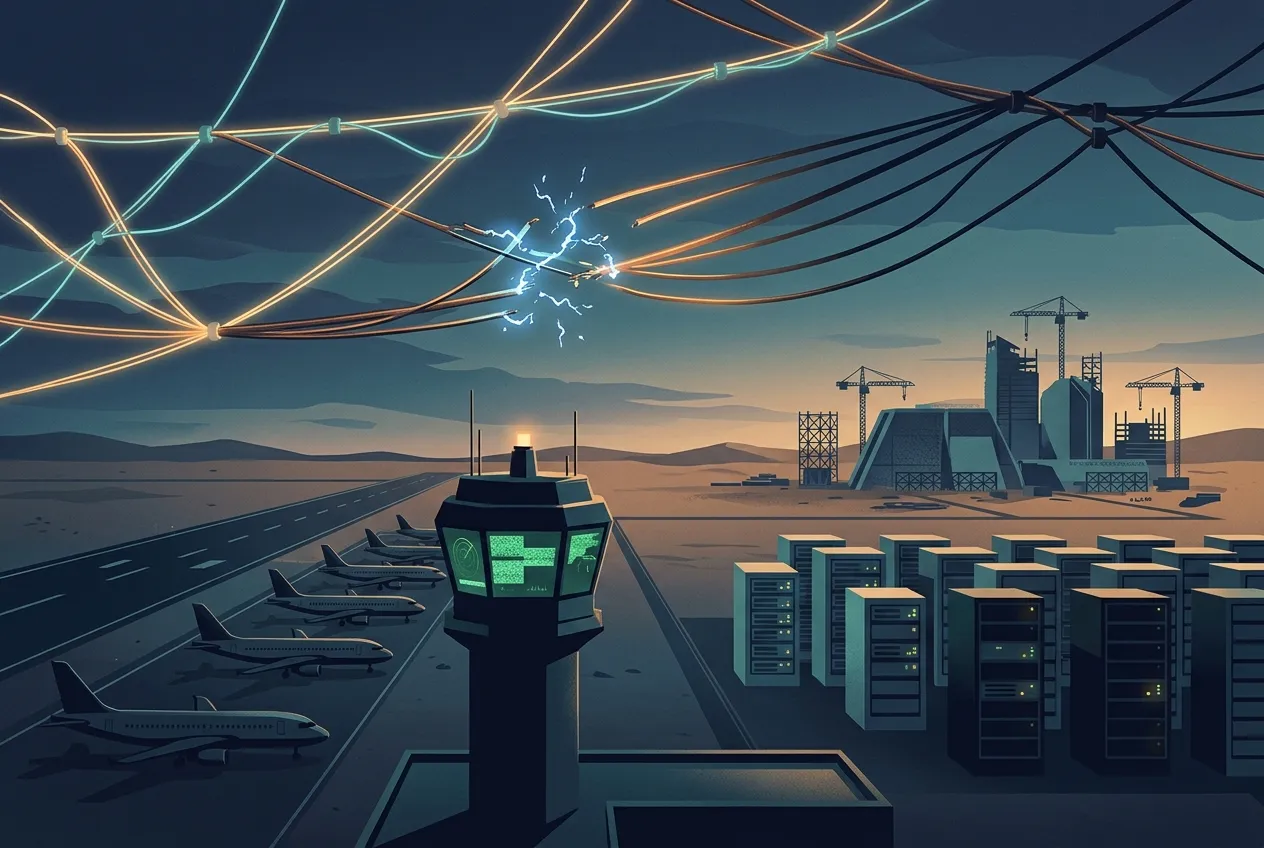
Two of the systems people trust most to simply work — Microsoft's office cloud and America's air traffic control network — failed within a day of each other this week, and in both cases the trigger appears to have been an infrastructure upgrade, not an attack. As airlines dig out from the longest nationwide ground stop in a quarter century, the week also brought fresh bets on the next generation of computing and autonomy, from SpaceX's $74 billion AI campus plan to Tesla putting its Cybercab on sale to private buyers.
A rare nationwide ground stop
On Friday, the Federal Aviation Administration halted departures across the United States for more than four hours. According to the Associated Press, it was the first nationwide stop since a pilot-notice computer failed in January 2023, and only the second since the September 11 attacks. An aviation consultant quoted by AP estimated it touched roughly a quarter of the 45,000 flights the U.S. handles on a typical day, and flight trackers counted between 3,200 and 4,100 additional cancellations on Saturday as carriers tried to reposition planes and crews.
Transportation Secretary Sean Duffy said a contractor had been swapping a section of old copper wiring for fiber when the work somehow overloaded the system, producing intermittent communication and radar gaps. He said investigators are examining whether the contractor or a faulty router is to blame. The contractor, L3Harris Technologies, had not publicly responded as of Saturday. Officials stressed that the more than 3,000 aircraft already airborne landed safely, and FAA Administrator Bryan Bedford said schedules should be back to normal by the end of Sunday.
Administration officials also pointed at Congress, saying more money is needed to finish replacing decades-old equipment; they are seeking roughly $30 billion beyond the $12.5 billion already approved. That is the administration's framing — what is clear from the record is that a regional fiber cut snarled Northeast traffic in September, and that the modernization work itself is now a source of risk while it is underway.
Microsoft 365 goes dark in 70-plus countries
The FAA failure came on the heels of a sweeping Microsoft outage that began around midday Thursday in the U.S. Outlook, Teams and the Copilot assistant were disrupted, and Downdetector logged reports from more than 70 countries and territories. Microsoft said Saturday it had restored service to all remaining customers and regions.
The company traced the incident to a problem introduced during an earlier network capacity upgrade that surfaced after a more recent network change, and said it found no sign of a cyberattack and no link to AI agents. The fallout was broad: AP reported that a Manchester trial was halted, British pharmacies warned of prescription delays, and government agencies in Japan, Singapore, Greece and Norway saw email disruptions. Even OpenAI and Anthropic reported trouble connecting their assistants to Microsoft 365 tools — a reminder that AI products increasingly inherit the reliability of the platforms they plug into.
With more than 430 million people using Microsoft 365 apps, the episode has revived debate, particularly outside the U.S., about concentration risk when so much of daily work runs on one provider's infrastructure.
SpaceX puts a $74 billion price on AI compute
While incumbents were firefighting, SpaceX attached its first dollar figure to its AI build-out. The company said it plans more than $74 billion across two supercomputing campuses: about $50 billion in rural Cochise County, Arizona, and more than $24 billion near its Starbase site in South Texas. SpaceX projects roughly 5,500 construction jobs and 1,000 permanent roles in Arizona, and more than 500 permanent jobs in Texas.
The Texas site is slated to run its own gas-fired power plant, which would sidestep a long wait for a grid connection, while the Arizona campus plans dry cooling with no new wells. The Arizona project still needs county approval, and Texas' incoming governor campaigned on a data center moratorium. SpaceX's AI unit brought in about $7.6 billion in third-quarter revenue — more than half the company's total — and it now rents computing capacity to outside AI developers, with Anthropic reported as its largest customer.
Tesla opens Cybercab orders — with a subscription
Tesla began inviting select customers to buy its steering-wheel-free Cybercab for personal use at $29,990 before taxes. The catch: owners must pay a $299 monthly "Autonomy Subscription" to operate it, and orders require a $1,000 non-refundable deposit, with first deliveries estimated for December in Austin. Electrek reported the vehicle is limited to Tesla's Robotaxi service areas in Texas and Florida, and Elon Musk himself said the fee is too high, suggesting it should land closer to $115 a month.
Why it matters
This week's common thread is infrastructure. The outages show that upgrades to aging or sprawling systems can be as disruptive as the failures they aim to prevent, while the SpaceX and Tesla moves show how much new capacity — and new dependence — the industry is racing to build. The resilience of that next layer will matter as much as its speed.
Sources
- Thousands of flights canceled as airlines work to recover from nationwide ground stop — Associated Press via PBS News
- Microsoft says services fully restored after global outage — Associated Press via PBS News
- Microsoft says global outage fully resolved after disrupting services in over 70 countries — Gulf News
- SpaceX is planning more than $74 billion in AI supercomputing campuses in Texas and Arizona — Quartz
- SpaceX plans $74B of AI computing centres in Arizona and Texas — The Next Web
- SpaceX to Invest $74B in Supercomputing Campuses in Texas, Arizona — GovCon Wire
- Tesla Cybercab orders open at $29,990 + $299/mo, only in Robotaxi zones — Electrek
- Tesla makes major Cybercab announcement as driverless vehicle goes on sale — Fox Business
Source: Associated Press