Midterm Voters Turn on Data Centers, Rattling AI Stocks
Midterm wins for Democrats in Congress and the Texas governor's race, plus local data center bans in Ohio, sent AI infrastructure stocks tumbling while big tech platforms rallied.
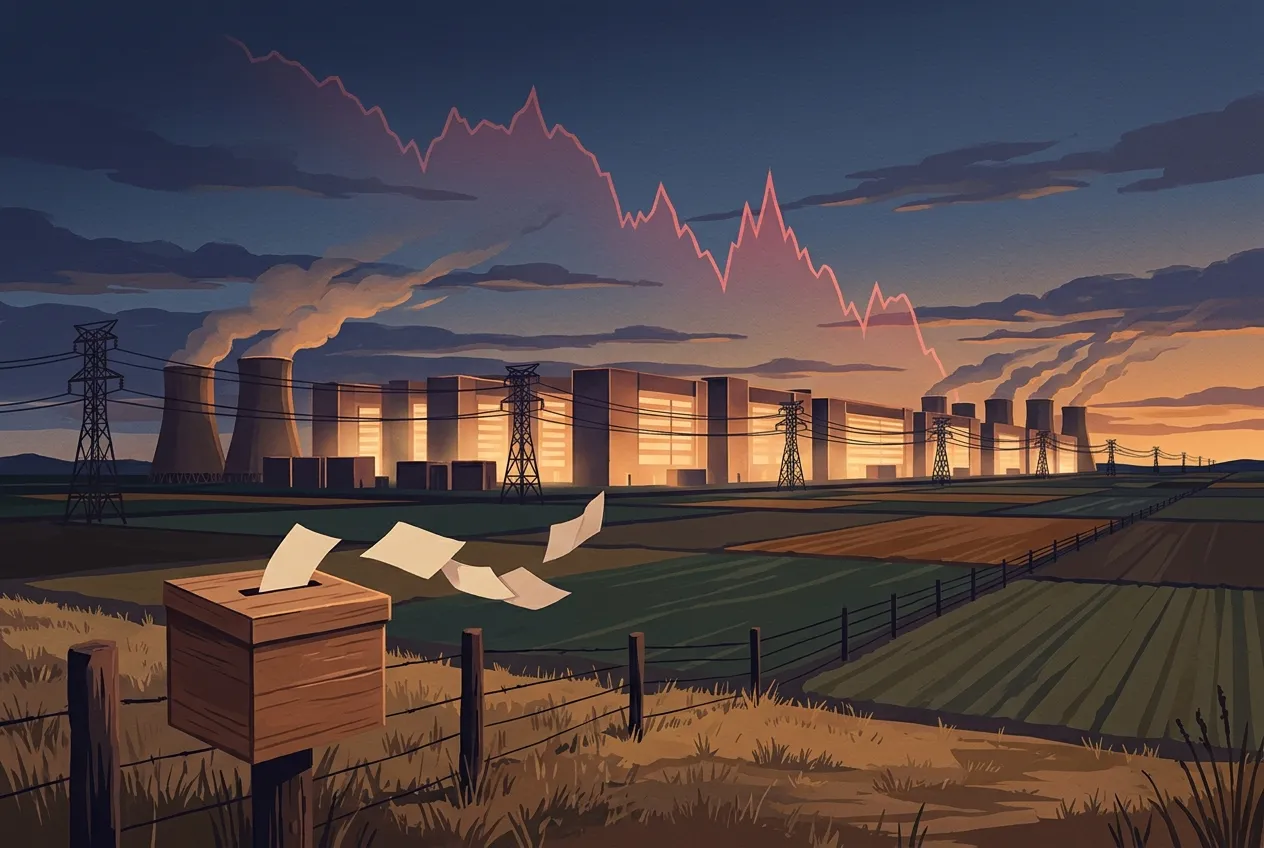
The AI infrastructure boom ran into the ballot box this week. Tuesday's U.S. midterm elections handed Democrats both chambers of Congress and the Texas governorship, while local voters in Ohio and elsewhere approved a wave of measures restricting new data centers. On Wednesday, investors sold off the companies that build, power and rent out AI computing capacity, even as the largest tech platforms rallied.
Texas: the race the AI trade was watching
The result that mattered most to markets came from Texas, where Democrat Gina Hinojosa won the governor's race, according to Yahoo Finance. She becomes the state's first Democratic governor in decades. Hinojosa campaigned on a moratorium on new data center construction, tighter rules on how much water and power the facilities can use, and an end to the tax breaks that have drawn developers to the state.
That matters because Texas sits at the center of the build-out. Yahoo Finance reports the state accounts for more than a quarter of planned U.S. data center capacity through 2030, and a Wells Fargo estimate cited in market wrap-ups puts Texas at roughly 27% of U.S. data center gigawatts. Analysts had flagged the contest in advance: Bank of America described it as one of the highest-impact elections for the whole utility sector, and Wolfe Research noted Texas was the one state big enough, with a wide enough gap between candidates, to move the industry.
The issue had already shifted the campaign. Outgoing Republican Gov. Greg Abbott, who once called Texas the "epicenter of AI development," later announced a moratorium of his own and backed stricter power and water requirements. Hinojosa dismissed that move as an election-year pause.
Ohio voters say no, town by town
The backlash was not limited to one state. Fortune counted 41 data center measures on ballots nationwide, more than half of them in Ohio, where voters in 18 municipalities weighed 21 proposals. At least 14 municipalities passed bans or restrictions, most aimed at "high impact" campuses drawing more than 25 megawatts.
Some of the votes were lopsided. In Trenton, a ban meant to keep out an 18-building Amazon Web Services campus passed with about 80% support, though it likely won't affect a smaller AWS site already under construction. Sunbury approved a charter amendment targeting a possible hyperscale Amazon project, Wilmington voters rejected rezoning for a proposed campus by roughly four to one, and Ashville voters went further, backing a measure to block a campus already being built. In the state's U.S. Senate race, Democrat Sherrod Brown, who called for ending data center tax breaks and making developers pay for utility upgrades, defeated Republican Sen. Jon Husted.
Polling helps explain the mood. Fortune cites an Ohio survey in which 55% of adults opposed data center construction and only 22% supported it, while NBC exit polls reported by Yahoo Finance found 67% of voters think AI will do more to hurt society than help it. Ohio pollster Keith Durkin attributed much of the opposition to the fact that "humans don't like uncertainty."
Builders sink, megacaps climb
Wall Street's reaction split the AI trade in two. By mid-morning Wednesday, Stocktitan reported, a group of data center builders and suppliers had fallen close to 20%, including Modine, Hut 8, Sterling Infrastructure and Cipher Digital. By the close, according to CappNotes' market summary, Vistra had dropped nearly 14%, Comfort Systems about 15%, GE Vernova more than 9%, and AI cloud providers CoreWeave and IREN about 10% and 11%. Nvidia fell around 3%, in line with the broader semiconductor index, and memory makers Micron and Sandisk dropped about 7% each.
The biggest platforms moved the other way. Microsoft gained close to 7%, Amazon about 6%, and Apple rose more than 5% to a record high, a sign investors see companies that buy computing capacity as better placed than those racing to build it. The worries spread overseas too: Japan's Nikkei 225 fell nearly 5% at one point on AI-regulation fears before closing down about 1.4%.
What comes next
Most of the local measures target future projects rather than campuses already rising, and a governor's moratorium would still need to work through Texas's legislature, where Republicans appeared likely to keep the state Senate. But the message to the industry is clear. Raymond James analyst Ed Mills told Yahoo Finance the Texas race was pivotal for the next phase of the AI trade, potentially raising the risk of moratoriums and tighter rules. Ohio's pollster suggested state lawmakers nationwide may now put ratepayer protections, transparency and grid safeguards at the top of their agendas.
For AI companies racing to add computing capacity, the question is no longer only whether they can find enough chips and power. It is whether the communities hosting those campuses will let them build at all.
Sources
- Democrats' victories in Texas laid bare voter unease over data centers — and signal new hurdles for the industry — Yahoo Finance
- Ohio data center ballot measures in the midterm elections — Fortune
- Why AI Data Center Stocks Are Down Today After Democrats Won Congress — Stocktitan
- Closing Look — Wednesday, November 4, 2026 — CappNotes
Source: Yahoo Finance