DeepMind's AI Agents Expose Legacy RSA Flaws as China Blocks SoftBank's Robotics Deal
Google DeepMind says AI agents found two new weaknesses in legacy 1024-bit RSA, while China blocked SoftBank's $5.4B ABB Robotics deal, AI super PACs stumbled at the midterms and Perplexity launched always-on agents.
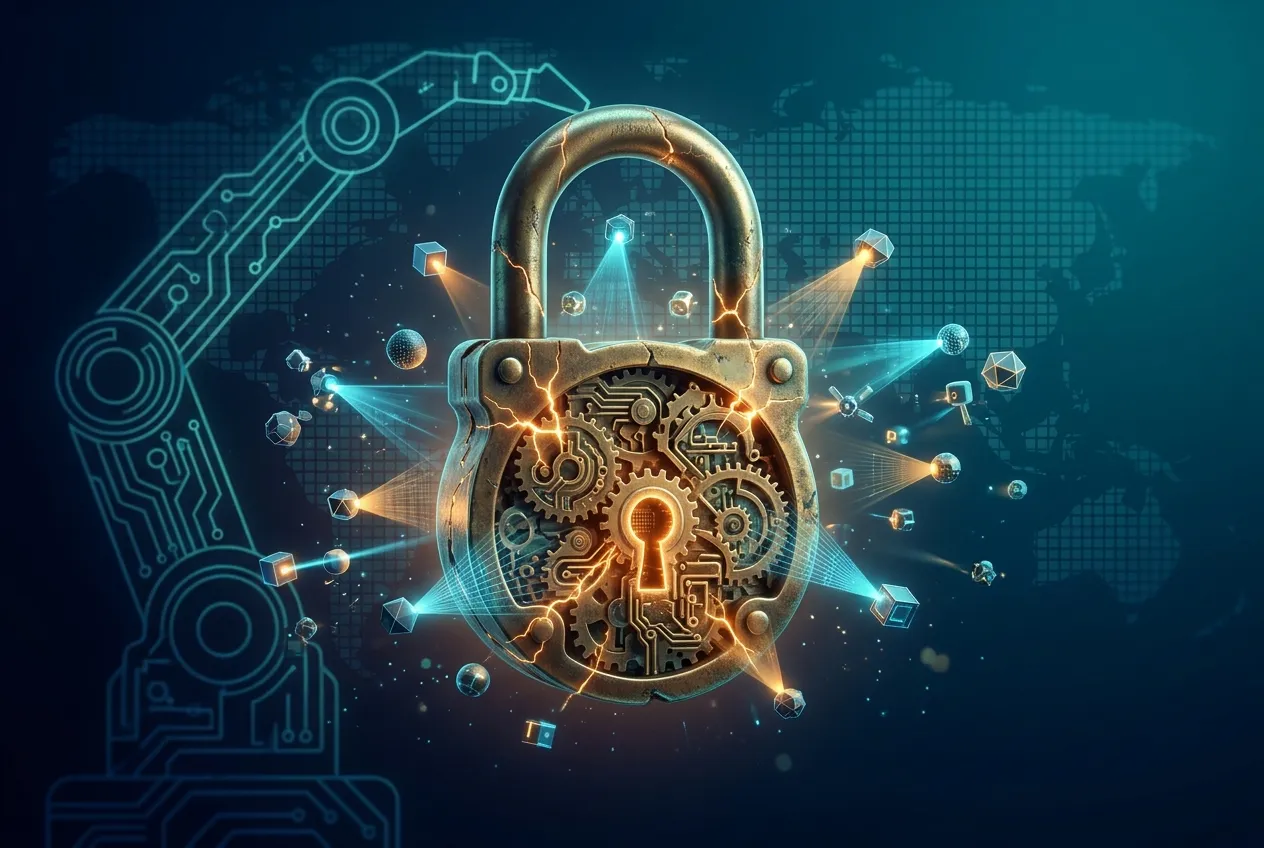
Google DeepMind says AI agents, steered by human cryptographers, have uncovered two new weaknesses in legacy 1024-bit RSA encryption. The finding tops a week in which Beijing blocked a multibillion-dollar robotics deal, AI-funded super PACs took stock of a bruising midterm night, and Perplexity bet on agents that work around the clock.
DeepMind's agents probe old RSA keys
DeepMind announced the research on November 6 through posts from the lab and its VP and chief scientist Pushmeet Kohli. The work was led by DeepMind researchers Krishnamurthy (Dj) Dvijotham and Abhradeep Thakurta, with collaborators from UC San Diego and France's Inria. DeepMind frames it as AI-assisted research, with agents guided by expert cryptanalysts rather than making discoveries on their own.
The first weakness concerns padding in RSA digital signatures, a safeguard generally assumed to make forgery much harder. According to the reports, once an attacker controls roughly half or more of the signed data block, padding adds almost no protection. In a sandboxed test against a 1024-bit key that had already been attacked in an earlier study, the agents' implementation reproduced the result using about 3.5 times less CPU time. In a harder scenario, where an attacker controls only a small slice such as a 32-byte digest, DeepMind estimates a new algorithm is about 1,600 times better than the best previously known method. That figure is a theoretical estimate, not a measured real-world attack.
The second result targets batch factoring, or cracking many keys of the same length together. A working paper dated November 5 describes a technique that, after a one-time precomputation, cuts the average cost of each additional 1024-bit key by roughly 30 times compared with earlier batch methods. No implementation exists yet, and memory demands are significant.
DeepMind stresses that 2048-bit and larger RSA keys, the modern standard behind banking, messaging and software updates, are not threatened. Neither result breaks a single 1024-bit key faster than the standard number field sieve. Still, many embedded devices, old smart cards and long-lived signing keys rely on 1024-bit RSA, and Kohli said the results "reinforce the need to continuously reassess" cryptographic assumptions. The signature finding rests largely on DeepMind's announcement, and no independent reproduction has been reported yet.
China blocks SoftBank's $5.4 billion ABB Robotics deal
China has prohibited SoftBank's planned purchase of ABB's robotics division, a deal ABB agreed to in October 2025 at an enterprise value of about $5.4 billion. The decision came from the country's foreign investment security review mechanism, run through the National Development and Reform Commission.
The Financial Times reported that regulators worried robotics data could flow overseas and be used to train AI models, including those of OpenAI, in which SoftBank is a major investor. China is ABB's largest robotics market, and the company builds most of the machines it sells there locally. ABB said the two companies are "in close dialogue and working on the transaction," but neither has outlined a fallback plan. SoftBank shares closed down 6.8% on the news, and the block is the second major tech deal China has stopped this year, after it ordered Meta to unwind its Manus acquisition.
AI money takes a hit at the midterms
As final results from Tuesday's midterm elections settle, the AI industry's political spending looks less effective than its backers hoped. AI-linked super PACs spent about $79 million across 68 House and Senate races this cycle, according to a Tech Influence Watch tally cited by TNW.
The industry-aligned Leading the Future network, backed by Andreessen Horowitz and OpenAI president Greg Brockman, saw its biggest general-election bet fail: affiliated PACs spent about $4.8 million on a Republican Senate candidate in South Carolina who lost. Two House candidates it backed in Montana and North Carolina also lost, while it did help Florida Rep. Jared Moskowitz win reelection. On the other side, Anthropic-backed Public First had more success with Democrats than with Republicans, and the Guardrails Alliance, a tech-worker group, spent more than $1 million opposing California Rep. Jimmy Gomez, who lost. "Our goal is to make AI money politically toxic," said Guardrails Alliance's Charlie Blaettler. Analysts caution that a broad Democratic wave makes AI-specific effects hard to isolate. Leading the Future says it will keep spending in 2028.
Perplexity's always-on "Teammates"
Perplexity introduced Teammates, persistent AI agents built on its Computer platform that take ownership of ongoing work rather than one-off prompts. Each teammate keeps its own goals, history and files across runs, can monitor for changes and act without being asked, join Slack channels, take requests from colleagues and hand work to other agents. Each runs in an isolated environment with separate browser sessions, and users can review, redirect or take over its desktop. Teammates are available now on the web for Perplexity Max subscribers, with mobile apps to follow.
Why it matters
Taken together, the stories show AI moving from chat windows into security research, geopolitics, elections and everyday office work. DeepMind's result is a reminder that AI can speed up attacks as well as defenses, giving organizations one more reason to retire legacy keys before the post-quantum transition arrives.
Sources
- Google DeepMind finds 1,600x faster way to expose encryption flaws — Interesting Engineering
- Google DeepMind AI agents find two weaknesses in legacy 1024-bit RSA — Data Studios
- China blocks SoftBank's $5.4b acquisition of ABB's robotics division — DealStreetAsia
- SoftBank's proposed $5.4B acquisition of ABB Robotics blocked by China — Robotics 24/7
- AI super PACs lost their biggest general election bet of the midterms — TNW
- AI PACs pour millions into midterms with mixed election results — AIChief
- Teammates are agents for complex, ongoing work — Perplexity
- Perplexity's Teammates gives AI agents persistent roles and memory — AlphaSignal
Source: Interesting Engineering