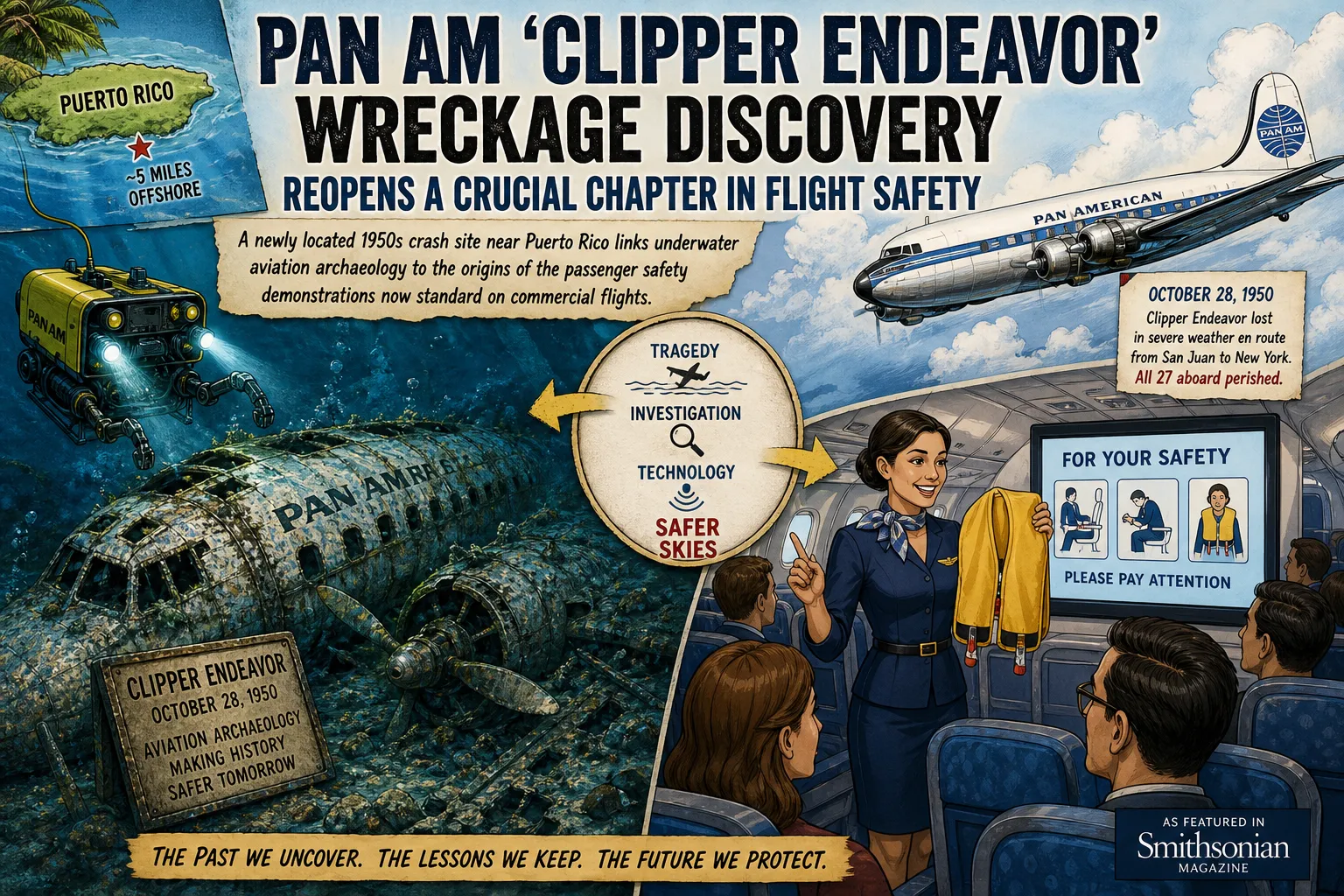
The reported discovery of the wreckage of Pan American’s Clipper Endeavor in waters off Puerto Rico is significant for more than one reason. On its face, it is an aviation archaeology story: searchers reportedly located the remains of the 1950s aircraft about five miles offshore using an autonomous underwater vehicle, bringing new clarity to a crash site that had long rested out of view. But the find also reconnects the public with a turning point in commercial aviation safety. According to the source summary from Smithsonian Magazine, the disaster is linked to the passenger safety demonstrations that travelers now routinely see before takeoff.
That connection gives the discovery unusual weight. It is not simply about identifying wreckage on the ocean floor. It is about tracing a direct line from a mid-century accident to one of the most familiar rituals in modern transport: the cabin crew demonstration explaining exits, flotation devices and emergency procedures. For historians, safety professionals and frequent flyers alike, the site offers a reminder that many standard practices in aviation were written in response to hard lessons.
Source: Smithsonian Magazine.
A crash site rediscovered beneath the Atlantic
The reported location of the Clipper Endeavor wreckage about five miles off Puerto Rico immediately highlights how much of aviation history remains physically inaccessible long after its public memory fades. Aircraft lost at sea often leave behind only fragmented records, witness accounts and official conclusions. Even when the broad outline of an accident is known, the actual site can remain elusive for decades.
That is why the use of an autonomous underwater vehicle matters. Underwater search technology has transformed the recovery and documentation of submerged wreckage by allowing teams to survey areas that would once have been difficult, dangerous or prohibitively expensive to examine in detail. In this case, the technology serves not only a practical purpose but also a historical one. It helps bridge the gap between archival memory and physical evidence.
The discovery also reflects a broader shift in how transport history is studied. Aviation archaeology is no longer limited to remote land sites, museum collections or written records. Increasingly, it includes sonar mapping, robotic survey methods and detailed underwater imaging. That combination of old questions and new tools makes the Clipper Endeavor story especially compelling: a tragedy from the piston-airliner era is being revisited with methods that belong to a far more advanced age.
Why this disaster still matters to every airline passenger
Many passengers treat preflight safety demonstrations as routine background noise. They are familiar, repetitive and easy to tune out. Yet the importance of the Clipper Endeavor story lies precisely in showing that these demonstrations did not emerge as mere airline formalities. They are part of aviation’s long habit of converting past failures into practical safeguards.
As summarized by Smithsonian Magazine, this 1950s disaster is linked to the safety briefings passengers know today. That historical link matters because it reframes the demonstration as a product of investigation and reform rather than tradition. Every instruction about seat belts, exits and flotation equipment exists because someone in aviation had to ask, after an accident, whether passengers had been given enough information to react quickly in an emergency.
Seen in that light, the rediscovery of the wreckage does more than revive interest in one Pan Am aircraft. It restores context to a modern safety behavior that millions of people encounter without thinking about its origins. The cabin demonstration is one of the clearest examples of how commercial flight evolved by standardizing communication, not just engineering. Safer aircraft design matters, but so does making sure passengers understand what to do when seconds count.
- It underscores that modern air travel procedures are rooted in historical experience.
- It reminds passengers that safety briefings were created to solve real problems.
- It shows that aviation safety depends on communication as well as machinery.
The meeting point of history, technology and transport safety
This discovery sits at an unusual crossroads. It is a history story because it recovers a lost chapter from the early age of global commercial flight. It is a technology story because an autonomous underwater vehicle reportedly made the find possible. And it is a transport safety story because the crash’s legacy survives in procedures still used on today’s airlines.
That crossover is worth emphasizing. Too often, aviation history is separated into neat categories: glamorous airline branding on one side, engineering progress on another, accident history somewhere else. The Clipper Endeavor wreckage discovery resists that separation. Pan Am represents a formative era in international travel, but the rediscovered site also reveals the less romantic truth that commercial aviation matured through repeated cycles of loss, investigation and reform.
It also demonstrates how technological progress can serve memory rather than replace it. The autonomous underwater vehicle is not the center of the story; it is the means by which a buried story becomes visible again. In that sense, the search technology acts almost like a translator between eras. It allows contemporary investigators and the public to revisit a 1950s event with fresh precision, while preserving the human meaning of what happened.
For transport safety, that matters because rediscovered sites can sharpen public understanding of why certain practices endure. Safety culture is strongest when procedures are not viewed as arbitrary. The more clearly people can see the historical reasons behind them, the more likely they are to respect them.
Aviation archaeology as a form of public memory
There is also a broader cultural dimension to this kind of discovery. Wreckage sites are not only technical artifacts; they are places where history, loss and public memory converge. Finding them can answer long-standing questions, but it can also reopen reflection on the passengers and crew whose experience shaped later reforms.
In aviation archaeology, the goal is not simply to recover objects. It is to reconstruct context. Where an aircraft came to rest, how it broke apart and what can be documented from the site all contribute to a fuller understanding of an event that may previously have lived only in summaries. Even when the major historical conclusion is already known, the physical site gives that history tangible form.
That is especially important in cases tied to lasting policy or procedural change. When a wreckage discovery is linked to the origins of modern safety demonstrations, the site becomes more than a historical curiosity. It becomes part of the story of how public transportation learned to communicate risk and preparedness to ordinary travelers.
What today’s travelers can take from the discovery
The most practical lesson from the Clipper Endeavor story is surprisingly simple: pay attention to the safety briefing. The rediscovery of the wreckage is a reminder that familiar procedures are often the product of painful experience. The demonstration may be standardized, but its purpose is not symbolic.
Travelers can also take a broader lesson from the story. Modern transport safety is cumulative. It is built not from one invention or one regulation, but from decades of adjustments informed by accidents, investigations and better tools. The reported use of an autonomous underwater vehicle to locate this site shows that even many years later, technology can still help deepen understanding and reinforce why certain safety habits matter.
- Listen to preflight safety instructions instead of treating them as routine noise.
- Notice the location of the nearest exits and safety equipment on each flight.
- Recognize that aviation safety practices are the result of historical learning.
In the end, the discovery of the Clipper Endeavor wreckage is powerful because it connects three timelines at once: the era of Pan Am’s global expansion, the long arc of accident-driven safety reform and the present-day use of advanced underwater search technology. It brings a forgotten crash site back into view, but it also restores the deeper significance of a procedure millions of passengers still encounter before takeoff. What looks routine in the cabin today is, in part, the legacy of a disaster that aviation never fully forgot.

Comments
No comments yet — be the first to share your thoughts.
Join the discussion