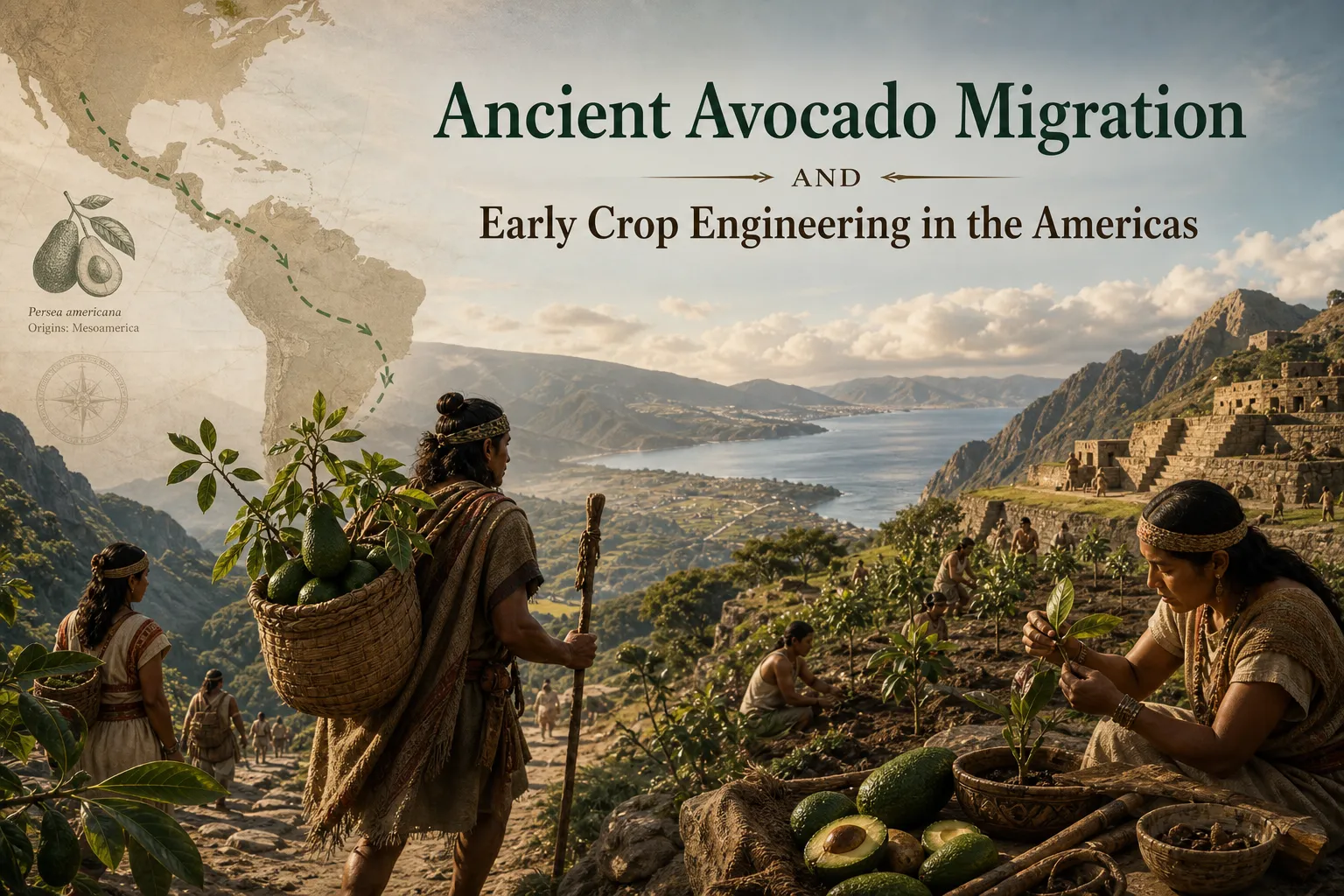
Avocados are often discussed as a modern global food trend, but their deeper history tells a much older and more revealing story. According to Smithsonian Magazine, new genetic evidence suggests that ancient people carried large avocado seeds from South America into Central America thousands of years ago, helping trigger a burst of diversity in the fruit. That finding shifts the conversation away from a simple climate-driven explanation and toward a more human one: people were actively shaping plant life long before formal agriculture, laboratories, or modern breeding programs existed.
The significance of this idea goes beyond avocados. It points to prehistoric food networks that moved useful plants across landscapes, to early forms of crop engineering based on observation and selection, and to the growing power of archaeogenetics to show how deeply human choices influenced staple foods. In other words, avocado diversity was not just something that happened to people. It was something people helped create.
Why this discovery matters
For a long time, crop history has often been told through broad environmental forces. Climate shifts, changing habitats, and the movement of wild species all clearly mattered. But the Smithsonian report emphasizes a more active role for ancient communities. If people intentionally carried large avocado seeds into new regions, then they were doing more than gathering food. They were selecting traits, transporting preferred varieties, and changing the evolutionary path of a plant.
That matters because seed movement is not neutral. A community that chooses larger seeds is also choosing a set of characteristics connected to fruit size, taste, usefulness, and cultivation potential. Even without written science or controlled breeding plots, such repeated choices can reshape a crop over generations. This is domestication in a broad and practical sense: not a single event, but a long process of human preference, movement, and care.
The avocado becomes a strong example of how ancient societies influenced biodiversity. Instead of imagining early people as passive participants in natural ecosystems, the evidence supports a more dynamic picture. They noticed valuable plants, moved them along travel routes, and helped create new combinations of traits in new places.
Prehistoric food networks were more sophisticated than they sound
It is easy to underestimate the sophistication of prehistoric exchange because it did not leave behind shipping records or commercial branding. Yet moving avocado seeds across major regions of the Americas suggests organized knowledge. People had to recognize which fruits were worth carrying, understand that seeds could establish plants elsewhere, and maintain enough continuity in travel or settlement patterns for those plants to spread.
This points to food networks that were practical, local, and cumulative. They may not have looked like later trade systems, but they still connected communities through plants, materials, and knowledge. In that sense, avocados were not just a food item. They were part of an ecological relationship built by human movement.
People likely identified desirable fruit traits and remembered them.
Seeds had to be transported intentionally rather than appearing randomly.
New growing areas created opportunities for plants to diversify.
Human exchange linked distant landscapes into shared food histories.
The larger lesson is that ancient mobility changed what people ate. It also changed what could exist botanically. When seeds crossed regions, they carried inherited traits with them. Once introduced into new environments and managed by new communities, those traits could combine, persist, or expand in ways that would not have happened through climate alone.
Avocado domestication before modern breeding
Modern readers often associate crop engineering with laboratories, seed catalogs, or formal breeding institutions. But the avocado story shows that crop engineering can begin with repeated human choices made over long periods. Selecting larger seeds may sound simple, yet it reflects a real intervention in plant history.
Early crop engineering did not require genetic theory. It required attention. People could observe which fruits were larger, more appealing, or more useful. They could save seeds from those fruits, carry them, plant them, and gradually favor certain outcomes. Over time, that process can generate meaningful biological change.
Seen this way, domestication is not just about turning a wild species into a farm crop. It is also about guiding variation. Ancient communities were effectively experimenting with inheritance through practice. They may not have described genes, but they interacted with them. The new genetic evidence gives scientific visibility to choices that were once invisible in the historical record.
This perspective also broadens the meaning of innovation. Innovation is not only mechanical or modern. It can be ecological, cumulative, and embedded in everyday survival. Carrying a seed because it came from a promising fruit is a small act. Repeating that act across generations can transform a species.
What archaeogenetics adds to the story
Archaeogenetics is especially powerful because it can recover histories that traditional narratives miss. Artifacts, settlement patterns, and plant remains can suggest what people ate or moved, but genetic evidence can reveal relationships between populations of plants across time and space. In the avocado case, that means researchers can identify patterns consistent with human transport and resulting diversification.
This is important because it helps resolve an old tension in crop history: how much change came from environment, and how much came from people? The answer is often both, but genetics can show that human agency was not secondary. It was central. By tracing lineages and variation, researchers can see that cultural behavior helped shape biological outcomes.
The method also strengthens a wider argument about staple crops in the Americas. Many foods now treated as ordinary were shaped by long chains of experimentation, exchange, and adaptation. Archaeogenetics helps make those chains visible. It turns ancient food history from a vague backdrop into a record of decisions.
For readers, that means the avocado is more than a familiar fruit with a deep past. It is evidence that human communities were active environmental managers. They influenced which plants traveled, which traits persisted, and which varieties multiplied.
Rethinking human influence on staple crops
The Smithsonian report encourages a broader rethinking of agricultural history. We often imagine a clean divide between wild nature and deliberate farming, as if meaningful crop development began only once settled agriculture became formalized. But the avocado evidence complicates that divide. Human influence can begin earlier, through movement, preference, and repeated interaction.
That has implications for how we understand staple crops across the Americas. Diversity did not emerge only from untouched landscapes or natural adaptation. It also emerged from people carrying, choosing, and cultivating plants in ways that reflected taste, need, and local knowledge. Human history and plant history were intertwined.
It also reminds us that biodiversity can be cultural as well as ecological. A diverse crop landscape may preserve the imprint of migration routes, exchange relationships, and long-standing food traditions. In this case, avocado diversity becomes a record of human connection across regions.
Practical takeaways from an ancient avocado story
This research offers a few useful takeaways for anyone interested in food history, agriculture, or biodiversity today.
Domestication is a long process. It often begins with repeated choices rather than formal science.
Food networks matter. The movement of seeds can reshape entire crops over time.
Genetics can reveal hidden history. Archaeogenetics helps show how human behavior influenced plant diversity.
Ancient communities were skilled environmental actors. Their knowledge shaped landscapes and food systems in lasting ways.
Ultimately, the ancient avocado story is not just about where a fruit traveled. It is about how people altered the biological world through practical decisions made thousands of years ago. The new genetic evidence, as reported by Smithsonian Magazine, makes that influence harder to overlook. Climate still mattered, of course, but it did not act alone. People carried seeds, favored certain traits, and helped generate the diversity that later generations inherited. That makes the avocado not only a food with a long past, but also a vivid case study in early human crop engineering across the Americas.
Source: Smithsonian Magazine, “Ancient Genes Reveal That Big, Bright Avocados Were Carried Through the Americas Thousands of Years Ago,” https://www.smithsonianmag.com/smithsonian-institution/ancient-genes-reveal-that-big-bright-avocados-were-carried-through-the-americas-thousands-of-years-ago-180989171/

Comments
No comments yet — be the first to share your thoughts.
Join the discussion