Intel Has Its Worst Day Since 1974 as AI Spending Fears Hit Tech
Intel shares fell 28.6%, their worst day since 1974, after a weak holiday forecast and PC slump, leading a broad tech selloff driven by doubts over AI spending.
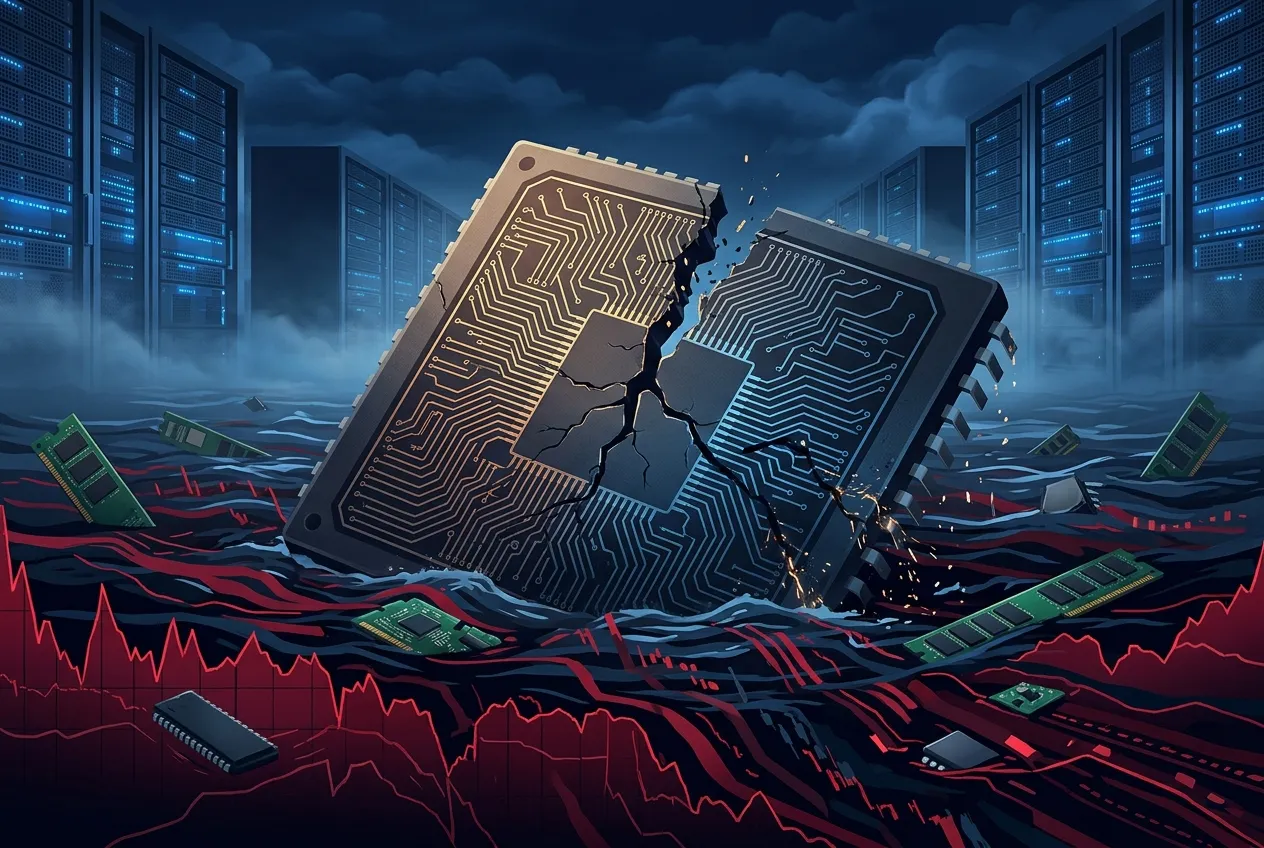
Intel shares collapsed 28.6% on Friday, October 30, the chipmaker's steepest one-day fall since 1974, after a disappointing holiday-quarter forecast reignited investor anxiety about who will actually profit from the AI building boom. The drop dragged chip stocks and the Nasdaq sharply lower and capped a bruising week for Big Tech earnings.
A strong quarter, a weak outlook
On paper, Intel's third quarter was solid. Adjusted earnings came in at 52 cents per share, well ahead of Wall Street's expectations, and revenue of $16.5 billion was up 21% from a year earlier. Its Data Center and AI unit grew roughly 78% to $7.3 billion, and Intel Foundry sales rose 58% to $6.7 billion.
The guidance is what broke the stock. Intel told investors to expect fourth-quarter revenue of $15 billion to $16 billion, short of the roughly $17 billion analysts had pencilled in, and adjusted earnings of about 25 cents a share against a consensus near 43 cents. Gross margin is projected to slip to around 38% from 43%. The company also said an early-October factory accident in Israel will shave roughly $300 million off fourth-quarter revenue, and management signaled it does not expect positive free cash flow in 2027 as capital spending climbs.
The memory squeeze hits PCs
The deeper problem is the PC market. Intel now expects PC shipments to shrink about 12% this year and another 10% in 2027, as the AI data center build-out soaks up memory chips and pushes prices higher for everyone else. Client Computing revenue fell 5% to about $8.1 billion. CEO Lip-Bu Tan said the pressure will last "until memory availability and prices begin to normalize."
Tan framed the company's position as a long-haul effort, telling analysts that rebuilding Intel will take several years. Analysts were less patient. Bernstein's Stacy Rasgon called the outlook "(in a word) terrible" and cut his price target to $75 from $110, according to Yahoo Finance. Bank of America and Roth both downgraded the stock, and Cantor Fitzgerald lowered its target.
From record high to half off
The selloff is a sharp reversal for a stock that had been one of 2026's biggest winners. Intel shares nearly quadrupled this year to a record on June 22 before losing more than half that value. Friday's plunge erased close to $140 billion in market value, Yahoo Finance reported, and knocked more than $10 billion off the US government's 9.9% stake in the company, which is still worth roughly three times what Washington paid for it.
A broader AI reckoning on Wall Street
Intel was not alone. Nvidia fell 4.2% and was actually the heaviest single drag on the S&P 500, while AMD lost about 11%. PC makers Dell and HP also slid. The S&P 500 dropped 1.8% to 7,580.07, its worst day since June, and the Nasdaq Composite tumbled 2.9% to 25,437. The Dow shed 1.1%.
The rout came a day after Alphabet suffered the worst day in its history, falling more than 12% after reporting it burned more cash over the summer than in the spring. Amazon slipped 1.4% on Friday after weaker-than-expected profit; Fortune reported the company burned $42.4 billion in free cash flow over the past 12 months while spending $94.8 billion on property and equipment, mostly for AI.
The common thread is a growing question over whether hundreds of billions of dollars in AI infrastructure spending will produce enough profit to justify it. Joe Tigay of Equity Armor Investments told Fortune that the market is entering a "show me" phase of the AI trade. Concerns that high interest rates could slow data center construction added to the pressure on chip stocks, and the selling spread abroad, with South Korea's Kospi down 3.5% on AI worries.
What to watch
For Intel, the near-term test is whether memory supply loosens enough to stabilize PC demand, and whether growth in its data center and foundry businesses can offset the drag. For the wider tech sector, the week's earnings have shifted the conversation from how much companies are spending on AI to when that spending starts paying for itself. Investors also face a crowded calendar: US midterm elections are on Tuesday, and AI has become a voter concern as well as a market one.
Sources
- Intel stock plunges nearly 29%, its worst day since 1974 (Yahoo Finance)
- Intel's worst drop since 1974 leads S&P 500 to worst day since June (Fortune / Associated Press)
- Intel Stock Crashes 27% in Worst Day in Decades as Memory Shortage Wrecks PC Outlook and Q4 Forecast Misses (International Business Times Australia)
- Intel -28.6% worst since 1974, Nasdaq -2.86% (Nocta Daily Brief)
Source: Yahoo Finance