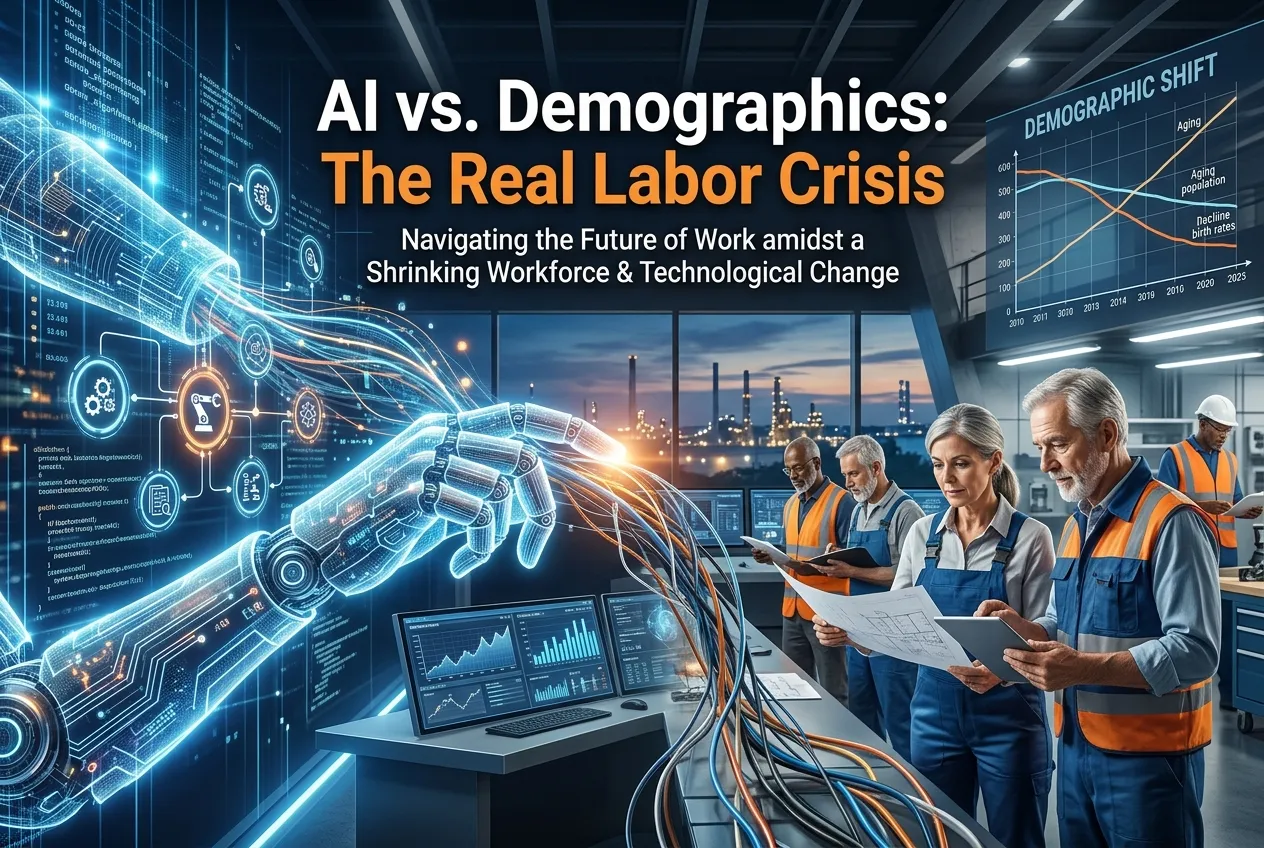
For years, the dominant narrative surrounding Artificial Intelligence has been one of anxiety and displacement. Headlines consistently warn of a dystopian future where algorithms and robots render human workers obsolete, sparking widespread fear across virtually every industry. However, a closer examination of global economic trends reveals a different, far more pressing crisis looming on the horizon. The real threat to the labor market isn't a sudden influx of intelligent machines; it is a rapid, irreversible demographic shift. As the Baby Boomer generation exits the workforce en masse, they are leaving behind a massive void that younger generations simply do not have the numbers to fill. Instead of viewing AI purely as a job destroyer, we must begin to understand it as a critical tool for survival in an era of unprecedented, structural labor shortages.
The Demographic Time Bomb: Retiring Baby Boomers
The foundation of the current and impending labor crisis lies in basic demographics. The Baby Boomer generation, long the backbone of the modern workforce, is reaching retirement age. This is not a sudden, unpredictable event, but rather a slow-moving demographic reality that has been anticipated for decades. Yet, the sheer scale of this exodus is only now beginning to fully impact the labor market. Every day, thousands of experienced professionals pack up their desks, taking decades of institutional knowledge and productivity with them.
Crucially, the generations following the Boomers—Generation X, Millennials, and Generation Z—are not large enough to replace these departing workers on a one-to-one basis. Birth rates have been steadily declining in many developed nations for decades, leading to a shrinking pool of available young talent. This demographic imbalance means that even in a healthy economy with robust job creation, there simply will not be enough human workers to fill every open position. The popular narrative that automation will steal jobs ignores the stark reality that, very soon, there may not be enough people to do the jobs we already have.
Insights from Indeed’s Chief Economist
This perspective is strongly supported by leading labor market analysts who look beyond the immediate hype cycle of technology. Insights from Indeed's chief economist highlight a fundamental misunderstanding in how society views the future of work. The prevailing public fear is that AI will create mass unemployment, but the actual data points toward a persistent, long-term labor shortage driven entirely by changing demographics.
According to this economic analysis, the shrinking working-age population is a far more immediate and concrete challenge than the hypothetical job losses attributed to automation. The labor market is tightening not because of a temporary economic cycle or a brief hiring freeze, but because the fundamental math of population growth has permanently changed. When a chief economist from one of the world's largest employment platforms points to demographics as the primary driver of labor scarcity, it signals a necessary paradigm shift for policymakers and business leaders alike. We must pivot our focus from protecting existing jobs from technology to figuring out how to maintain economic output with a significantly smaller workforce.
Reframing AI: From Job Killer to Necessary Solution
When we accept the reality of a shrinking labor pool, the role of Artificial Intelligence transforms dramatically. AI transitions from being a looming threat to human employment to becoming an absolute necessity for sustaining economic growth and maintaining our modern standard of living. In sectors ranging from healthcare and logistics to manufacturing and customer service, the lack of available human workers is already causing supply chain disruptions, increased wait times, and reduced service quality.
AI and automation offer a vital lifeline. By taking over repetitive, time-consuming, and physically demanding tasks, AI allows the shrinking human workforce to focus on high-value, complex, and empathetic work that machines cannot replicate. For instance, if a hospital cannot hire enough administrative staff due to demographic shortages, AI-driven scheduling and data entry systems become essential to keeping the facility operational and allowing nurses to focus on patient care. In this context, AI is not replacing a worker who needs a job; it is filling a critical gap left by a worker who simply does not exist.
Practical Analysis and Broader Implications
The implications of this demographic shift and our subsequent reliance on AI are profound for every level of the economy. For businesses, the overarching strategy must shift from cost-cutting through automation to capacity-building through technological integration. Companies that fail to adopt AI will not just fall behind in efficiency; they will literally find themselves unable to operate due to a severe lack of staff.
This reality requires significant investment in both technology and the upskilling of the remaining human workforce. Workers will need to learn how to collaborate seamlessly with AI systems, transitioning into roles that manage, oversee, and complement automated processes. Furthermore, this dynamic has massive implications for national immigration policy, education systems, and social safety nets. As nations compete for a shrinking pool of global talent, those that successfully integrate AI to maximize the productivity of their existing populations will emerge as the new economic leaders. The conversation must evolve from a defensive posture against technology to a proactive strategy for demographic resilience.
Key Takeaways
- Demographics Drive the Crisis: The mass retirement of Baby Boomers is creating a structural labor shortage that younger, smaller generations cannot adequately fill.
- Data Over Fear: Insights from labor experts, including Indeed's chief economist, confirm that a shrinking workforce is a far more pressing economic threat than automation-driven unemployment.
- AI as a Lifeline: Artificial Intelligence must be reframed as a necessary tool to maintain productivity and fill the massive gaps left by the departing workforce.
- Adaptation is Mandatory: Businesses and workers must pivot toward integrating AI into their daily operations to survive the impending demographic drought and ensure ongoing economic stability.
Source: Read the full analysis here



Comments
No comments yet — be the first to share your thoughts.
Join the discussion