My Cousin Thought He Had $102,000 in Equity. Then He Asked to Borrow $30,000.
A veteran, a VA loan, a $465,000 estimate — and the phone call where it all turned into vapor
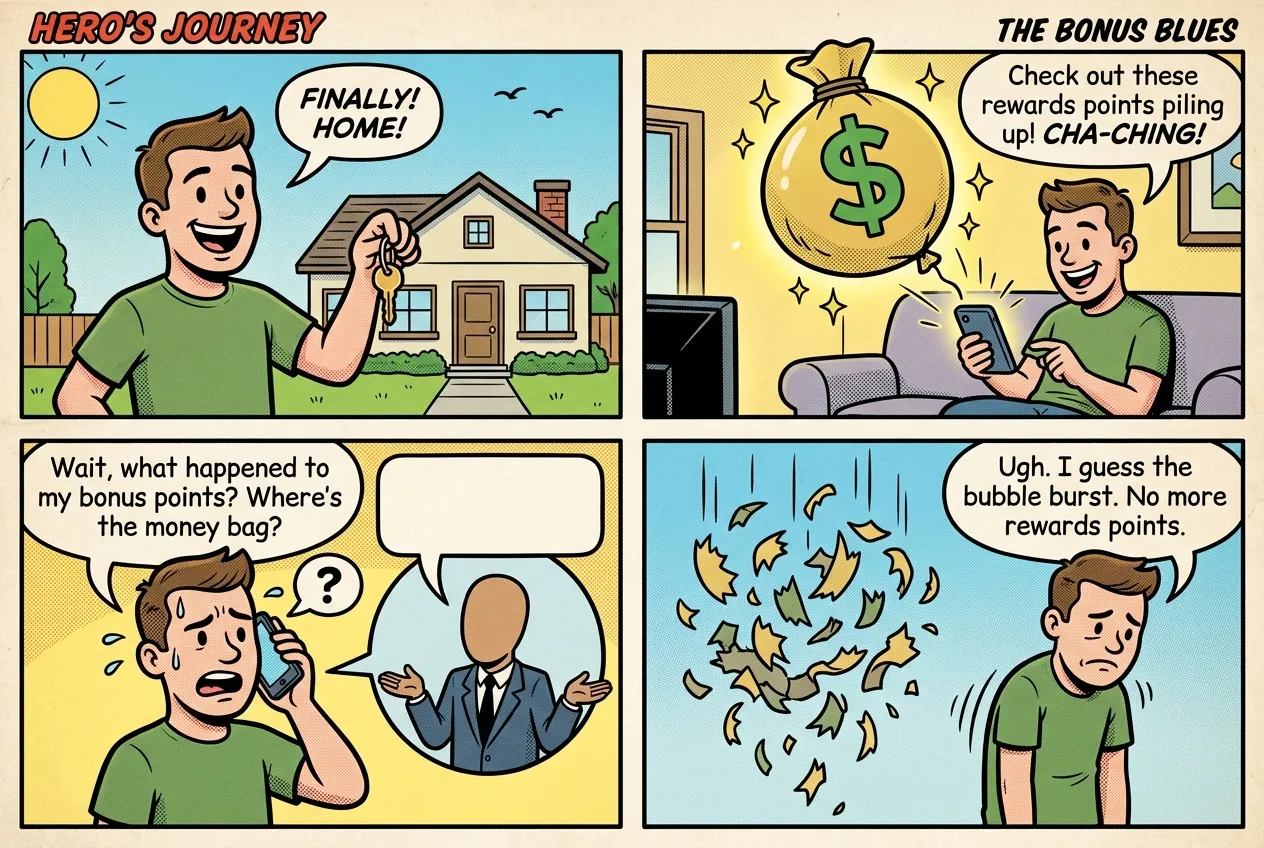
My cousin called me on a Tuesday, and I could hear it in his voice before he said a word. He is a veteran. He bought his house in the middle of 2021, zero down, thirty years, three percent. For four years his mortgage app has greeted him with the same cheerful little dashboard: estimated home value $465,000, estimated equity $102,460. He never asked for those numbers. They were simply there, every time he logged in to make a payment.
Then his house needed repairs, and he asked to borrow $30,000 — less than a third of the equity his own lender told him he had. That is when he found out what the number actually meant.
The phone call
He tapped the button the app put in front of him — the one about using your equity — and got a human being on the line. What followed was not a conversation about a loan. It was an interrogation about a number he did not invent.
“Are you sure? Are you confident your house is worth around $465,000?”
He kept giving the same answer, and you can hear how reasonable it is: that number came from your company. It is on your screen. I am reading it back to you. Round and round. A man being asked to defend his lender's own arithmetic to his lender.
Eventually the rep came back with the verdict. His equity did not even reach $45,000 — the minimum they will lend against. Not the $102,460 on the dashboard. Not the $30,000 he actually asked for. He wasn't turned down for asking too much. He was turned down for the gap between two numbers, only one of which he had ever been shown.
“Nada. Zilch. I thought that house was my backup, and it turns out it's a screenshot.”
The number on your dashboard is not an appraisal
Here is the part nobody explains, because explaining it would ruin the effect. That $465,000 is an automated valuation model — an AVM. It is a statistical guess produced by software from public records and nearby sales. It is not an appraisal, and lenders and regulators treat the two as fundamentally different things, with a whole separate rulebook governing the automated kind (Datafloq).
How far off can a model be? Zillow publishes its own error rate, to its credit: a median error of 7.20% for off-market homes — meaning every house somebody actually lives in (Zillow). Median. Half of all homes are off by more than that. On a $465,000 estimate, a routine miss is thirty grand in either direction — the entire amount my cousin was asking for.
The dashboard number is marketing. The appraisal number is money. They are shown to you with the same confidence, in the same font, by the same company — and only one of them can be spent.
Now do the math they didn't show him
Even if the $465,000 is perfect, you cannot borrow against all of it. Rocket's own page states that most of its loans require you to keep 15–20% equity in the home after closing (Rocket Mortgage). NerdWallet's review puts the ceiling at a 90% combined loan-to-value, with an appraisal required (NerdWallet), and CNBC confirms the $45,000 minimum he ran into (CNBC).
Run his actual figures through that and the $102,460 evaporates in three lines:
| If they cap him at… | Max total debt | Minus his ~$362,000 | Clears the $45k floor? |
|---|---|---|---|
| 90% CLTV | $418,500 | $56,500 | Barely |
| 85% CLTV | $395,250 | $33,250 | No |
| 80% CLTV | $372,000 | $10,000 | No |
Look at the bottom row. Ten thousand dollars. The same house, the same day, the same lender — and the "$102,460" is ten grand. And if a real appraiser walks in and says $440,000 instead of $465,000, even the friendliest 90% math drops him to about $34,000, back under the floor again.
Below their minimum, $10,000 and $0 are the same answer. That is why a man who asked for $30,000 was told to go away.
That is not an error. That is a design choice.
Every input needed for the honest number — the balance, the CLTV cap, the $45,000 minimum — is already in their system. They own all of it. They chose to show him the big number and keep the small one for the phone call. You cannot show a man a number every day for four years and then act surprised that he believed it.
What actually got taken
It was never really about the thirty grand. He'll patch the roof some other way; people always do. What went missing was the floor under his feet.
That house was supposed to be the thing he could stand on. The backup. The chip you keep in your pocket for the year that goes wrong — the layoff, the hospital bill, the transmission. He served, he came home, he bought a house with nothing down, he paid on time for four years, and a screen told him he had built something. Then one phone call turned it into a decorative graphic. The wealth was real enough to display and not real enough to touch.
If that has happened to you, you are not bad at math and you were not being greedy. You were reading the number your lender put in front of you.
Has this happened to you?
I want to know how common this is, and I want it in people's own words. Tell me in the comments — and name your lender, whoever it is. This is not one company's habit.
Did the equity in your app vanish the moment you tried to use it?
Were you asked to justify their valuation back to them?
Did a minimum, a CLTV cap, or a low appraisal ambush you at the end?
Did anyone ever explain "equity" vs. "borrowable equity" before you asked?
One honest thing, before you go chasing your own equity
My cousin is sitting on a VA loan at 3%. That is a rate that does not exist anymore. Any second loan he takes today gets priced at today's numbers, and the interest on $30,000 borrowed now could quietly cost him more than the repairs ever will.
So it is possible — genuinely — that the wall he hit did him a favor. But that is not a defense of anything. Nobody walked him through that trade-off either. He wasn't protected; he was stonewalled, after being marketed to. If the answer was always going to be no, the app had four years and a thousand logins to say so.
A door painted on a wall is still a wall. The only thing the paint accomplishes is the moment you walk into it.
Sources
- Rocket Mortgage — Home Equity Loans (15–20% equity required after closing)
- NerdWallet — Rocket home equity loan review (90% CLTV cap, appraisal required)
- CNBC Select — Rocket Mortgage home equity loan review ($45,000 minimum)
- Zillow — Zestimate accuracy (7.20% median error, off-market homes)
- Datafloq — Automated valuation models after the 2025 rule
This is one household's experience plus publicly published lender terms — not financial advice. Your own numbers depend on your appraisal, your balance, and your lender's caps. Ask for all three in writing before you plan around any of them.
Comments
No comments yet — be the first to share your thoughts.
Join the discussion