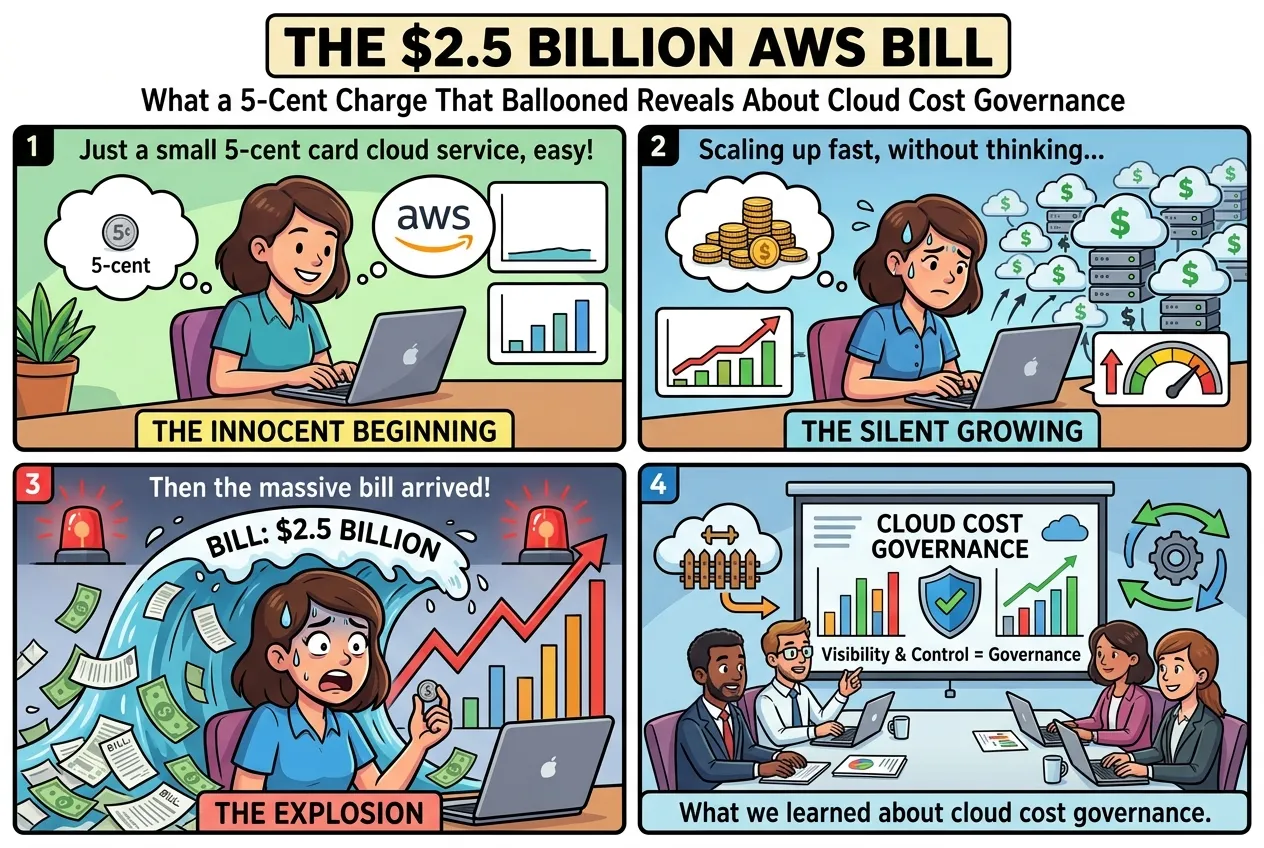
Every few months, the cloud community gets a story that is equal parts hilarious and terrifying. This week's entry: an AWS customer whose bill for a routine, five-cent charge somehow ballooned to roughly $2.5 billion. AWS has acknowledged the anomaly as a billing bug and the customer is not, in fact, on the hook for a sum that exceeds the GDP of several small nations. But the screenshot is already immortal, and the questions it raises about cloud cost governance are not going away.
Source: Google News aggregation.
How Five Cents Becomes $2.5 Billion
The precise internal mechanics of the miscalculation have not been disclosed by AWS, but the shape of the error is familiar to anyone who has worked with high-volume metered systems. Cloud billing pipelines aggregate billions of tiny usage events — API calls, byte transfers, seconds of compute — and multiply them through layered rate cards, discounts, and currency conversions. Somewhere in that pipeline, a unit, a decimal, or a multiplier can drift. When it does, the output is not a slightly-wrong number. It is a number that no longer belongs to the same order of magnitude as reality.
That is the first uncomfortable takeaway: at hyperscale, the difference between "correct" and "catastrophically wrong" is often a single misplaced field. There is no physical constraint stopping a spreadsheet from rendering ten zeros where two belong.
AWS Does Have Anomaly Protections — And They Still Missed This
AWS is not naive about billing surprises. The platform ships with AWS Cost Anomaly Detection, AWS Budgets, and CloudWatch billing alarms, all of which are designed to flag unusual spend before it becomes a crisis. Enterprises with mature cloud practices layer these with third-party FinOps tooling from vendors like Vantage, CloudHealth, or Apptio Cloudability.
And yet, an invoice line reportedly reached ten figures before anyone at the customer or the provider stopped it from being rendered. That is worth sitting with. It suggests that the anomaly-detection tooling operates on the usage side of the equation, not always on the presentation side. If the underlying meter says a customer consumed a normal amount of a service, the anomaly detector has no reason to fire — even if the invoice arithmetic downstream goes sideways.
Hard Spend Caps: The Feature Cloud Providers Won't Ship
One of the oldest complaints in cloud FinOps is that none of the major hyperscalers offer a true hard spend cap — a switch that says "when I hit $X, turn everything off." Budgets and alarms notify you. They do not stop you. The official rationale is availability: cutting off a production workload because a budget tripped could be worse than the overage itself.
That rationale is defensible for a running e-commerce site. It is much harder to defend for a solo developer's sandbox account. Stories like the $2.5B invoice keep this debate alive because they highlight the asymmetry: the customer bears the reputational and psychological cost of a runaway bill, while the provider retains full control over whether a cap is ever available.
What Good Billing-Alert Hygiene Looks Like
Even without hard caps, teams can dramatically reduce their exposure. A defensible baseline includes:
- Multiple CloudWatch billing alarms at increasing thresholds — for example, 50%, 80%, and 120% of expected monthly spend.
- Per-service and per-tag budgets in AWS Budgets, so a runaway Lambda or a forgotten NAT gateway does not hide inside a global number.
- Cost Anomaly Detection configured with email or SNS notifications routed to a channel a human actually reads.
- Automated remediation playbooks — Lambda functions or Step Functions that can stop non-production resources when a threshold is crossed.
- Regular FinOps reviews where engineering, finance, and product jointly interrogate the bill instead of treating it as a rounding error.
FinOps Is a Discipline, Not a Dashboard
The FinOps Foundation frames cloud cost management as a cross-functional practice, not a tool purchase. The viral $2.5B screenshot is a useful teaching moment because it collapses the abstract argument into a concrete image. If your organization cannot answer "who would see this first, and what would they do in the next fifteen minutes?" then you do not yet have a FinOps practice — you have a monitoring subscription.
Mature FinOps teams treat the bill like production telemetry. Anomalies get paged. Post-mortems get written. Ownership is assigned by tag, by team, and by cost center. The goal is not just to catch a $2.5B bug — those are, thankfully, rare — but to catch the $2,500 bug that quietly runs for six months.
Why "It's Just a Bug" Isn't Reassuring
AWS will fix this. The customer will not pay $2.5 billion. The meme cycle will move on. But for enterprise buyers running procurement reviews, "it's just a bug" is a genuinely unsettling answer. Enterprise finance teams build forecasting models, board reports, and capital plans on the assumption that vendor invoices are, at minimum, arithmetically sound. A single viral screenshot undermines that assumption in a way that a hundred uptime SLAs cannot repair.
The deeper lesson is about the fragility of usage-based pricing at hyperscale. When your unit of billing is a fraction of a cent and your customer count is in the millions, the multiplication problem is unforgiving. Providers that want to keep the trust of enterprise buyers will need to invest as heavily in invoice integrity as they do in service reliability — and to give customers real, hard-edged tools to protect themselves when the math misbehaves.
Until then, the practical advice is unglamorous but urgent: set the alarms, tag the resources, review the bill, and assume that "impossible" numbers are, at hyperscale, merely improbable.

Comments
No comments yet — be the first to share your thoughts.
Join the discussion